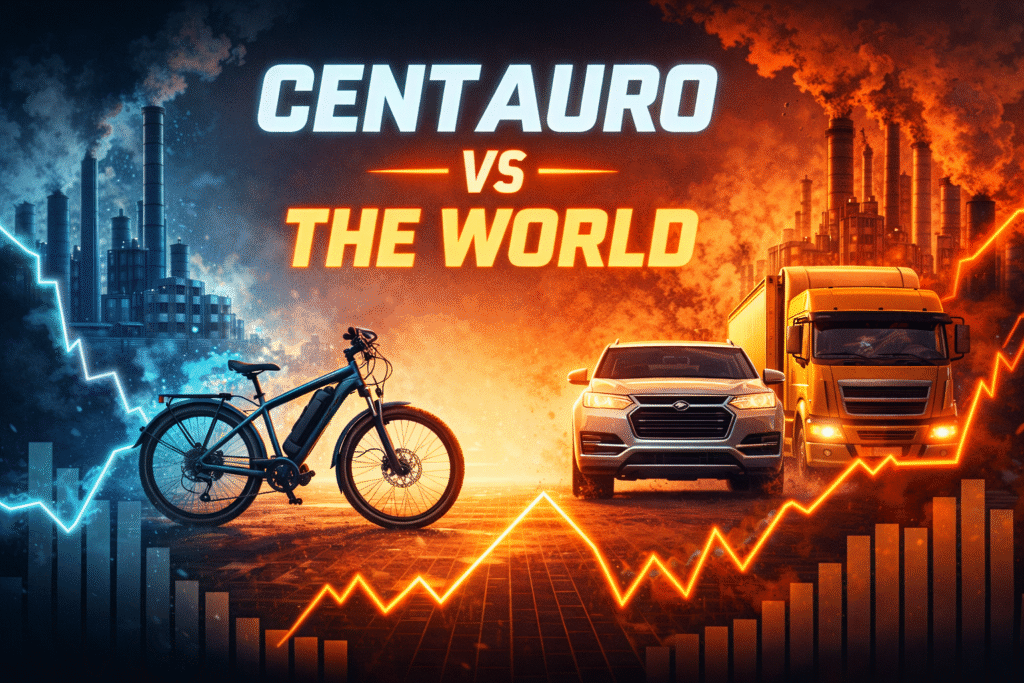
Governments allow the average person (no “superpowers”, no special reflexes) to operate vehicles that weigh 1,500–3,000+ kg, with hundreds of horsepower, and no built-in speed limiters—only rules and enforcement.
At the same time, e-bikes are typically regulated by motor-assist cut-offs (in NSW, assistance must cut out at 25 km/h). Transport for NSW+1
That’s not just inconsistent. It’s backwards—because the bigger and heavier the machine, the more energy it takes to manufacture, and the more energy it takes to run. More energy almost always means more pollution.
Why energy matters: manufacturing + running = pollution
A vehicle creates pollution in two big phases:
-
Embodied pollution (manufacturing)
Mining, smelting, plastics, transport, factory power, assembly.
More mass = more material = more energy = more emissions. -
Operational pollution (running)
Fuel burned or electricity generated.
More energy per kilometre = more emissions per kilometre.
And pollution isn’t abstract. Air pollution is linked to millions of deaths worldwide every year.
Manufacturing footprint: car vs e-bike (Centauro class)
A useful benchmark from the European Cycling Federation (as quoted by Bicycle Network):
-
E-bike manufacturing: ~134 kg CO₂e
-
Small hatchback manufacturing: ~5,500 kg CO₂e
(And SUVs can be far higher.) Bicycle Network
The Cyberbikes Centauro is a robust, heavy-duty commuter/cargo e-bike, so its manufacturing footprint will be higher than a light commuter e-bike (bigger frame, larger battery, more components). A reasonable engineering estimate is ~250 kg CO₂e for a heavy-duty e-bike like the Centauro (order-of-magnitude correct, but still an estimate).
So manufacturing emissions (rough comparison):
-
1500 kg car: ~5,500 kg CO₂e Bicycle Network
-
Centauro-class e-bike: ~250 kg CO₂e (estimate)
✅ Difference: ~5,250 kg CO₂e before the first kilometre is even ridden.
Running energy: 20 km/day in a 2.0L car vs a Centauro (Sydney/NSW)
Let’s compare a realistic daily commute: 20 km total per day.
1) Running energy + CO₂ (20 km/day)
Car (2.0L, ~1500 kg) — city driving: 10–12 L/100 km
Daily fuel
-
At 10 L/100 km: 10/100×20=2.010/100 \times 20 = 2.0 L/day
-
At 12 L/100 km: 12/100×20=2.412/100 \times 20 = 2.4 L/day
Using:
-
2.31 kg CO₂ per litre petrol (tailpipe)
-
34.2 MJ per litre (energy content)
Daily CO₂ (car)
-
2.0 × 2.31 = 4.62 kg CO₂/day
-
2.4 × 2.31 = 5.54 kg CO₂/day
Daily energy (car)
-
2.0 × 34.2 = 68.4 MJ/day
-
2.4 × 34.2 = 82.1 MJ/day
Cyberbikes Centauro — 22 Wh/km at 25 km/h cruise
Daily electricity
-
22 Wh/km × 20 km = 440 Wh/day = 0.44 kWh/day
Using 0.68 kg CO₂e/kWh (NSW grid factor):
-
0.44 × 0.68 = 0.30 kg CO₂/day (0.2992)
Daily energy (Centauro)
-
0.44 kWh × 3.6 MJ/kWh = 1.58 MJ/day
✅ Daily savings (running only)
CO₂ saved per day
-
Low (10 L/100): 4.62 − 0.30 = 4.32 kg CO₂/day
-
High (12 L/100): 5.54 − 0.30 = 5.24 kg CO₂/day
Energy saved per day
-
Low: 68.4 − 1.58 = 66.8 MJ/day
-
High: 82.1 − 1.58 = 80.5 MJ/day
“How many times less energy?”
-
68.4 / 1.58 = 43× less
-
82.1 / 1.58 = 52× less
So with your updated city figure + Centauro consumption:
✅ ~43–52× less energy to do the same 20 km/day.
2) Manufacturing pollution: car vs Centauro
Manufacturing CO₂ (total)
Using the same earlier benchmark values:
-
Standard car: ~5,500 kg CO₂e to manufacture
-
Centauro estimate (heavy-duty e-bike): ~250 kg CO₂e
✅ How much more pollution just to manufacture the car?
-
5,500 − 250 = 5,250 kg CO₂e more (extra)
-
Ratio: 5,500 / 250 = 22× more manufacturing pollution
That means the car “starts life” with roughly 5.25 tonnes of CO₂e more pollution before it drives a single kilometre.
3) Estimating the energy used to manufacture each (in Wh / kWh)
Manufacturing emissions come from a mix (electricity + heat + transport + industrial processes), so we can’t convert CO₂ → energy perfectly. But we can make a transparent estimate by choosing a reasonable “CO₂ per kWh” for industrial energy.
Assumption for conversion (clearly stated)
Let’s use a simple conversion factor:
-
0.5 kg CO₂e per kWh of manufacturing energy (rough “mixed energy” estimate)
Then:
Car manufacturing energy (estimate)
-
5,500 kg CO₂ ÷ 0.5 kg/kWh = 11,000 kWh
-
In Wh: 11,000,000 Wh
Centauro manufacturing energy (estimate)
-
250 kg CO₂ ÷ 0.5 kg/kWh = 500 kWh
-
In Wh: 500,000 Wh
Extra energy to manufacture the car (estimate)
-
11,000 − 500 = 10,500 kWh
-
In Wh: 10,500,000 Wh
✅ So: the car likely requires ~10.5 MWh more energy to manufacture than the Centauro.