Electric bicycles (or e-bikes) have gained significant popularity across Australia, offering a convenient and eco-friendly alternative to traditional vehicles. However, the legal requirements and specifications for electric bicycles can vary across states and territories. It’s essential to understand these regulations before purchasing or riding an e-bike to ensure compliance with local laws.
Are Electric Bicycles Legal in Australia?
Yes, electric bicycles are legal in Australia, but the specifications that determine their legality differ depending on the state or territory. Generally, Australian e-bike laws are aligned with European standards, ensuring that the bicycles maintain a balance between motor assistance and pedal power, keeping them distinct from mopeds or motorbikes.
For an e-bike to be legal in Australia, it must meet specific technical requirements, particularly concerning power output, speed limits, and the type of motor.
Power Output and Speed Limits Across Australia:
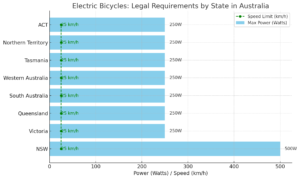
The maximum permitted power output and speed of an e-bike are the two key factors that determine its legal status. In most cases, the motor’s power must cut off once the bike reaches a particular speed. Below is a breakdown of the accepted specifications by state and territory.
1. New South Wales (NSW)
- Maximum motor output: Up to 500 watts.
- Motor assistance:
- The motor’s power must progressively reduce as the bicycle’s speed exceeds 6 km/h.
- Motor assistance must cut off when:
- The bicycle reaches a speed of 25 km/h.
- The rider stops pedaling and the speed exceeds 6 km/h.
- This allows for powerful e-bikes up to 500 watts, but the motor control must strictly follow speed regulations, ensuring it does not turn the bike into a moped or motorcycle equivalent.
2. Victoria (VIC)
- Maximum motor output: 250 watts (for pedal-assist).
- Speed limit: 25 km/h.
- Throttle use is permitted for start-up but limited to a speed of 6 km/h.
3. Queensland (QLD)
- Maximum motor output: 200 watts (throttle-controlled) or 250 watts (pedal-assist).
- Speed limit: 25 km/h.
- E-bikes with power over 200 watts must be pedal-assist.
4. South Australia (SA)
- Maximum motor output: 250 watts (pedal-assist).
- Speed limit: 25 km/h.
- Throttle use is limited to low speeds.
5. Western Australia (WA)
- Maximum motor output: 250 watts.
- Speed limit: 25 km/h.
- Throttle use is allowed for start-up and low-speed assistance.
6. Tasmania
- Maximum motor output: 250 watts.
- Speed limit: 25 km/h.
- Throttle use is restricted to speeds under 6 km/h.
7. Northern Territory (NT)
- Maximum motor output: 200 watts (throttle-controlled) or 250 watts (pedal-assist).
- Speed limit: 25 km/h.
- E-bikes with up to 200 watts can operate without pedals.
8. Australian Capital Territory (ACT)
- Maximum motor output: 250 watts (pedal-assist).
- Speed limit: 25 km/h.
- Throttle use is limited to 6 km/h.
Key Considerations for E-Bike Riders in Australia:
- Helmet Requirements: In all states and territories, riders must wear helmets when operating an electric bicycle.
- Age Restrictions: Some regions may impose age restrictions for riding certain types of e-bikes:
Pedelec bikes (up to 250W): Generally, there are no specific age restrictions across all states and territories, as these are considered safer due to the pedal-assist mechanism.
Throttle-controlled bikes (over 200W): In most states, riders must be at least 16 years old, particularly for higher-powered e-bikes (over 200W). This is to ensure that younger riders aren’t using more powerful or faster models without adequate experience.
- Road Rules: Electric bicycles must adhere to the same road rules as regular bicycles, including giving way to pedestrians and following traffic signals.
Conclusion:
Electric bicycles are widely accepted across Australia, but ensuring that your e-bike meets the legal specifications of your state or territory is crucial. While power output and speed limits are generally consistent, throttle use and specific regulations can vary. Familiarizing yourself with these laws will ensure a safe and enjoyable riding experience without running into legal trouble.
Before hitting the road on your electric bike, make sure to review the regulations for your specific location and stay updated on any changes that may occur. This way, you can enjoy all the benefits of e-biking while complying with the law.