Buying an e-bike in Sydney in 2026 means choosing a road-legal EPAC: a pedal-assist electric bike with a motor rated up to 250W continuous that cuts off assistance at 25 km/h. Get that one detail right and everything else — no licence, no registration, no insurance, and years of cheap, traffic-beating riding — falls into place. Get it wrong and you risk fines and, under NSW’s new laws, having the bike seized and crushed.
This is the most complete guide to buying an e-bike in Sydney you’ll find anywhere. We run a shop on Parramatta Road in Leichhardt, we ride these bikes through Sydney traffic every day, and below we answer every real question a first-time buyer asks — the law, the motor, the battery, the price, where to buy, and how to test ride before you commit — so you can make a confident buying decision without opening twenty more tabs.
What this guide covers
- What counts as a legal e-bike in Sydney in 2026?
- Do you need a licence or registration for an e-bike in NSW?
- How much does an e-bike cost in Sydney?
- What motor power do you actually need — and what’s legal?
- Mid-drive vs hub motor: which is better for Sydney?
- What size battery do you need?
- How far can an e-bike go on one charge?
- How long does an e-bike battery last?
- What brakes and components should you look for?
- Are fat-tyre e-bikes good for Sydney?
- Should you buy online or from a local Sydney shop?
- New vs used: is a second-hand e-bike worth it?
- Rent-to-own vs buying outright: which makes sense?
- How do you test ride an e-bike before buying?
- E-bike vs car: is it really cheaper in Sydney?
- How do you keep your e-bike and battery safe from fire?
- What maintenance does an e-bike need?
- The best e-bike to buy in Sydney: the Cyberbikes Centauro
- Frequently asked questions
What counts as a legal e-bike in Sydney in 2026?
A legal e-bike in Sydney is an Electrically Power-Assisted Cycle (EPAC): the motor is rated to a maximum of 250W continuous power, it only assists while you pedal, and the assistance progressively cuts out once you reach 25 km/h. A bike that meets this definition is treated exactly like a normal bicycle under NSW law. It can be ridden on roads, in bike lanes and on shared paths without any of the paperwork a motor vehicle needs.
NSW recognises a second, older category too: the Power-Assisted Pedal Cycle (PAPC), which has a motor of up to 200W and may use a throttle. It’s still legal, but the 250W pedal-assist EPAC is the modern standard and the one worth buying today. Importantly, NSW used to allow up to 500W, but that state exception was repealed in March 2026 — 250W continuous is now the national ceiling. If a bike is advertised at 500W, 750W or “1000W peak” for road use, walk away.
Do you need a licence or registration for an e-bike in NSW?
No. If your e-bike meets the 250W EPAC (or 200W PAPC) definition, you do not need a driver’s licence, you do not need to register it, and you are not required to hold compulsory third-party insurance. It’s legally a bicycle. You do have to follow the same road rules as any cyclist, and — like all bike riders in NSW — you must wear an approved helmet. Riders must be at least 16 to ride an e-bike unsupervised on the road.
The flip side matters just as much: because a compliant e-bike needs no rego, the compliance is on you at the point of purchase. NSW is rolling out roadside “dyno” testing and new seizure-and-crushing powers for non-compliant bikes, so the certification of the bike you buy is the thing that keeps you legal.
How much does an e-bike cost in Sydney?
Quality e-bikes in Sydney start at around $1,500–$2,000 for a genuine entry-level model, with the $2,500–$3,500 band being where build quality, hydraulic brakes, a proper warranty and components that survive daily commuting really begin. Below roughly $1,500 you’re usually looking at unbranded imports with weak after-sales support and batteries that fade fast.
Price isn’t only the sticker, though. Factor in the total cost of ownership: charging a battery costs only a few cents, servicing is far cheaper than a car, and a well-built bike holds together for years. That’s also why rent-to-own has become popular in Sydney — you can start riding a premium bike from $99.99 a week instead of paying thousands upfront. More on that below.
What motor power do you actually need — and what’s legal?
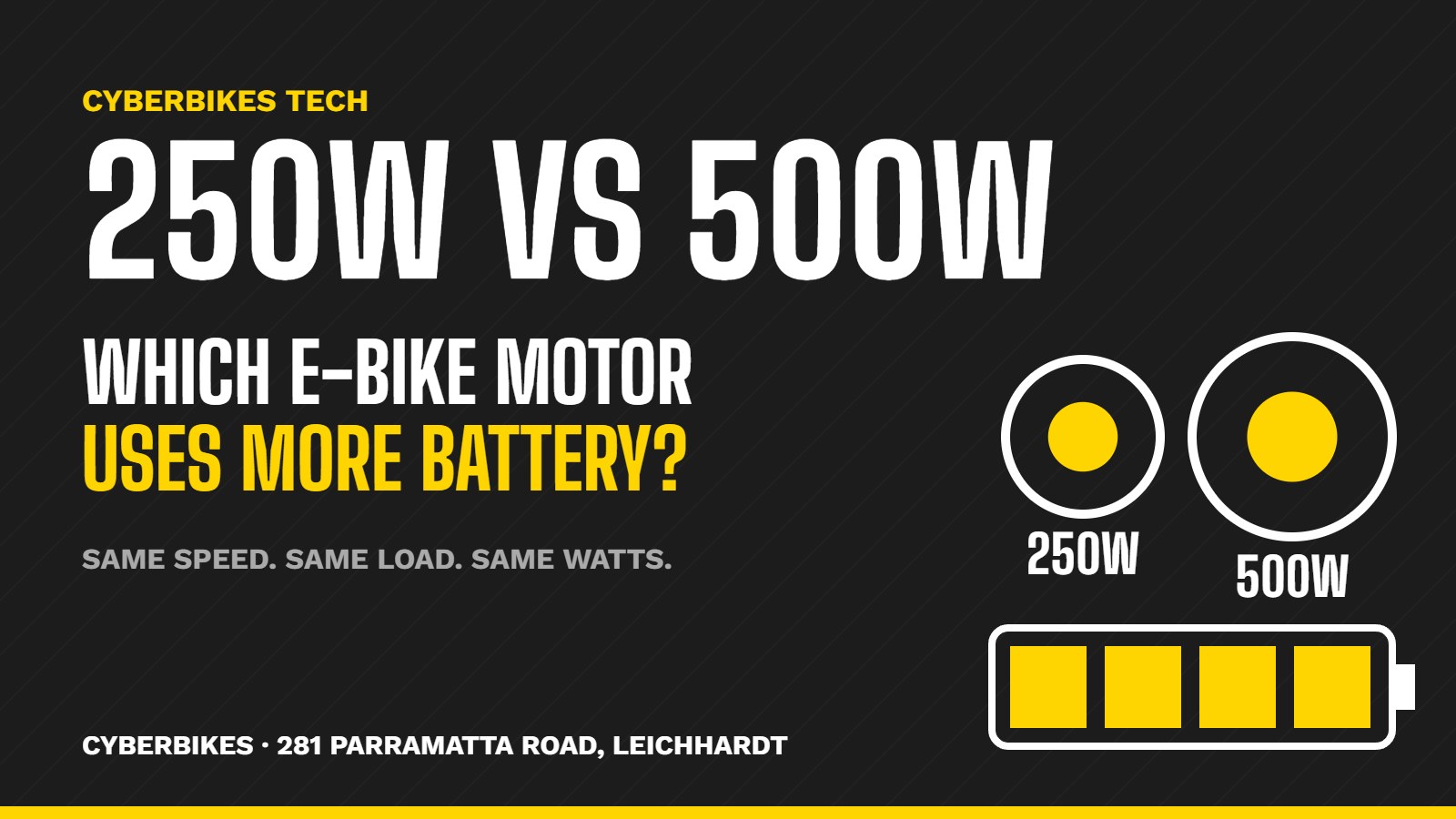
For legal road use in Sydney you need a motor rated at 250W continuous — and that number is plenty for real-world riding, including Sydney’s hills. The word that matters is continuous: it’s the power the motor can sustain, and it’s the figure regulators care about. “Peak” or “max” power is a short burst for hill starts and is not what defines legality.
Be wary of bikes marketed with a low “rated” figure but a much higher real output unlocked by an app or a hidden mode. These are exactly the bikes NSW’s roadside dyno units are designed to catch. The safest way to verify power is to look for EN 15194 (or AS/NZS equivalent) certification, which independently tests the 250W limit, the 25 km/h cut-off and the pedal-assist requirement together.
Mid-drive vs hub motor: which is better for Sydney?
Both work well in Sydney; the right choice depends on your route. A hub motor (built into the rear wheel) is simpler, quieter, cheaper to maintain and excellent for flat-to-moderate commutes across the inner west and CBD. A mid-drive motor sits at the cranks, drives through the gears, and delivers stronger, more natural torque on steep climbs — handy if your ride involves the harbourside hills.
For most Sydney commuters, a well-tuned hub-drive e-bike with a torque or cadence sensor is the sweet spot: reliable, affordable to service, and more than capable. If you live somewhere genuinely hilly and ride loaded, a mid-drive is worth the premium.
What size battery do you need?
Aim for a 48V or 52V battery with at least 15Ah of capacity; for daily commuting of 30 km or more, 48V/52V with 18–20Ah is the practical target. Battery capacity (watt-hours = volts × amp-hours) is what determines range, so a 52V 20Ah pack (about 1,040Wh) will comfortably outlast a smaller one.
Just as important as the numbers: buy a battery with reputable cells and a proper battery management system (BMS). A good BMS protects against overcharging, over-heating and short circuits — the safety layer that separates a quality e-bike from a cheap fire risk.
How far can an e-bike go on one charge?
A quality e-bike with a 20Ah battery realistically covers 60–80 km per charge under typical Sydney commuting conditions. Your actual range depends on rider weight, terrain, wind, tyre pressure, how much you pedal, and which assist level you use. Ride in a lower assist level on the flat and you’ll stretch it further; hammer the top setting up hills and it’ll drop.
For context, most Sydney commutes are well under 20 km each way, so a mid-size battery easily handles several days of riding between charges. Buy a bit more capacity than you think you need — it means fewer charges, less battery stress, and years more life.
How long does an e-bike battery last?
A quality lithium e-bike battery typically delivers 500–1,000 full charge cycles before its capacity noticeably declines — roughly 3–5 years for someone charging every second day. “Capacity fade” is gradual, not a sudden death: you simply notice slightly less range over time, and a replacement pack restores it.
You extend that life by storing the bike somewhere cool, avoiding leaving it at 0% or 100% for long stretches, and using the charger that came with it. Treat the battery well and it will comfortably see out several years of daily Sydney commuting.
What brakes and components should you look for?
Prioritise hydraulic disc brakes — they give consistent, powerful stopping in Sydney’s wet weather and stop-start traffic, which is exactly where cheaper mechanical brakes struggle. From there, look for a sturdy alloy frame, puncture-resistant tyres, integrated lights, mudguards and a rack if you commute, plus a clear display that shows speed, battery and assist level.
Components are where corners get cut on cheap bikes. A slightly more expensive bike with quality brakes, a name-brand drivetrain and a properly sealed battery will cost far less over its life than a bargain bike that needs constant repairs.
Are fat-tyre e-bikes good for Sydney?
Yes — fat and wide tyres are a strong choice for Sydney riding because they soak up rough roads, tram tracks, kerbs and the occasional gravel path, and they give extra grip and stability in the wet. The trade-off is a little more rolling resistance, which the motor easily offsets. For a comfortable, planted commuter that shrugs off Sydney’s mixed surfaces, wider tyres are a genuine upgrade rather than just a look.
Should you buy online or from a local Sydney shop?
Buying from a local Sydney shop is almost always the better move, because an e-bike is a serviceable vehicle, not a gadget — and being able to test ride it, get it assembled correctly, and walk it back in for a service is worth a lot. A cheap online-only bike can turn into an expensive headache when there’s no one nearby to fix it and warranty claims mean shipping the whole bike interstate.
If you do buy online, make sure the brand has a real service presence in Australia and genuinely stocks spare parts. At Cyberbikes we’re on Parramatta Road in Leichhardt precisely so buyers can throw a leg over the bike first and know there’s a workshop behind it.
New vs used: is a second-hand e-bike worth it?
A second-hand e-bike can save money, but the risk sits in the two most expensive and safety-critical parts — the battery and the motor — which you can’t easily inspect. A used battery may have most of its cycles already spent, and there’s no warranty if it fails. If you buy used, insist on seeing the bike charge and ride, ask how old the battery is, and factor in that a replacement pack can cost several hundred dollars.
For most first-time buyers, a new bike (or rent-to-own) with a warranty and a shop behind it is the safer, and often cheaper-over-time, path.
Rent-to-own vs buying outright: which makes sense?
Rent-to-own lets you ride a premium e-bike immediately for a low weekly payment instead of a large upfront cost, which suits commuters who want to replace car or transport costs from day one without draining savings. At Cyberbikes, rent-to-own starts from $99.99 per week — often less than a Sydney parking-and-fuel bill — and puts you on a quality, road-legal bike straight away.
Buying outright makes sense if you have the cash and want the lowest total cost. Rent-to-own makes sense if you’d rather spread the cost, keep your capital, and get riding now. Either way, the key is the same: choose a compliant bike from a shop that services what it sells.
How do you test ride an e-bike before buying?
Always test ride before you buy — it’s the single best way to judge fit, comfort and how the assist feels. On the ride, check that the motor engages smoothly (not with a jerky surge), confirm the assistance eases off and stops around 25 km/h, squeeze the brakes hard from speed, and ride up the nearest hill to feel the torque. Sit on the saddle for more than a minute; a commute reveals comfort problems a car-park lap won’t.
You can book a free test ride at our Leichhardt store and ride a Cyberbikes Centauro through real Sydney streets before you decide anything.
E-bike vs car: is it really cheaper in Sydney?
For most inner-Sydney commutes, an e-bike is dramatically cheaper than a car. A full battery charge costs only a few cents of electricity, there’s no rego, no fuel, no tolls, no CTP, no parking, and servicing is a fraction of a car’s. Add the time saved slipping past traffic in bike lanes and the numbers get lopsided fast — many riders find the bike pays for itself within a year of replaced fuel, parking and public-transport costs.
It’s also faster than it sounds. Across the congested inner west and CBD, a compliant e-bike doing a steady 25 km/h in bike lanes often beats a car door-to-door in peak hour.
How do you keep your e-bike and battery safe from fire?
Buy a certified battery and charge it safely — that combination removes almost all of the fire risk you read about. The rare incidents that make the news overwhelmingly involve cheap, uncertified batteries or mismatched chargers. Protect yourself by buying a bike with a quality BMS, only ever using the supplied charger, not charging unattended overnight or in an exit path, and never using a battery that’s been damaged, dropped hard or water-logged.
A reputable brand and a certified pack are your best insurance here, which is another reason to buy from an established shop rather than the cheapest listing online.
What maintenance does an e-bike need?
An e-bike needs the same basic care as a normal bike — tyre pressure, a clean and lubed chain, and brake checks — plus a little battery hygiene. Keep the tyres pumped, wipe and oil the chain regularly, and book a workshop service every few months to check brake pads, spokes and the electrical connections. The motor and battery themselves are largely maintenance-free; you mostly just keep them clean, dry and correctly charged.
The advantage of buying locally shows up here too: a quick service at a Sydney shop keeps the bike safe and the warranty intact, with none of the hassle of shipping.
The best e-bike to buy in Sydney: the Cyberbikes Centauro
If you want a single, no-regrets answer, the Cyberbikes Centauro is built for exactly the buyer this guide describes: a Sydney commuter who wants a road-legal, comfortable, genuinely capable e-bike without the guesswork. It’s designed around the things that actually matter day to day — confident braking, a comfortable upright ride, real range for the inner-city commute, and the reassurance of a local shop and workshop behind it.
Best of all, you don’t have to pay thousands upfront. The Centauro is available on rent-to-own from $99.99 per week, so you can swap car and transport costs for a premium e-bike from day one. Come and ride one: see the Centauro and book a free test ride at our Leichhardt store before you commit.
- Road-legal for Sydney — built to the compliant EPAC standard, so no licence, rego or insurance.
- Made for commuting — comfortable geometry, strong brakes and real-world range for the daily ride.
- Rent-to-own from $99.99/week — start riding now, no big upfront cost.
- Backed by a real shop — test rides, assembly and servicing at 281 Parramatta Road, Leichhardt.
The bottom line
Buying an e-bike in Sydney comes down to one decision made well: pick a certified, road-legal 250W EPAC from a shop that will service it, match the battery to your commute, and test ride before you buy. Do that and you get years of cheap, fast, traffic-proof riding with none of the paperwork a car demands. The Cyberbikes Centauro ticks every box in this guide, and from $99.99 a week rent-to-own there’s no reason to keep sitting in traffic. See the Centauro and book your test ride here.
Frequently asked questions
Is a 250W e-bike enough for Sydney’s hills?
Yes. A 250W continuous motor is the legal limit in NSW and handles Sydney’s hills well, especially with pedal-assist and the right gearing. For very steep, loaded riding, a mid-drive motor gives stronger climbing torque within the same legal power.
Can I ride an e-bike in Sydney without a licence?
Yes. A compliant e-bike (250W EPAC or 200W PAPC) is legally a bicycle in NSW, so you need no licence, no registration and no insurance — just an approved helmet and to follow normal road rules.
How much should I spend on my first e-bike in Sydney?
Budget around $2,500–$3,500 for a quality commuter with hydraulic brakes, a certified battery and a proper warranty. If you’d rather not pay upfront, rent-to-own from $99.99/week gets you a premium bike immediately.
Where can I test ride an e-bike in Sydney?
You can book a free test ride at the Cyberbikes store, 281 Parramatta Road, Leichhardt, and ride a Centauro on real Sydney streets before deciding.
Ready to ride? Visit Cyberbikes at 281 Parramatta Road, Leichhardt, call 0491 794 668, or book your free Centauro test ride online.
#Cyberbikes #eBikeSydney #ElectricBikeSydney #Centauro #RentToOwn #SydneyCommute #Leichhardt #eBikeAustralia