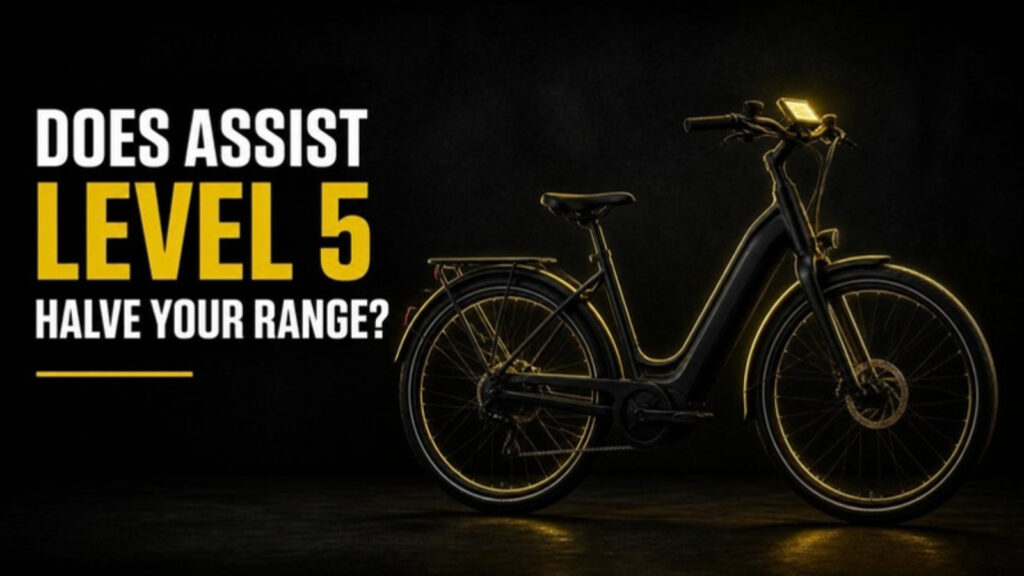
No — the assist level itself does not halve your range. The speed it lets you hold does. Grin Technologies puts it bluntly on their pedal assist page: “The range you get on an ebike fundamentally has nothing to do with what kind of control system you use, and everything to do with the average amount of power you draw.” Push from 20 km/h to 25 km/h and air drag alone roughly doubles — from about 53 W to about 103 W in a typical Sydney commuter setup. Level 5 is expensive because it is fast, not because it is level 5.
That distinction matters if you are trying to get from Leichhardt to the CBD and back on one charge. Riders tend to treat the assist number as a fuel gauge. It is closer to a speed dial — and speed is billed to you at a brutal rate. Here is what is actually happening inside the controller, and what it costs in watt-hours.
What does an e-bike assist level actually change?
It changes how much motor power the controller is willing to add — but not by one universal method. Grin’s pedal assist explainer lists several distinct control schemes that manufacturers use, and they behave very differently:
- Constant power: a fixed wattage regardless of speed — for example, always 200 W.
- Constant throttle: the assist level acts like a throttle position, effectively setting a speed limit.
- Cadence-based: power varies with how fast you spin the cranks.
- Torque multiplier: motor power scales with your effort — Grin’s example is to “double it so that for every watt of human power the motor puts out 2 watts”.
- Torque multiplier with offset: you must clear a threshold, such as a “200 watt threshold”, before assist engages at all.
This is why level 3 on one bike feels like level 5 on another. On a cadence-sensing bike the controller “only knows how fast you are spinning the cranks, but it does not know how much force you are actually applying” — so the level is essentially a power setting you dial in. On a torque-sensing bike, it is a multiplier on your own legs. The Centauro uses a torque sensor on the pedal assist, which means the level sets how much your effort gets amplified rather than a flat wattage.
Why does a higher assist level cost so much range?
Because the power needed to push through air rises with the cube of your speed. Rolling resistance rises in a straight line with speed; aerodynamic drag does not. Go 25% faster and you need roughly twice the drag power.
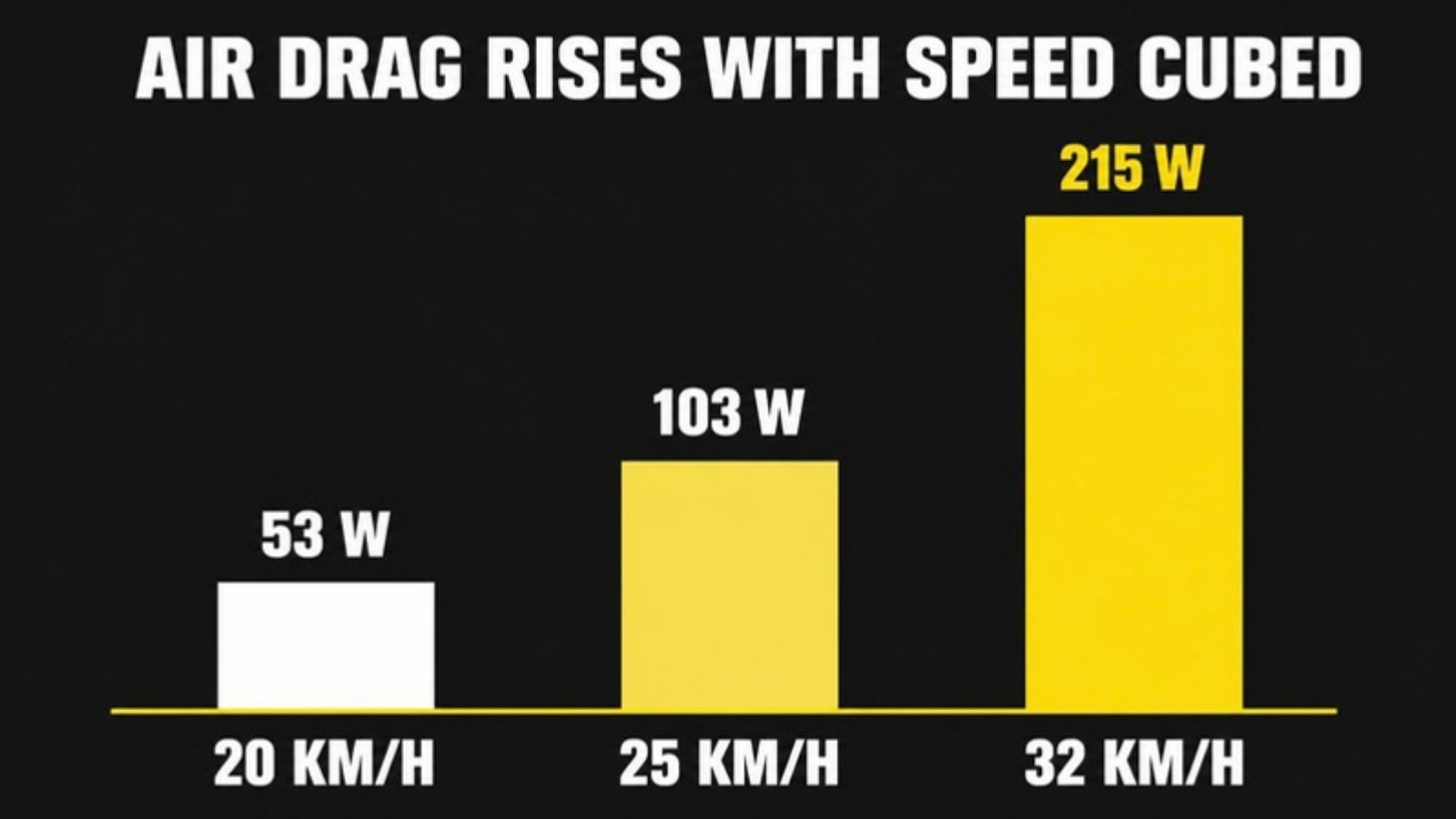
Work it through with the coefficients Grin publishes with their motor simulator — rolling resistance for bike tyres runs “about 0.004 for a high pressure road slick, up to 0.012 for a low pressure knobby wheel”, and drag area runs “from 0.2 for a fairly streamlined recumbent up to 0.8 for a wide upright mountain bike”. Take a 110 kg rider-and-bike, Crr 0.008, CdA 0.5:
| Speed | Rolling | Air drag | Total at the wheel |
|---|---|---|---|
| 20 km/h | 48 W | 53 W | ~100 W |
| 25 km/h | 60 W | 103 W | ~163 W |
| 28 km/h | 67 W | 144 W | ~211 W |
Five extra km/h costs you about 63% more power. That is the whole story of assist levels in one line. If level 5 takes you from a 20 km/h cruise to a 25 km/h cruise, your battery drains roughly 60% faster — not because the setting is greedy, but because the air is.
How many kilometres does each assist level really give you?
Convert power into the only battery unit that matters: watt-hours, which is volts × amp-hours. The Cyberbikes Centauro product page lists a 48V 25Ah (1200Wh) Samsung lithium-ion battery — 48 × 25 = 1200 Wh on board. Divide that by your consumption in Wh per kilometre:
| Riding style | Typical consumption | Range from 1200 Wh |
|---|---|---|
| Low assist, steady, flat | 8–10 Wh/km | 120–150 km |
| Mid assist, some stops | 11–13 Wh/km | 90–110 km |
| High assist, hilly or loaded | 15–18 Wh/km | 65–80 km |
Roughly a two-to-one spread between the gentlest and the hardest riding on the same bike and the same battery. Note that these bands already include stop-start losses and gradient — a steady-state calculation on flat ground looks far rosier than any real Sydney commute. For the full picture on how packs deliver and hold those watt-hours, see our definitive guide to e-bike batteries and range.
Does high assist make the motor run hotter?
Yes, and disproportionately so — but the culprit is torque, not the level number. Grin’s guide to motor power ratings states that “it’s not the output power but the output torque of the motor which causes it to heat up.”
Torque demands current, and heat scales with the square of current. If you double the current through the windings you “increase the amount of copper heat being generated by a factor of FOUR (the I²R relationship)”. The relationship tying it together is Power (W) = Torque (Nm) × RPM × 0.104 — so making power slowly is far hotter than making the same power quickly.
Practical upshot: level 5 on a flat road is cheap in heat and expensive in watt-hours; level 5 crawling up a hill is expensive in both. Grin’s own example shows how far marketing wattage can sit from thermal reality — MXUS 45 mm motors sold as 5000 W will see the core “eventually reach 100°C with just 800 watts” at 250 rpm. If you want to protect a hub motor, use a lower assist level and a lower gear on long climbs, not a higher one.
Does NSW law make the top assist level pointless anyway?
Above 25 km/h, effectively yes. Transport for NSW requires a legal e-bike to have “a maximum continuous rated power of 500 watts” and “a motor that does not provide power at speeds higher than 25km/h”, with throttle-only assistance cutting out at 6 km/h. Whatever number is on the display, the motor stops contributing at the same speed.
So the top assist level does not raise your top speed on a compliant bike — it changes how hard the motor works to get you to 25 km/h, and how much of the pedalling it takes off you once you are there. Transport for NSW also warns that “E-bikes that exceed any of these limits are illegal, even if the power or speed is restricted by software (app, switch or code)”, and from 1 March 2029 only EN 15194 certified e-bikes will be allowed on NSW roads. Check the current rules on the Transport for NSW e-bike page.
The Centauro is listed with a 250W rear hub motor and certification to UL 2849, UL 2271, ISO 4210 and EN 15194 — already meeting the standard that becomes mandatory in 2029.
What assist level should you actually ride in Sydney?
Ride the lowest level that keeps you comfortably at the speed of the traffic you are in. On Parramatta Road at peak hour, that is rarely level 5 — the bike is rolling at the pace of the queue anyway. Here is that run, unedited, from the CBD back to Leichhardt:
A practical pattern that works on most inner-west commutes: low assist on the flat, step up for the climbs and the standing starts, step back down once you are rolling. You will finish at the same time and arrive with noticeably more battery. If you want the deeper version of the speed argument, we covered why faster e-bikes drain the battery separately.
Frequently Asked Questions
Does using a lower assist level make an e-bike battery last longer?
Yes, mainly because it lowers your average speed and therefore your average power draw. Grin Technologies notes that range depends on the average amount of power you draw rather than on the control system itself. Dropping from a 25 km/h cruise to 20 km/h cuts total power by roughly 40% for a typical upright commuter.
Why does assist level 3 feel different on two e-bikes?
Because manufacturers use different control schemes. An assist level can mean a fixed wattage, a speed limit acting like a throttle position, a power curve based on pedalling cadence, or a multiplier on your own pedal force. A torque-multiplier system amplifies your effort, so the same numbered level feels entirely different from a constant-power system.
Does the highest assist level make an e-bike go faster in NSW?
Not above the legal limit. Transport for NSW requires a compliant e-bike to have a motor that does not provide power above 25 km/h, so no assist level raises the top assisted speed. A higher level only changes how much of the work the motor takes off you up to that speed.
Come and feel the difference
Assist levels are one of those things you understand in about ninety seconds of riding and never quite from a spec sheet. Take a Cyberbikes Centauro out and run it through every level on the same stretch of road.
Book a test ride at Cyberbikes Leichhardt, 281 Parramatta Road — open Tuesday to Saturday, or call 0491 794 668. Prefer to start without buying outright? Rent-to-own runs from $99.99 a week; the full breakdown is in our car-free Sydney commuting and rent-to-own guide.
#ebikeSydney #CyberbikesLeichhardt #ebikerange #pedalassist #Centauro #electricbikeSydney #ebikebattery #rentToOwnEbike