An e-bike battery is a rechargeable lithium-ion pack — rated in watt-hours (Wh) — that stores the energy your motor draws, and it is the single most important part of any electric bike. A good 1,000Wh-plus pack will carry most riders 60–100 km on a single charge and last 500–1,000 full charge cycles (roughly 3–5 years) before capacity drops enough to warrant a replacement. Get the battery right and everything else — range, reliability, resale value, safety — falls into place.
This is the most complete e-bike battery guide you will find in Australia. We run a Sydney e-bike shop, we build and service these packs every week, and below we answer every real question a buyer or owner asks — how batteries work, what the numbers mean, how far they go, how long they last, how to charge and store them, the new NSW safety rules for 2026, and how to choose a battery you can actually trust. By the end you will be able to make a buying decision without reading anything else.
What this guide covers
- How does an e-bike battery actually work?
- What is a watt-hour (Wh) — and why it decides range
- How far can an e-bike battery take you on one charge?
- How long does an e-bike battery last?
- What is a charge cycle (and what counts as one)?
- 48V vs 52V: which battery voltage is better?
- How should you charge an e-bike battery? (the 20–80% rule)
- How do you store an e-bike battery safely?
- Why does an e-bike battery lose range in winter?
- Are e-bike batteries safe?
- What battery safety standards must a legal e-bike meet in NSW (2026)?
- How do you know if your e-bike battery is dying?
- Can you replace or upgrade an e-bike battery?
- How much does an e-bike battery cost to replace?
- Removable vs integrated batteries: which is better?
- How do you dispose of or recycle an old e-bike battery?
- The best e-bike battery in Sydney: the Cyberbikes Centauro
- Frequently asked questions
How does an e-bike battery actually work?
An e-bike battery is a pack of small lithium-ion cells wired together in series and parallel, managed by a small circuit board called a Battery Management System (BMS). The cells store chemical energy; when you pedal or twist the throttle, the BMS releases that energy as electricity to the motor and monitors voltage, temperature and current to keep everything safe. When you plug in the charger, the process reverses and the cells refill.
The BMS is the brain of the pack. It balances the individual cells so they charge and discharge evenly, cuts power if a cell gets too hot or too low, and prevents the overcharging that causes the fires you occasionally read about with cheap, uncertified packs. A quality battery — like the UL 2271-certified Samsung pack we fit to our bikes — is defined as much by its BMS and cell quality as by its raw capacity.
What is a watt-hour (Wh) — and why it decides your range
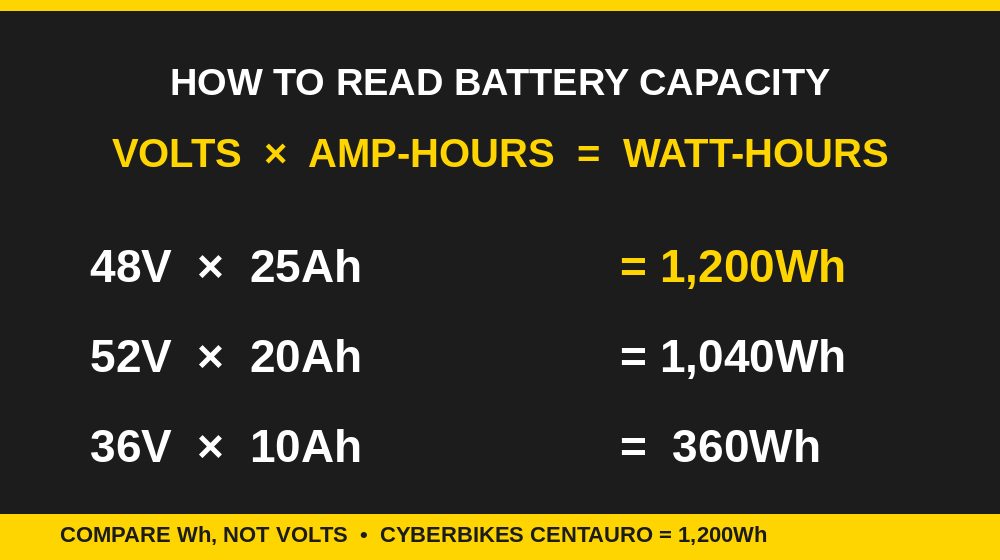
A watt-hour is the true measure of how much energy a battery holds, and it is the number that actually predicts range. You calculate it by multiplying voltage (V) by amp-hours (Ah): Volts × Amp-hours = Watt-hours. A 48V 25Ah battery holds 1,200Wh; a 52V 20Ah battery holds 1,040Wh; a budget 36V 10Ah pack holds only 360Wh.
Ignore any bike advertised by voltage alone. A “52V battery” tells you nothing about how far it goes — a 52V 10Ah pack (520Wh) will run flat in half the distance of a 48V 25Ah pack (1,200Wh). Watt-hours are the honest number, so when you compare e-bikes, compare Wh. As a rough Sydney rule of thumb, plan on 8–12Wh per kilometre depending on hills, wind, rider weight and assist level — which is exactly why a 1,200Wh pack comfortably covers a week of commuting.
How far can an e-bike battery take you on one charge?
Most e-bikes travel between 40 km and 112 km (25–70 miles) on a single charge, with real-world range decided by battery size, terrain, rider weight, tyre pressure and how much you lean on the throttle. A large 1,000–1,200Wh battery on eco or mid assist will get most riders through a 60–100 km day; a small 360Wh pack might manage 25–35 km.
The biggest range killers are throttle-only riding, steep hills, under-inflated tyres, cold weather and carrying heavy loads. The easiest way to extend range is to actually pedal — using a lower assist level and contributing your own effort can double the distance you get from the same battery.
How long does an e-bike battery last?
A typical lithium-ion e-bike battery lasts 500–1,000 full charge cycles, or about 3–5 years of average use. Premium packs with a good BMS and quality cells stretch to 1,000–2,000 cycles or 5–7 years. “End of life” does not mean the battery dies — it means capacity has fallen to about 60–80% of new, so your range shrinks noticeably.
How you treat the battery matters more than the calendar. Heat, deep discharges and fast charging age cells faster than simple time. Two identical batteries can differ by years of usable life purely based on charging habits and storage — which is why the care sections below are worth reading properly.
What is a charge cycle (and what counts as one)?
One full charge cycle equals using 100% of the battery’s capacity — but not necessarily in one go. If you use 50% today and recharge, then use 50% tomorrow and recharge, that counts as a single full cycle, not two. This is why small daily top-ups are gentler on a battery than running it flat and charging it to 100% every time.
Manufacturers rate lifespan in cycles precisely because this is what wears cells out. Shallow, partial charges — the “little and often” approach — stretch your cycle count and keep the pack healthier for longer.
48V vs 52V: which battery voltage is better?
Neither voltage is automatically “better” — 52V delivers slightly punchier acceleration and marginally more efficiency under load, while 48V is the mature, widely supported standard with easier access to chargers and replacement parts. The difference most riders actually feel is small; capacity (watt-hours) affects your day far more than voltage does.
| Feature | 48V system | 52V system |
|---|---|---|
| Acceleration feel | Smooth, strong | Slightly snappier under load |
| Efficiency on hills | Very good | Marginally better |
| Charger & parts availability | Widest (industry standard) | Good, but less universal |
| Best for | Commuters wanting reliability | Riders chasing peak performance |
Our advice for Sydney commuting: choose a 48V system with a large watt-hour capacity — like the Centauro’s 48V 25Ah (1,200Wh) pack — over a small-capacity 52V pack. Range and reliability win the daily commute.
How should you charge an e-bike battery? (the 20–80% rule)
For the longest life, keep the battery between roughly 20% and 80% for daily riding, charge at moderate speed (a 2–4A charger), and avoid leaving it plugged in at 100% for days. Charging all the way to 100% occasionally is fine — do it the night before a long ride — but living at the extremes of full and empty is what wears cells out fastest.
Practical charging habits that add years to a pack: charge indoors at room temperature, let a hot battery cool for 20–30 minutes after a ride before plugging in, only use the charger supplied with the bike, and unplug once it is full rather than trickling overnight. Never charge a visibly damaged, swollen or water-affected battery.
How do you store an e-bike battery safely?
If you are not riding for a few weeks, store the battery at around 40–60% charge, somewhere cool and dry (ideally 10–20°C), and away from direct sun, heaters and anything flammable. Top it up to 40–60% every couple of months so it never sits fully discharged, which can permanently damage cells.
Do not store a battery in a hot car, a sealed shed that bakes in summer, or below freezing for long periods. Heat is the number-one enemy of lithium-ion cells, and a battery cooked over summer will quietly lose capacity you never get back.
Why does an e-bike battery lose range in winter?
Cold slows the chemical reactions inside lithium-ion cells, so below about 0°C you can temporarily lose up to 30% of your usual range. This is not damage — the capacity comes back as the battery warms up — but it can be a surprise on a frosty Sydney winter morning.
To cushion the cold: store and charge the battery indoors, fit it to the bike just before you leave rather than the night before, and consider a neoprene battery cover for exposed packs. Warm cells simply give you more kilometres.
Are e-bike batteries safe?
A certified e-bike battery from a reputable brand is very safe; almost every serious e-bike fire traces back to cheap uncertified packs, damaged batteries, or the wrong charger. The lithium-ion cells themselves are a mature, well-understood technology — the risk comes from poor manufacturing, no BMS protection, and abuse.
Reduce risk to near zero by buying a battery certified to a recognised standard (see below), charging on a hard surface away from exits and flammable materials, never using a mismatched charger, and retiring any pack that is swollen, punctured, hissing or leaking. This is exactly why certification is now being written into law.
What battery safety standards must a legal e-bike meet in NSW (2026)?
From 2026, NSW Fair Trading requires e-bikes and their batteries sold in NSW to be certified to recognised safety standards, with heavy penalties for retailers selling uncertified products. This is the single most important thing to check before you buy — a compliant battery is both safer and future-proof.
The battery itself should meet one of these recognised standards: UL 2271 (batteries for light electric vehicles), EN 50604-1 (lithium batteries for light EV applications), or IEC 62133-2 (safety of secondary lithium cells). At the whole-bike level, the recognised electrical-safety and product standards are EN 15194 / AS 15194 and UL 2849, which test the motor, controller, battery and charger together for fire and shock risk. When you shop, ask the retailer which standard the battery is certified to — if they cannot answer, walk away. Every Cyberbikes Centauro ships with a Samsung pack certified to UL 2271.
How do you know if your e-bike battery is dying?
The clearest sign is shrinking range — when a pack that once did 80 km now struggles to reach 45 km on the same route and assist level, capacity has faded. Other warning signs include much longer charge times, the battery running hot, refusing to hold a full charge, or the bike cutting out under load even though the gauge shows charge left.
Any physical change is a hard stop: a swollen or bulging case, a hissing sound, a chemical smell, or visible leaking means you should stop using and charging the battery immediately and have it professionally assessed or recycled. Gradual range loss is normal ageing; physical changes are a safety issue.
Can you replace or upgrade an e-bike battery?
Yes — on most quality e-bikes the battery is a replaceable module, so when the original pack ages you fit a fresh one and the bike is effectively renewed, no need to replace the whole bike. Some riders also buy a second battery to double their range for touring or long days.
The key is compatibility: a replacement must match the voltage, connector, mounting and BMS communication of your bike, which is why buying from a shop that services the same bikes it sells (like us in Leichhardt) saves headaches. Avoid generic marketplace batteries of unknown origin — they are the leading cause of e-bike fires and often lack proper certification.
How much does an e-bike battery cost to replace?
In Australia, a genuine replacement e-bike battery typically costs between roughly AUD $400 and $1,000, depending on capacity, cell brand and certification. A large, name-brand certified pack (Samsung or LG cells, 1,000Wh-plus) sits at the upper end, while smaller packs cost less — but the cheapest listings are usually uncertified imports best avoided.
Think of it as a service item, not a shock cost: spread over 3–5 years and thousands of kilometres of car-free travel, a replacement battery works out to a few dollars a week — far cheaper than fuel, parking and public transport over the same period.
Removable vs integrated batteries: which is better?
Removable batteries are the more practical choice for most riders because you can carry the pack inside to charge and store it, while integrated (in-frame) batteries look cleaner but tie charging to wherever the bike is parked.
| Consideration | Removable battery | Integrated battery |
|---|---|---|
| Charging convenience | Charge anywhere — take it inside | Charge only where the bike is |
| Security | Remove it so the bike is less of a target | Locked in the frame |
| Weather protection | Store indoors easily | Stays with the bike |
| Replacement | Simple swap | Sometimes needs a workshop |
For apartment-dwelling Sydney commuters who cannot wheel a whole bike inside, a removable battery is a genuine daily convenience — carry the pack up to your flat, charge it safely, and leave a locked bike downstairs.
How do you dispose of or recycle an old e-bike battery?
Never put a lithium-ion battery in your household bin or recycling — damaged cells can ignite in waste trucks and facilities. Instead, take dead packs to a dedicated battery recycling drop-off (many councils and retailers, including bike shops, accept them) so the lithium, nickel and cobalt can be recovered.
If a battery is swollen or damaged, tape over the terminals, keep it away from heat, and let a shop or recycler handle it. We are happy to accept old Cyberbikes packs for correct recycling when you upgrade.
The best e-bike battery in Sydney: the Cyberbikes Centauro
If you want a battery you never have to worry about, the Cyberbikes Centauro is our answer for Sydney riders. It runs a 48V 25Ah (1,200Wh) Samsung battery — one of the largest, highest-quality packs on any commuter e-bike in this price bracket — and it is certified to UL 2271, so it meets the safety standard buyers should be demanding in 2026.
That 1,200Wh capacity translates to genuine 60–100 km real-world range, the removable pack means you can charge it safely in your apartment, and the Centauro is a full-suspension step-through built for real Sydney commuting, with hydraulic brakes, a 150 kg max load and a 50 kg-rated welded rear rack. Rather than paying thousands upfront, you can ride one on rent-to-own from $99.99 per week — and you own the bike at the end, with a helmet, lock, alarm, GPS tracker and phone holder included.
See the Centauro and start rent-to-own from $99.99/week → or book a free test ride at our Leichhardt store.
The bottom line on e-bike batteries
The battery is the heart of your e-bike, and choosing well is simple once you know what matters: buy the largest watt-hour capacity you can, insist on a recognised safety certification like UL 2271, charge and store it kindly (20–80%, cool and dry), and it will reward you with years of quiet, car-free kilometres. Range fades slowly and predictably; treat the pack well and you will get 3–5 years or more before a straightforward replacement.
For most Sydney riders, the easiest path to a battery you can trust is the Centauro’s certified 1,200Wh Samsung pack — available on rent-to-own from $99.99/week. Check out the Centauro here.
Frequently asked questions about e-bike batteries
How long does an e-bike battery last before it needs replacing?
A quality lithium-ion e-bike battery lasts about 500–1,000 full charge cycles, or 3–5 years of average use, before its capacity drops to roughly 60–80% of new. Premium packs with a good BMS can reach 1,000–2,000 cycles. Good charging and storage habits are the biggest factor in how long yours lasts.
Is it OK to leave my e-bike battery charging overnight?
It is best not to. Charging to 100% and leaving the battery plugged in for many hours stresses the cells over time. For daily riding, keep the battery between about 20% and 80%, use the supplied charger, and unplug once it is full rather than trickling overnight.
How far can an e-bike go on a single charge?
Most e-bikes travel 40–112 km (25–70 miles) per charge, depending on battery size, terrain, rider weight and assist level. A large 1,200Wh pack like the Cyberbikes Centauro’s covers roughly 60–100 km of real-world Sydney riding on eco or mid assist.
Are e-bike batteries safe from fire?
A certified battery from a reputable brand is very safe. Almost all e-bike fires involve cheap uncertified packs, damaged batteries, or mismatched chargers. Buy a battery certified to UL 2271, EN 50604 or IEC 62133, use only the supplied charger, and never charge a swollen or damaged pack.
Come and see the Centauro in person and talk batteries with people who build them: Cyberbikes, 281 Parramatta Road, Leichhardt. Book a free test ride on 0491 794 668.
#Cyberbikes #ebike #ebikeSydney #electricbike #ebikebattery #Centauro #renttoown #Leichhardt #Sydneycommute #ebikelife