E-bike maintenance is simple: a five-minute weekly check of tyres, brakes, chain and battery, plus a proper service every 6–12 months, keeps a modern electric bike safe and reliable for years. The motor, controller and battery are largely sealed and low-maintenance — most of the care an e-bike needs is ordinary bike care, done a little more often because the bike is heavier and faster than a push bike.
This is the complete guide to looking after an e-bike in Sydney and across Australia. It covers how often to service, what you can safely do yourself, real costs, cleaning, chain and brake care, tyre pressure, battery life, motor upkeep, riding in the rain, error codes, a full maintenance schedule and when to hand the bike to a professional. Every technical claim is tied to a verifiable source, and the specs quoted for our own Cyberbikes Centauro are pulled live from the product page. By the end you’ll know exactly what e-bike maintenance involves — and how to make an electric bike last.
Table of contents
- How often should you service an e-bike?
- Can you service an e-bike yourself, or do you need a shop?
- How much does e-bike maintenance and repair cost in Australia?
- What tools do you need for basic e-bike maintenance?
- How do you clean an e-bike safely?
- How do you look after the chain and drivetrain?
- How do you keep e-bike brakes safe and quiet?
- What tyre pressure should an e-bike run?
- How do you make an e-bike battery last longer?
- How should you store an e-bike and its battery?
- Do e-bike motors need maintenance?
- Can you ride and wash an e-bike in the rain?
- How do you fix a display error or update firmware?
- How do you keep bolts, suspension and frame in good shape?
- What are the most common e-bike problems and quick fixes?
- The complete e-bike maintenance schedule
- When should you take an e-bike to a professional?
- The low-maintenance choice: the Cyberbikes Centauro
- Frequently asked questions
How often should you service an e-bike?
Do a two-minute glance before every ride, a five-minute check every week, and a full workshop service every 6–12 months or roughly every 1,500–2,000 km, whichever comes first. Riders who commute daily, carry cargo or ride in the wet should service more often; a bike that only does the occasional weekend loop can stretch toward the yearly end.
The pre-ride glance is the “ABC” every mechanic teaches: Air (tyres firm), Brakes (levers bite), Chain and cranks (nothing loose or rattling). The weekly check adds a wipe-down, a chain lube and a bolt squeeze. The bigger service — brake bleed if needed, gear tune, spoke and bearing check, firmware and torque check — is the one most people skip, and it’s the one that prevents the expensive failures.
Can you service an e-bike yourself, or do you need a shop?
You can safely do most routine e-bike maintenance yourself: cleaning, lubing the chain, inflating tyres, adjusting brake pads, checking bolt torque and looking after the battery. What’s best left to a shop is anything inside the sealed electrical system — opening the battery pack, replacing motor internals, diagnosing controller faults — plus hydraulic brake bleeds and wheel truing if you’re not confident.
The reason to respect that line isn’t complexity, it’s safety. An e-bike battery stores a lot of energy, and a damaged lithium pack is a genuine fire risk. Never open, puncture or “repair” a battery at home, and never use a mismatched charger. Mechanical jobs are fair game for a home mechanic; the high-voltage and structural jobs belong on a workbench with the right tools.
How much does e-bike maintenance and repair cost in Australia?
Budget around $80–$150 for a standard e-bike service at a Sydney shop, and $150–$300 for a major service that includes a brake bleed, new pads, cables and a full drivetrain clean. Consumables you’ll replace over time are cheap: a chain runs about $30–$60, brake pads $20–$40 a set, tyres $40–$80 each, and chain lube a few dollars a bottle that lasts months.
The big-ticket items are the electrical parts, and they’re exactly what good habits protect. A replacement battery is the single most expensive component on any e-bike, which is why the battery-care section below matters more than anything else in this guide. Look after the pack and you may never buy a second one; neglect it and you’re facing the priciest repair the bike has.
What tools do you need for basic e-bike maintenance?
A starter kit is small and cheap: a set of Allen (hex) keys, a floor pump with a pressure gauge, a rag, degreaser, chain lube, and a torque wrench for anything the manual gives a torque figure for. That’s enough for 90% of the maintenance an e-bike will ever need.
Add a chain-wear checker (a $10 gauge that tells you when a chain is stretched), tyre levers and a spare tube, and a work stand if you want to make the job pleasant. The torque wrench is the one people underrate — e-bikes are heavier and put more stress through the frame, so under- or over-tightened bolts fail faster. Torque figures printed on the part or in the manual exist for a reason.
How do you clean an e-bike safely?
Clean an e-bike with a bucket of soapy water, a soft brush and a sponge — never a high-pressure hose. Pressure washers force water past seals into the bearings, motor and electrical connectors, and that’s where corrosion and faults start. A gentle wash, a rinse with a light spray or damp cloth, and a dry with a towel is all it takes.
Before you start, turn the bike off and, if the battery is removable, take it out and wipe the contacts with a dry cloth. Keep water away from the display, charge port and motor cable entry. Wash the frame and wheels, degrease and rinse the chain separately, then dry everything and re-lube the chain. A clean drivetrain wears far slower than a gritty one, so cleaning isn’t cosmetic — it’s the cheapest way to make parts last.
How do you look after the chain and drivetrain?
Keep the chain clean and lightly lubed, and replace it before it wears out. A dry, squeaky chain wastes your battery and grinds down the cassette and chainring; an over-oiled chain just glues grit to itself. The rule is simple: wipe the chain clean, apply one drop of lube per link, spin the pedals, then wipe off all the excess so the lube is in the rollers, not sitting on the outside.
E-bikes wear chains faster than push bikes because the motor adds torque through the drivetrain, so check chain stretch monthly with a cheap gauge and swap the chain at around 0.5–0.75% wear. Replacing a $40 chain on time saves the $120 cassette-and-chainring bill that comes from riding a worn one. Use a wet lube for Sydney’s rain and a dry lube in dry spells, and you’ll rarely have drivetrain trouble.
How do you keep e-bike brakes safe and quiet?
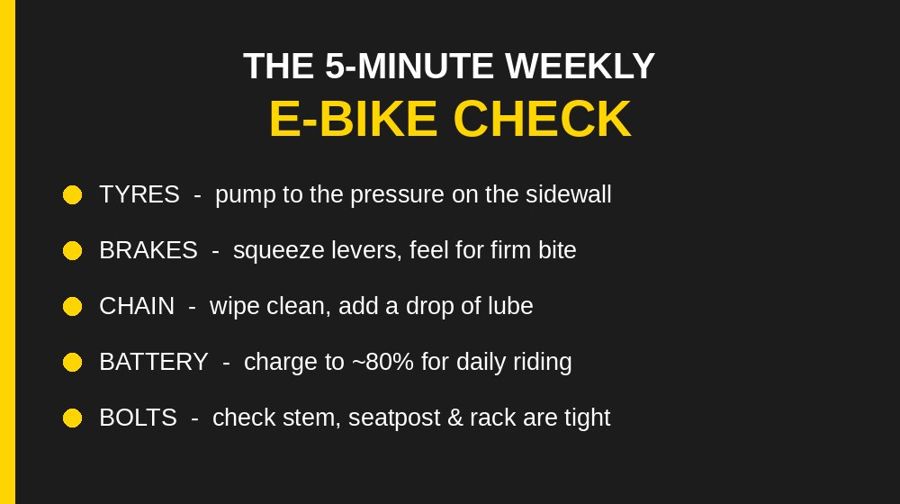
Check brakes every week by squeezing the levers — they should feel firm and stop the bike well before the lever reaches the bar — and inspect the pads for wear each month. Because e-bikes are heavier and faster, their brakes work harder, so pads wear quicker and good braking matters more than on a regular bike. Replace pads once the friction material is down to about 1 mm.
Most quality e-bikes, including the Centauro, use hydraulic disc brakes. These are powerful and low-effort but need an occasional fluid bleed — a shop job — if the lever starts feeling spongy. A squealing brake is usually contamination: don’t touch the rotor or pad face with oily fingers, clean the rotor with isopropyl alcohol, and if lube ever gets on a pad, replace it. Keep rotors true and bolts tight, and your brakes stay safe and silent.
What tyre pressure should an e-bike run?
Run the pressure printed on the tyre sidewall, and check it weekly — e-bike tyres lose pressure faster because they carry more weight. Most e-bike tyres list a range (for example, a 26 x 2.4 tyre might sit around 30–50 psi); ride toward the lower end for grip and comfort and the higher end for speed and puncture resistance on smooth roads.
Correct pressure is the single easiest way to prevent flats and get more range — an under-inflated tyre rolls slower, drains the battery and pinch-flats over kerbs. A floor pump with a gauge takes thirty seconds and does more for your ride quality than almost anything else. Check the tread and sidewalls while you’re there, and pull out any embedded glass before it works through to the tube.
How do you make an e-bike battery last longer?
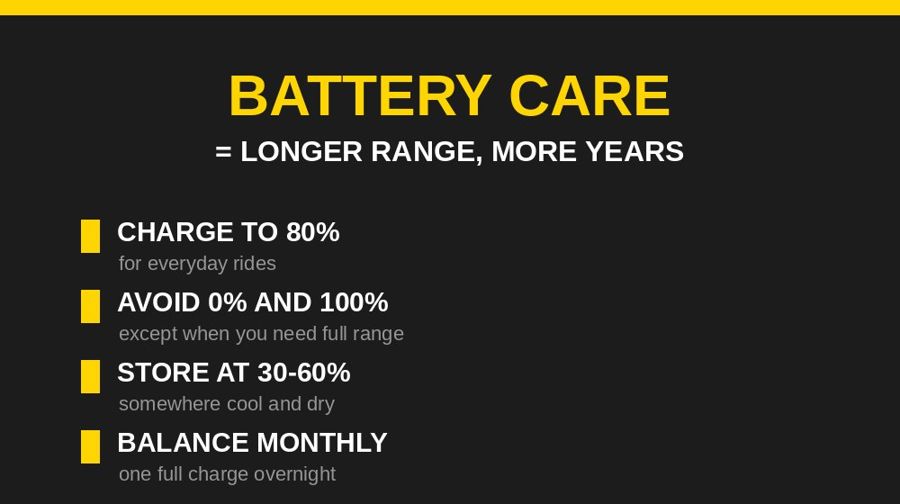
The battery is the most valuable part of an e-bike, and how you charge it decides whether it lasts two years or five. According to Grin Technologies’ engineering resource at ebikes.ca, most lithium chemistries see “drastic improvements in calendar and cycle life” when they aren’t held at a full 4.2 V per cell — in other words, don’t charge to 100% and leave it there. Charging to around 80% for everyday rides can extend a pack from the 1–2 years of careless use to more like 4–5 years.
The practical routine: charge to about 80% for daily commuting, top up to 100% only when you need the full range, and avoid running the pack flat to 0%. Use only the charger supplied for the battery, charge on a hard surface away from anything flammable, and unplug once full. One more tip from ebikes.ca — because many BMS circuits only balance cells near full charge, leave the pack on a 100% charge overnight roughly once a month so the cells stay balanced. Our Centauro’s UL 2271-certified Samsung pack rewards exactly this habit.
How should you store an e-bike and its battery?
Store the battery at a partial charge — around 30–60% — in a cool, dry place, not fully charged and not empty. A pack left full or flat for weeks degrades faster; a mid-charge pack sitting somewhere cool ages slowest. This mirrors how manufacturers ship batteries: ebikes.ca notes that cells are recharged to roughly 30% capacity as the “ideal state for shipping or storage.”
For the bike itself, store it somewhere dry and out of direct sun, ideally indoors. If it’ll sit for a month or more, clean and lube the chain first (a dirty chain rusts in storage), pump the tyres up so they don’t develop flat spots, and top the battery back toward 50% every couple of months. Avoid extreme heat — a hot shed or a car boot in an Australian summer is the worst place you can leave a lithium battery.
Do e-bike motors need maintenance?
A hub motor needs almost no maintenance — it’s a sealed unit with very few wear parts, which is one of the main reasons hub motors are so popular. As ebikes.ca explains in Why Hub Motors Are Awesome, even a geared hub is “straightforward” to open and service if it ever needs it, with replacement gears and bearings readily available. For the vast majority of riders, the motor is the part you think about least.
Keep the motor cable clean and undamaged, don’t blast the hub with a pressure washer, and listen for any new grinding or clicking that could signal a bearing or gear needing attention. The Centauro uses a 250W rear hub motor, so day-to-day there’s nothing to service on it — just keep it dry and connected. Mid-drive motors ask a little more (they wear chains faster and some need periodic checks), but a hub-motor commuter is about as low-maintenance as an e-bike gets.
Can you ride and wash an e-bike in the rain?
Yes — quality e-bikes are built to handle rain and puddles, and riding in a Sydney downpour won’t hurt a properly sealed bike. What they’re not designed for is submersion or a high-pressure jet aimed straight at the seals. Ride in the wet freely; just don’t ride through water deep enough to reach the motor or battery, and don’t pressure-wash afterwards.
After a wet ride, wipe the bike down, dry the chain and re-lube it (water strips lube and invites rust), and dry the battery contacts before charging. Check that connector covers and the charge-port flap are seated. Do that and rain becomes a non-issue. Neglect it and the problems show up not as electrical faults but as a rusty, noisy drivetrain — which is really a lubrication problem, not a waterproofing one.
How do you fix a display error or update firmware?
Most display errors are connection issues, not failures. If the screen shows an error code or the motor cuts out, start simple: turn the bike fully off and on, check the battery is seated and charged, and inspect the motor and display cables for a loose or dirty connector. A surprising share of “dead” e-bikes are just a battery that isn’t clicked in properly or a connector that’s worked loose.
Every brand uses its own error codes, so check the manual for what a specific number means before assuming the worst — codes usually point to a single subsystem (throttle, brake sensor, motor, controller). Some e-bikes also receive firmware updates through the shop or an app that can smooth out a glitch or improve battery behaviour. If a genuine fault code keeps returning after a reset, that’s the moment to book a diagnostic rather than keep riding.
How do you keep bolts, suspension and frame in good shape?
Check the key bolts monthly with a torque wrench: stem, handlebar, seatpost, brake mounts, and any rack or accessory bolts. E-bikes carry more weight and vibrate more than push bikes, so bolts loosen over time — a thirty-second torque check prevents a rattly, unsafe bike. Tighten to the figure printed on the part, no more.
If the bike has suspension, like the Centauro’s full-suspension frame with 100 mm of front travel, keep the stanchions clean and wipe them after wet or dusty rides so grit doesn’t score the seals; a fuller service (lower-leg oil, seal checks) is a yearly shop job. Inspect the frame now and then for cracks or damage, especially around welds and the head tube, and check the wheels for loose or broken spokes by squeezing pairs — they should all feel evenly tight. None of this takes long, and it’s what keeps a bike feeling tight and new instead of vague and clunky.
What are the most common e-bike problems and quick fixes?
The most common e-bike problems are simple ones with simple fixes. A bike that won’t turn on is usually a battery not seated, flat, or a loose connector. Reduced range is almost always cold weather, low tyre pressure, or an ageing or over-stressed battery. A squealing brake is a contaminated pad or rotor; a slipping or noisy gear is a stretched chain or a cable that needs a barrel-adjuster tweak.
Here’s the quick-fix logic: no power → check battery and connectors; poor range → check tyres, then charging habits; squeal → clean the rotor, replace contaminated pads; skipping chain → check chain wear and cable tension; motor cuts out → check for an error code and a loose cable. Most of these you can solve in the driveway. The pattern to notice is that “electrical” complaints are frequently mechanical or connection issues in disguise — which is exactly why the weekly check catches them early.
The complete e-bike maintenance schedule
Here’s the whole guide distilled into a routine. Follow it and an e-bike stays safe, efficient and reliable for years.
| How often | What to do |
|---|---|
| Every ride | ABC glance — tyres firm, brakes bite, nothing loose or rattling. |
| Weekly | Check tyre pressure, squeeze brakes, wipe and lube the chain, look over the battery, quick bolt squeeze. |
| Monthly | Check chain wear with a gauge, inspect brake pads, torque key bolts, clean the bike properly, balance the battery with one full charge. |
| Every 6–12 months | Full shop service: brake bleed if spongy, gear tune, cables, spoke and bearing check, suspension service, firmware check. |
| As needed | Replace chain (~0.5–0.75% wear), pads (~1 mm left), tyres (worn tread), and diagnose any recurring error code. |
When should you take an e-bike to a professional?
Take an e-bike to a professional for anything electrical inside the sealed system, hydraulic brake bleeds, wheel truing, suspension servicing, and any fault code that returns after a reset. These jobs need the right tools and training, and getting the battery or brakes wrong has real safety consequences. There’s no shame in it — even confident home mechanics book the big service.
A good local shop is also worth it for the yearly once-over that catches the things you can’t: a hairline frame crack, a bearing on its way out, brakes that need bleeding before they fail. If you’re in the inner west, our workshop at 281 Parramatta Road, Leichhardt services every make of e-bike, not just ours — sales, rent-to-own and repair under one roof. Knowing where your line is between DIY and shop is itself part of good maintenance.
Watch: keeping your e-bike shifting and braking right
The low-maintenance choice: the Cyberbikes Centauro
If you want an e-bike that’s built to need less maintenance, the Cyberbikes Centauro is engineered around exactly the components this guide recommends. It runs a sealed 250W rear hub motor (almost nothing to service), a 48V 25Ah (1200Wh) Samsung lithium-ion battery that’s UL 2271-certified and removable for easy charging and storage, and 4-piston hydraulic disc brakes with 180 mm rotors for confident, low-effort stopping.
The step-through, full-suspension 6061 aluminium frame (100 mm front travel) soaks up Sydney’s rough roads, the 26 x 2.4 e-bike-ready tyres resist punctures, and it carries up to 150 kg of rider and cargo with a welded rear rack and integrated GPS. It meets UL 2271 (battery), ISO 4210 (frame) and EN 15194 (250W continuous, 25 km/h pedal-assist, 6 km/h throttle), so it’s road-legal in NSW out of the box. Every one of those specs is pulled live from the product page, and every one is chosen to keep upkeep minimal.
You can ride one away from $99.99 a week on rent-to-own, with servicing and support from our Leichhardt workshop built in. See the Centauro and book a test ride →
Conclusion: a little care goes a long way
E-bike maintenance really does come down to a few good habits: a quick check before you ride, five minutes a week on tyres, brakes, chain and battery, and a proper service once or twice a year. The electrical heart of a modern e-bike is sealed and reliable — it’s the ordinary bike parts and the battery-charging routine that decide how long everything lasts. Charge smart, keep it clean, replace the cheap parts on time, and an e-bike will give you years of near-trouble-free riding.
If you’d rather start with a bike that’s designed to need less of all this, the Cyberbikes Centauro is built around low-maintenance parts and backed by a real workshop. Come see it, or bring your current e-bike in for a service — we look after every brand.
Frequently asked questions
How often should an e-bike be serviced?
Do a quick check before every ride, a five-minute maintenance check weekly, and a full professional service every 6–12 months or roughly every 1,500–2,000 km. Daily commuters and wet-weather riders should service more often.
Is e-bike maintenance more expensive than a normal bike?
The routine maintenance costs about the same — chains, pads, tyres and lube are the same price. The one costly difference is the battery, which is why good charging habits (charging to around 80% and never storing it flat) matter so much. Look after the battery and running costs stay low.
Can I wash my e-bike with a hose?
Use a bucket, sponge and a gentle spray, never a high-pressure hose. Pressure washers force water past the seals into the bearings, motor and electrical connectors. Turn the bike off, remove the battery if you can, wash the frame and wheels, then dry and re-lube the chain.
How do I make my e-bike battery last as long as possible?
Charge to about 80% for everyday rides, only go to 100% when you need full range, avoid draining it to 0%, and store it at 30–60% somewhere cool. Use only the supplied charger. Done consistently, this can extend a pack from 1–2 years to 4–5, according to Grin Technologies (ebikes.ca).
Ride an e-bike in Sydney? Come see us at 281 Parramatta Road, Leichhardt, or call 0491 794 668 — we sell, service and rent-to-own every kind of e-bike. #Cyberbikes #ebikeSydney #ebikeMaintenance #electricbike #LeichhardtNSW #Centauro #rentToOwn