Most e-bike batteries take roughly 3.5 to 7 hours to fully charge an e-bike battery from empty on a standard charger, and the last 20% alone can eat up an hour or more. The exact time comes down to two numbers: how much energy the pack holds (watt-hours) and how fast your charger pushes energy in (watts). Divide one by the other and you have your answer. A Cyberbikes Centauro’s 48V 25Ah (1200Wh) Samsung pack, for example, takes about 7 to 8 hours on a common 3-amp charger, or roughly half that on a 5-amp fast charger. Below, our Leichhardt workshop breaks down the maths, why the final stretch is so slow, whether overnight charging is safe, and how to charge so your battery lasts for years.
The short answer: watt-hours divided by watts
Charging time is mostly simple arithmetic. A battery’s capacity is measured in watt-hours (Wh), and as Grin Technologies explains in their battery fundamentals guide, you get watt-hours by multiplying the pack’s amp-hours by its voltage. A charger is rated in volts and amps, and volts times amps equals watts — the rate energy flows in.
The formula that predicts your charge time
To estimate charging time from empty to full: hours ≈ battery watt-hours ÷ (charger volts × charger amps), then add roughly an hour for the slow final top-up. So a 500Wh commuter pack on a 2-amp, 42V charger (about 84W) takes around 6 hours plus the top-up. Bump up to a 4-amp charger and you roughly halve the bulk of that time. The bigger the battery and the smaller the charger, the longer you wait.
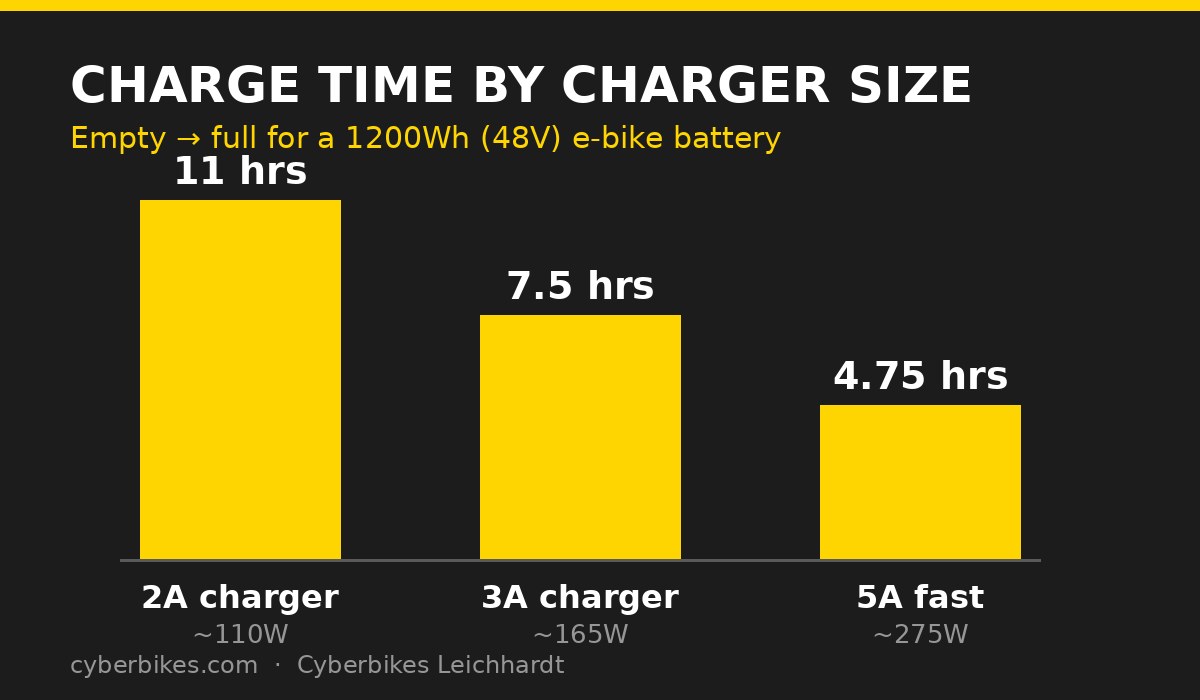
Charge time by charger size (for a 1200Wh pack)
| Charger output | Rough power | Empty → full (incl. top-up) |
|---|---|---|
| 2 amps | ~110W | ~11 hours |
| 3 amps | ~165W | ~7–8 hours |
| 5 amps (fast) | ~275W | ~4.5–5 hours |
These are ballpark figures for a fully drained battery. In real life you rarely arrive home completely empty, so most Sydney commuters top up from 30–40% and are done in 3 to 5 hours.
Why does the last 20% take so long?
If you have ever watched your charger sit at 90% for what feels like forever, that is completely normal. Lithium-ion batteries charge in two stages, and the second stage is deliberately slow to protect the cells.
In the first stage, constant current, the charger pumps in its full rated amps and the pack voltage climbs steadily. This is where the bulk of the charge happens, quickly. Once the cells near their peak voltage, the charger switches to constant voltage: it holds the voltage steady and lets the current taper off gently towards zero. That taper is what fills the final 10–20% and balances the cells so no single group is overcharged. It is slow by design — pushing hard at that stage is exactly what shortens a battery’s life. So a slow finish is not a fault; it is your battery being looked after.
Can you leave an e-bike battery charging overnight?
Generally yes, if you are using the correct charger for your battery and it is in good condition. A quality e-bike charger and a healthy Battery Management System (BMS) will stop delivering current once the pack is full, so it will not “overfill.” That said, our Leichhardt mechanics still recommend three habits: charge on a hard, non-flammable surface away from doorways, don’t charge unattended while you sleep if the charger or battery is damaged or swollen, and unplug once it hits 100% rather than leaving it plugged in for days. If a charger ever runs hot enough that you can’t hold it comfortably, stop using it and get it checked.
How to charge so your e-bike battery lasts longer
Charging time is one thing; battery lifespan is another, and how you charge has a big effect on both. A few evidence-based habits from the workshop:
Charge to 80–90% for everyday riding. Lithium-ion cells age fastest when held at a full 100% or run flat to 0%. If your commute doesn’t need the whole range, unplugging early is one of the easiest ways to add years of life. Charge to full only when you actually need the distance.
Avoid charging a freezing-cold battery. Charging lithium-ion below about 0°C can permanently damage the cells. Sydney winters are mild, but if your Centauro has been outside on a cold Leichhardt morning, let the pack warm to room temperature before plugging in. The same goes the other way — don’t charge a battery that is still hot from a hard climb.
Don’t leave it flat for months. Storing a battery empty is one of the surest ways to kill it. If you’re parking the bike for a while, leave the pack around 50–60% and top it up every couple of months.
For the full picture on chemistry, cycles and care, see our complete 2026 guide to e-bike batteries, and for lifespan specifically, read how long e-bike batteries last and how to make yours go further.
Watch: how battery capacity turns into real range
Charge time and range are two sides of the same watt-hour coin — the more energy your charger has to replace, the further you can ride on the result. Our Cyberbikes team explains exactly how battery capacity translates into kilometres in this short video:
A real Sydney example: charging the Cyberbikes Centauro
Take the 2026 Cyberbikes Centauro we build here in Leichhardt. Its 48V 25Ah Samsung battery holds 1200 watt-hours — a big, genuinely long-range pack, and it’s UL 2271-certified for battery safety. On a standard 3-amp charger, a full empty-to-full charge lands around 7 to 8 hours, most of which you’ll do overnight. Realistically, though, a typical Sydney commute of 20–30km only draws down a fraction of that 1200Wh, so a nightly top-up takes just a couple of hours.
Because the Centauro runs a 250W motor rated for 25km/h pedal-assist under EN 15194, it sips energy rather than gulping it — which is exactly why such a large battery delivers so much range per charge. Pair that with the 80–90% habit above and you have a pack that will keep its capacity for many years of riding. This is the kind of practical detail we walk every customer through when they buy or rent-to-own a Centauro e-bike.
Frequently Asked Questions
How long does it take to charge an e-bike battery from empty?
Most e-bike batteries take about 3.5 to 7 hours to charge fully from empty on a standard charger. Larger packs like the Cyberbikes Centauro’s 1200Wh battery take around 7 to 8 hours on a 3-amp charger. You can estimate it by dividing the battery’s watt-hours by the charger’s watts (volts × amps), then adding about an hour for the slow final top-up.
Is it OK to leave my e-bike battery charging overnight?
Yes, in most cases, provided you use the correct charger and the battery is in good condition. A healthy charger and Battery Management System stop the current once the pack is full. For safety, charge on a hard non-flammable surface, never charge a damaged or swollen battery unattended, and unplug once it reaches 100%.
Should I always charge my e-bike battery to 100%?
Not for everyday riding. Lithium-ion batteries last longer when kept between roughly 20% and 90%. Charging to a full 100% only when you need the maximum range, and unplugging earlier the rest of the time, noticeably slows battery ageing.
Charge smart, ride further — with Cyberbikes Leichhardt
Whether you ride a Centauro or any other e-bike, the right charging habits keep your battery healthy and your range high. Come in for a test ride at Cyberbikes, 281 Parramatta Road, Leichhardt, browse the Centauro e-bike range, or ask us about rent-to-own plans from $99.99/week. Call 0491 794 668 or visit us Tuesday–Saturday.
#eBikeSydney #Cyberbikes #electricbikeLeichhardt #CentauroEbike #eBikeBattery #eBikeCharging #rentToOwnEbike