No — building more roads has never fixed Sydney’s traffic, and it never will. A well-documented effect called induced demand means every new lane or motorway quickly fills with extra car trips, so congestion returns to roughly where it started. The lasting fix isn’t more asphalt. It’s giving people a faster, cheaper way to make the short trips that clog our streets — and in a dense city like Sydney, the electric bike is the standout answer.
We hear this every week at Cyberbikes in Leichhardt: “Why is the traffic still terrible after they spent billions on new roads?” The honest answer is that widening roads treats the symptom, not the cause. Here’s what the evidence actually shows.
What is induced demand — and why does new road space keep filling up?
Induced demand is the tendency for new road capacity to generate new traffic until congestion returns to its previous level. When a road becomes faster, more people choose to drive it, they drive further, they make trips they’d otherwise have skipped, and freight and new housing follow the capacity.
The landmark study is Gilles Duranton and Matthew Turner’s “Fundamental Law of Road Congestion” (2011), which found the elasticity of driving to road capacity is essentially one-to-one: a 1% increase in highway lane-kilometres produces roughly a 1% increase in kilometres driven. Add lanes, and within a few years the extra space is full again. That is why “just build more roads” keeps failing.
Has Sydney already seen induced demand in action?
Yes — Sydney’s own Rozelle Interchange is a textbook case. The WestConnex interchange opened in November 2023 and was built to carry around 100,000 vehicles a day. Instead of smoothing the run to the CBD, its opening was followed by longer travel times and heavy new traffic spilling onto surrounding streets.
Inner West Council was moved to call for a parliamentary inquiry after residential streets like Bridge Road in Glebe became rat-runs. A multi-billion-dollar road project didn’t remove congestion — it moved it, and in places made it worse. That is induced demand and traffic displacement, exactly as the research predicts.
What is car dependency costing Sydney?
Congestion is already a multi-billion-dollar drag on the city. The Bureau of Infrastructure and Transport Research Economics projects the avoidable cost of congestion across Australia’s capitals to reach around $30 billion a year by 2030, with Sydney carrying the single largest share.
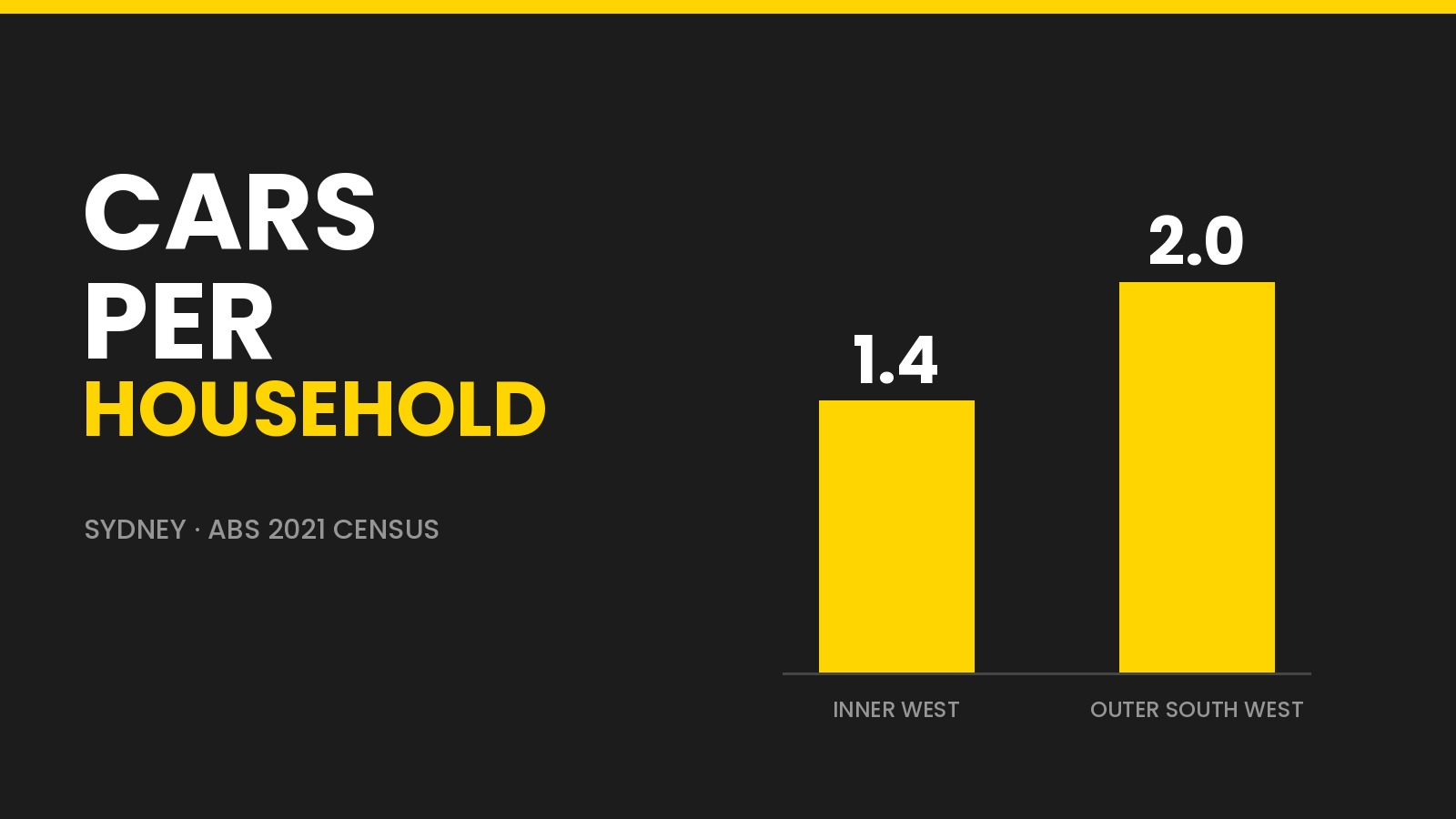
Much of that traffic is short and easily replaced. On the 2021 Census, 36.9% of Greater Sydney commuters travelled to work by private car — many of them on trips of just a few kilometres. Every one of those is a candidate for a bike, and it adds up fast when you tally what owning a car in Sydney really costs.
How do e-bikes break the induced-demand cycle?
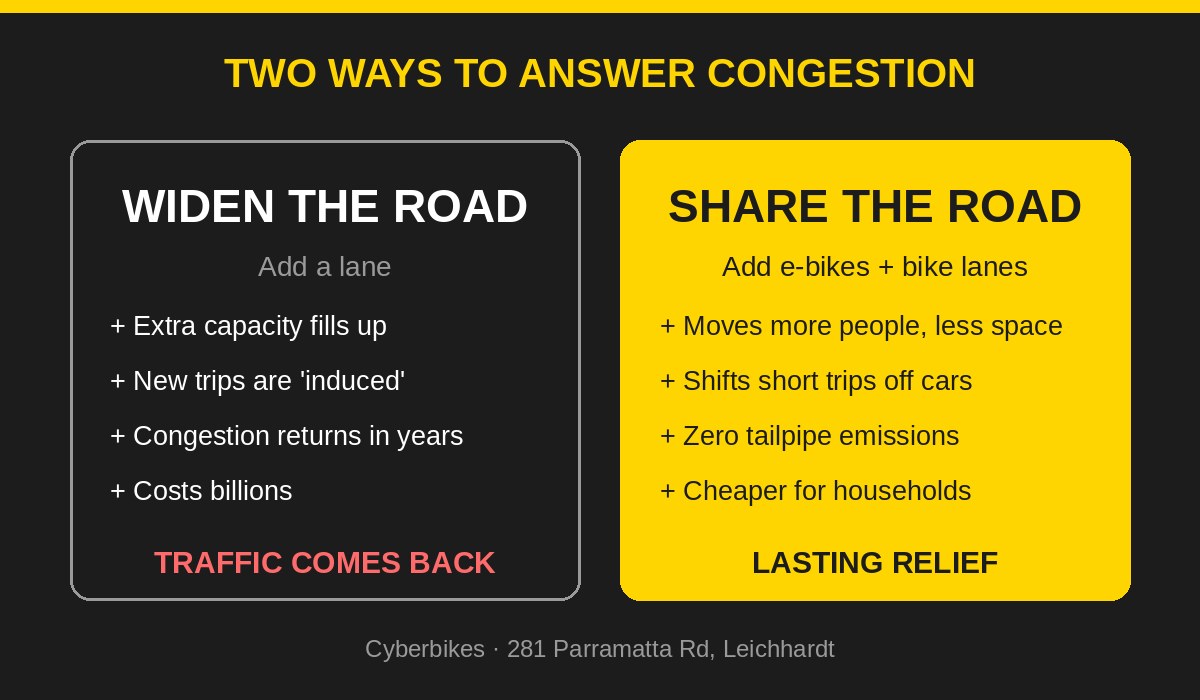
Because e-bikes move people, not metal. A car trip carries roughly 1.5 tonnes of vehicle to shift one person; an e-bike does the same job on a fraction of the road space, with zero tailpipe emissions and no fight for a parking spot. When short trips shift to bikes, you free up road capacity without inducing a fresh wave of driving to swallow it.
| Response to congestion | What actually happens |
|---|---|
| Widen the road / add a lane | Extra capacity is “induced” full again; congestion returns in a few years; costs billions |
| Shift short trips to e-bikes and bike lanes | Moves more people in less space; takes cars off the road for good; cheaper for households |
In NSW this is genuinely easy. A road-legal pedal-assist e-bike is capped at 250W of continuous power with assistance cutting out at 25 km/h, so it needs no licence, registration or insurance — just a helmet, which is mandatory. That makes swapping a short car trip for a ride a near-frictionless choice.
Our Cyberbikes Centauro is built for exactly this: a 250W rear-hub motor and a UL 2271-certified 48V 25Ah (1200Wh) Samsung battery for long-range everyday riding, on a full-suspension step-through frame with a welded rear rack for cargo and the school run. If you want the full picture, read our complete guide to going car-free in Sydney.
Frequently Asked Questions
Does adding lanes reduce traffic congestion?
Usually not for long. Because of induced demand, new lanes attract additional car trips until congestion returns to roughly its previous level — a pattern confirmed by the 2011 “Fundamental Law of Road Congestion” study and visible in Sydney’s Rozelle Interchange.
What is induced demand in simple terms?
Induced demand means that when you make driving easier or faster by adding road space, more people drive, so the extra capacity fills up. Research finds roughly a 1% rise in traffic for every 1% rise in road capacity.
Can e-bikes really reduce Sydney’s traffic?
Yes. Around 37% of Greater Sydney commutes are by car and many are short, replaceable trips. Shifting even one trip a week to an e-bike removes cars from the road without inducing new driving, unlike road widening.
Sydney doesn’t have a shortage of roads — it has a shortage of good alternatives to driving. Swap one car trip a week for an e-bike ride and see what changes. Come try one at Cyberbikes, 281 Parramatta Road, Leichhardt.
#Cyberbikes #ebikeSydney #InducedDemand #CarFreeSydney #Leichhardt #Ebike #UrbanMobility #SydneyTraffic