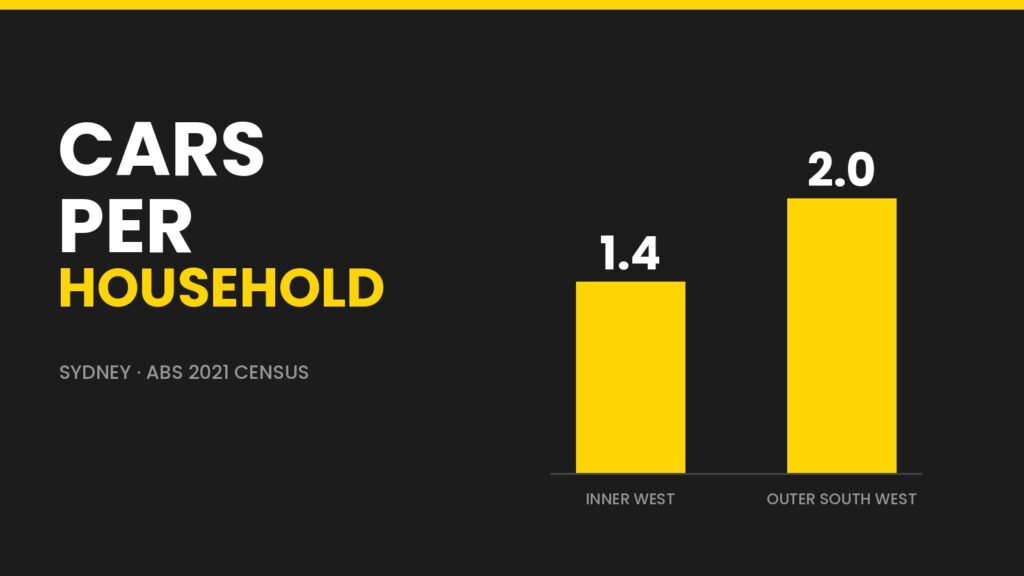
Car ownership in Sydney is not a preference map — it is a transport map. At the 2021 Census, dwellings in Sydney – Outer South West averaged 2.0 motor vehicles and only 5.6% had none at all. In the Inner West, the average was 1.4 and 14.7% of households ran no car whatsoever (ABS QuickStats). Same city, same petrol price, same licences. The difference is that one of those places gives you a realistic way to live without a car, and the other does not.
Which parts of Sydney actually own the most cars?
Greater Sydney as a whole averages 1.7 motor vehicles per dwelling, with 11.1% of households car-free. But that average hides a spread that lines up almost perfectly with rail and bus coverage.
| Area (ABS 2021) | No vehicle | Three or more | Average per dwelling |
|---|---|---|---|
| Sydney – Inner West | 14.7% | 9.1% | 1.4 |
| Sydney – Parramatta | 12.1% | 13.3% | 1.6 |
| Greater Sydney | 11.1% | 15.7% | 1.7 |
| Sydney – Outer West & Blue Mountains | 6.3% | 21.3% | 1.9 |
| Sydney – Outer South West | 5.6% | 23.5% | 2.0 |
Read the last column twice. Nearly a quarter of households in Sydney’s outer south west run three or more vehicles. In the Inner West that figure is under one in ten. Nobody in Camden woke up loving car finance more than someone in Leichhardt. They were handed a different set of options.
Why do outer suburbs end up with two or three cars?
Because the alternative does not reach them. The Outer Western Sydney Alliance, a group of councils, told ABC News in October 2026 that just 12% of Wollondilly Shire residents have regular public transport within 400 metres of home, and that residents of Wollondilly and Camden live an average of about 9 km from the nearest train station. One resident quoted in that report makes a 25-minute drive to Narellan — or a 1 hour 40 minute trip by bus, train and bus.
That is not a lifestyle choice. That is a design outcome. We approved housing faster than we approved the services to reach it, then treated the resulting traffic as a personal failing. The same region is projected to absorb roughly 38% of Sydney’s population growth, pushing past 1.4 million people by 2046. Build it the same way and you manufacture another half a million forced car trips.
Money is moving — $302 million bought five permanent new bus routes through Narellan, Oran Park and Mount Druitt from July, and $140 million has gone into Metro business cases. Good. It is also a rounding error next to what the same decades spent on motorway lanes, and buses every 40 minutes do not replace a car.
What does the second car actually cost a Sydney household?
More than almost anyone budgets for. The Australian Automobile Association’s Transport Affordability Index for the December quarter 2025 puts a typical Sydney household’s transport bill at $567.03 a week — $29,486 a year, or 15.5% of household income. That is the highest weekly figure of any Australian capital, $89.11 above the capital-city average.
The breakdown is where it stings: car loan repayments $215.29 a week, fuel $94.93, insurance $64.31, tolls $60.00, registration and CTP $42.26, servicing and tyres $37.61. Six of those seven lines exist only because the car exists. Tolls and loan repayments alone — $275 a week — are a second rent for the privilege of reaching work.
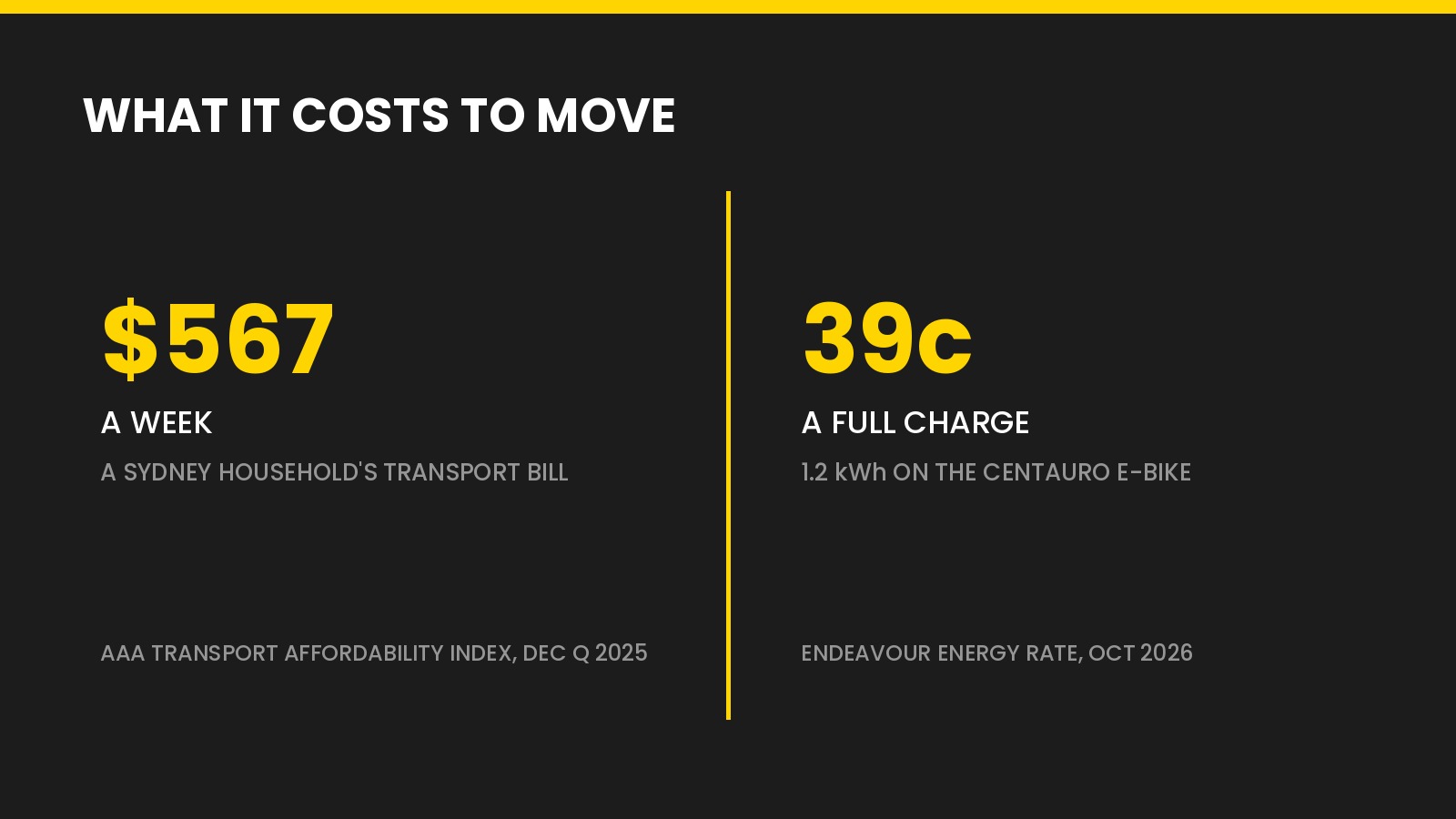
Now price the other vehicle. The Cyberbikes Centauro carries a 48V 25Ah Samsung pack — 1,200Wh, or 1.2 kWh. At the median Endeavour Energy usage rate of 32.14c/kWh for Western Sydney in October 2026 (EnergyPlans), a full charge costs about 39 cents. The product page claims up to 120 km from that charge under ideal conditions — flat road, 25 km/h, 75 kg rider, no headwind. Even at half that in the real world, you are moving for well under a cent a kilometre.
Can an e-bike legally do the second car’s job in NSW?
For the trips that second car mostly does — school drop-off, the shops, the station, a 5–10 km run across the suburb — yes, within clear limits. Transport for NSW currently allows a maximum of 500W continuous rated power, with pedal assist cutting out at 25 km/h and any throttle-only function cutting out at 6 km/h. From 1 March 2029 the ceiling drops to 250W and only EN 15194 certified e-bikes stay road-legal. Helmets are mandatory, and a bike over those limits is illegal even if an app or switch holds it down — since 21 August 2026, police can seize illegal e-bikes. Our complete guide to NSW and Australian e-bike laws goes through it properly.
Buy for 2029 now, not for today. The Centauro is listed with EN 15194 for power and speed, ISO 4210 for the frame, and UL 2271 and UL 2849 for the battery and electrical system — the certifications that will still be legal in four years. It is rated to a 150 kg combined rider and cargo load, with a 50 kg rear rack: enough for the groceries run that currently justifies a whole extra vehicle.
What would make a car genuinely optional out west?
Three things, none of them exotic. Frequency before coverage — a bus every 10 minutes on one corridor beats a bus every 40 minutes on four. Protected bike lanes to stations, because a 9 km gap to the nearest platform is a 25-minute e-bike ride, not a dealbreaker, provided you are not asked to ride it in a traffic lane. And secure bike parking at those stations, so the bike survives the day. Do that and the second car stops being compulsory. Leave it, and every new housing approval quietly bills another household $29,486 a year.
We are not arguing nobody should own a car. We are arguing that nobody should be forced to. Our car-free Sydney e-bike commuting and rent-to-own guide works through what replacing one vehicle actually looks like, trip by trip.
Frequently asked questions
Which Sydney region has the highest car ownership?
At the 2021 Census, Sydney – Outer South West had the highest car ownership of the Sydney regions compared here, averaging 2.0 motor vehicles per dwelling, with 23.5% of households running three or more vehicles and only 5.6% running none.
How much do Sydney households spend on transport each year?
The AAA Transport Affordability Index for the December quarter 2025 puts a typical Sydney household’s transport costs at $567.03 a week, or $29,486 a year — 15.5% of household income, and the highest weekly figure of any Australian capital city.
What is the legal power limit for an e-bike in NSW?
Transport for NSW allows a maximum of 500W continuous rated power, with pedal assist cutting out at 25 km/h and throttle-only operation cutting out at 6 km/h. From 1 March 2029 the limit drops to 250W and only EN 15194 certified e-bikes will be permitted on NSW roads.
Swap one car trip a week for an e-bike ride and see what changes. We are at Cyberbikes, 281 Parramatta Road, Leichhardt.
#CarOwnershipSydney #EbikeSydney #WesternSydney #CarDependency #Cyberbikes #Leichhardt #SydneyTransport #CentauroEbike