
No — you don’t need to charge your e-bike battery to 100% every time, and for the longest life you shouldn’t. Capping your everyday charge at around 80–90% and saving a full 100% charge for the days you actually need maximum range can, according to Grin Technologies (ebikes.ca), give a lithium pack two to three times as many charge cycles as always filling it to the brim. Here’s the engineering behind that number — and how to charge for maximum range when you need it and maximum battery life every other day.
At the Cyberbikes workshop in Leichhardt we hear this question every week, usually from riders whose charger has a single “charge to full” setting who assume that’s simply what you do. It isn’t the only option, and understanding why is one of the easiest ways to protect the most expensive part of your e-bike.
The short answer: charge to 80–90% for daily rides
Charging to 100% now and then is perfectly fine, and sometimes necessary. The damage isn’t done by the occasional full charge — it comes from parking the battery at 100% and from heat. A lithium cell held at its maximum voltage, especially when it’s warm, ages faster than one resting at a more relaxed state of charge. So the practical rule is simple: for everyday commuting around Sydney, top up to about 80–90%; for a big weekend loop or a long trip, charge to 100% shortly before you ride.
What “100%” actually means inside your e-bike battery
Your battery isn’t one big cell — it’s dozens of small lithium cells wired in series and parallel. Each individual cell has a nominal voltage of about 3.7 V and swings from roughly 3.0 V empty to 4.2 V full. As ebikes.ca puts it, a 100% charge with most cells is 4.2 V per cell. “100%” on your display simply means every cell has been pushed to that 4.2 V ceiling.
The energy the pack stores is measured in watt-hours, and the maths is easy: watt-hours = volts × amp-hours. That’s why a Cyberbikes Centauro, with its 48 V, 25 Ah Samsung pack, carries 48 × 25 = 1,200 Wh of energy. If watt-hours versus amp-hours is new to you, our complete guide to e-bike batteries breaks the units down.
Why the top of the charge is hardest on the cells
That last slice of voltage, from roughly 4.0 V up to 4.2 V per cell, is where a lithium cell is under the most chemical stress. Backing off to about 4.1 V (≈90%) or 4.0 V (≈80%) sharply reduces that stress, which is why partial charging is the single biggest lever you have over how long your pack lasts. You give up a little range today in exchange for a lot of cycles over the battery’s life.
Why charging to 80–90% can double or triple battery life
Batteries age two ways at once. Cycle ageing is wear from charging and discharging; calendar ageing is the slow decline that happens simply with time, and it’s worse the longer a cell sits full and warm. Partial charging helps with both. As ebikes.ca explains, setting your everyday charge to 80 or 90% can multiply both the cycle life and the calendar life of a lithium battery, and with good management you can often get two to three times as many discharge cycles as you would from a generic charger that always drives the pack to 100%.
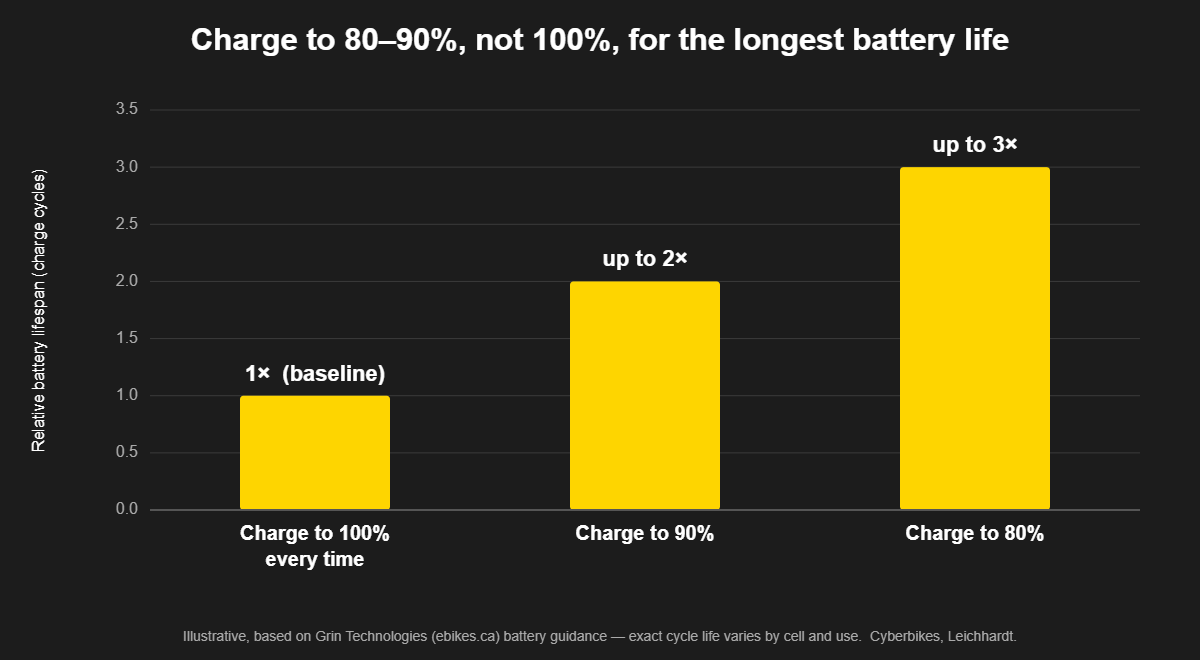
Here’s how the trade-off looks in practice:
| Everyday charge | Range you get | Effect on battery life |
|---|---|---|
| Charge to 100% every time | Maximum range each ride | Baseline — fastest ageing, especially if left sitting full |
| Charge to ~90% | About 90% of range | Noticeably longer life, barely any range lost |
| Charge to ~80% | About 80% of range | Longest life — up to two to three times the cycles |
The catch: your battery still needs an occasional full charge
There’s one important caveat to partial charging. The battery management system (BMS) inside your pack only rebalances the individual cells when they reach full voltage. If you never charge to 100%, ebikes.ca notes, the BMS can’t rebalance cells that are drifting apart, and over time you can lose usable capacity as one cell hits the low-voltage cut-off before the others. The fix is easy: every month or two, do a full 100% charge and leave it on the charger a little longer so the BMS can even the cells out.
Charging habits that quietly kill e-bike batteries
Beyond the 80–90% rule, a few everyday habits make a real difference:
- Keep it cool. Heat is the biggest enemy of lithium cells. Don’t charge or store your battery in a hot car, in direct sun, or beside a heater — and let it cool after a hard ride before charging.
- Don’t leave it sitting at 100%. If you do a full charge, ride soon after rather than letting the pack sit full for days.
- Don’t leave it flat. Storing a lithium battery at 0% for long periods can damage it. If you won’t ride for a while, leave it partly charged.
- Use the right charger. A programmable charger such as Grin’s Satiator caps the charge at 80 or 90% automatically; you can even model different profiles with their charge simulator.
Should you leave your e-bike on the charger overnight?
It’s best not to leave any lithium battery charging unattended for long stretches. A quality charger stops delivering current once the pack is full, but for safety, charge on a hard, non-flammable surface, keep the battery cool, and unplug once it’s done rather than leaving it connected for days. If you want to protect the battery and avoid sitting at 100%, a charger you can set to 80–90% is the neatest solution.
How should you store an e-bike battery for a few weeks?
For longer breaks, store the pack at a partial charge — not full, not empty — somewhere cool and dry, then top it back up to your riding level before you head out. This keeps calendar ageing to a minimum, which matters especially over a Sydney winter when bikes sometimes sit longer between rides. For more on charging times, see our guide to how long it takes to charge an e-bike battery.
What this means for a Cyberbikes Centauro rider in Sydney
Let’s make it concrete. The Centauro’s 1,200 Wh battery, at an efficient real-world draw of around 10 Wh per kilometre, is good for roughly 100 km on a full charge (ebikes.ca puts typical consumption at about 9–12 Wh/km). Charge to 80% instead and you still have close to 80 km on tap — far more than a Leichhardt-to-city commute and back. So for daily riding there’s genuinely no downside to the 80–90% habit: you keep more than enough range and you meaningfully extend the life of a Samsung pack that’s UL 2271-certified and built to last. Save the full 100% charges for the weekends you’re chasing the whole 100 km.
Want to see the Centauro and its battery up close? Here’s our full walk-through:
Frequently asked questions
Is it bad to charge my e-bike battery to 100%?
Charging to 100% occasionally is fine and sometimes needed for maximum range. The wear comes from doing it every single time and letting the pack sit full, especially in heat. For everyday riding, Grin Technologies (ebikes.ca) recommends capping the charge around 80–90%, which can give a lithium pack two to three times as many charge cycles.
What percentage should I charge my e-bike battery to?
Aim for about 80–90% for daily rides, and charge to 100% only when you need the full range for a long trip. Every month or two, let it reach a full 100% charge and leave it on the charger a little longer so the battery management system (BMS) can rebalance the cells.
Can I leave my e-bike battery on the charger overnight?
It’s best not to leave any lithium e-bike battery charging unattended for long periods. Modern chargers stop at full, but for safety charge on a hard, non-flammable surface, keep it cool, and unplug once it’s done rather than leaving it connected for days. A programmable charger like Grin’s Satiator can cap the charge at 80–90% automatically.
Charging questions? Bring your bike in. Our team can set up your charger, check your battery’s health, and get you riding further for longer. Visit Cyberbikes at 281 Parramatta Road, Leichhardt, browse the range at cyberbikes.com, or ask about our rent-to-own plans from $99.99/week.
#ebikeSydney #Cyberbikes #ebikebattery #CentauroEbike #Leichhardt #electricbike