Most e-bikes ride best with tyre pressures between 30 and 50 psi — but the exact number depends on three things: how wide your tyres are, how much you and your cargo weigh, and the surface you ride. Wider tyres, like the 26 x 2.4 rubber on the Cyberbikes Centauro, sit at the lower end, around 30 to 40 psi, while narrower commuter tyres want 45 to 60 psi. Always start from the pressure range printed on the tyre sidewall, and never go above the maximum. Get this one number right and you unlock more range, better grip and a comfier ride around Sydney — get it wrong and you quietly lose all three.
The short answer: find your pressure window
There is no single magic psi. Tyre pressure is a window, and the correct spot inside that window shifts with tyre width and total weight. As a rule, the wider the tyre, the lower the pressure — a fat tyre holds far more air, so it supports the same load at a lower pressure. Here is a practical starting guide for common e-bike tyre widths:
| Tyre width | Typical pressure window | Best for |
|---|---|---|
| 1.5 – 1.95″ | 50 – 65 psi | Road and fast commuting |
| 2.0 – 2.35″ | 40 – 55 psi | Urban / hybrid riding |
| 2.4 – 2.6″ (e.g. Centauro) | 30 – 42 psi | Comfort, cargo, mixed roads |
| 3.0″+ (fat) | 15 – 25 psi | Sand, gravel, trails |
Two adjustments sit on top of that table. Heavier riders and loaded cargo should move toward the top of the window; lighter riders can drop toward the bottom. And whatever the chart says, the tyre sidewall has the final word — the moulded “max” figure is a hard ceiling, not a target. On the Centauro’s 26 x 2.4 tyres, most Sydney riders land happily around 34 to 38 psi.
Why tyre pressure quietly controls your e-bike range
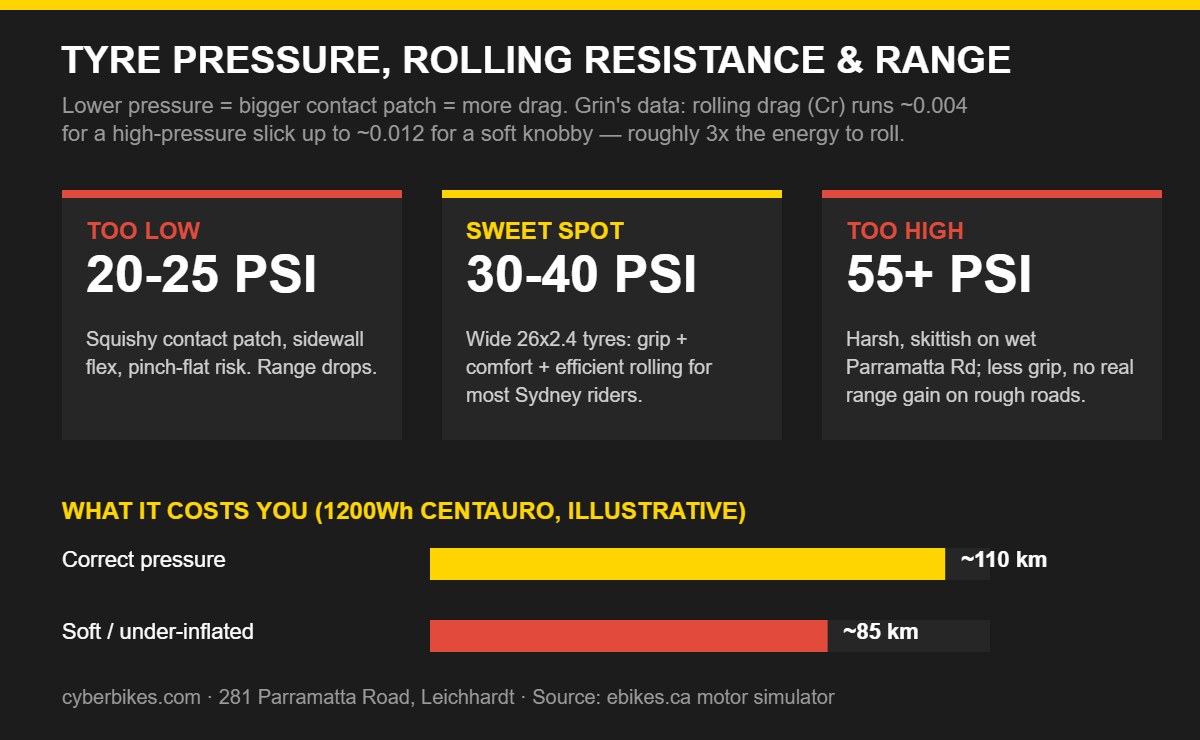
Every metre you ride, energy is lost to rolling resistance — the tyre constantly squashing and un-squashing against the road. Softer tyres deform more, so they waste more energy as heat, and your motor has to make up the difference from the battery. This is not a rounding error. The motor simulator built by Grin Technologies at ebikes.ca lists the rolling drag coefficient (Cr) of bike tyres as running “from about 0.004 for a high pressure road slick, up to 0.012 for a low pressure knobby wheel” — roughly three times the energy to roll the same distance.
Put that in everyday terms. E-bike energy is measured in watt-hours: watt-hours = volts x amp-hours, so the Centauro’s 48V 25Ah Samsung pack holds 1,200Wh. A reasonably efficient rider on a flat commute uses around 10 to 14 Wh per kilometre, which is why a 1,200Wh battery is good for roughly 85 to 120 km. Let your tyres go soft and your Wh-per-km climbs, so the same battery delivers noticeably fewer kilometres. Correct pressure is one of the cheapest range upgrades there is — no new battery required.
Too soft vs too hard: what actually goes wrong
Riders usually assume “harder = faster = better.” On a real road, that is only half true, and both extremes have a cost.
Run them too soft and you get:
A sluggish, heavy-feeling ride, more effort from the motor (and less range, as above), a squirmy tyre in corners, and — worst of all — pinch flats. Hit a Sydney pothole or a kerb edge on an under-inflated tyre and the tube gets crushed between rim and obstacle, punching two neat “snakebite” holes. E-bikes are heavy, so they pinch-flat more easily than a lightweight push-bike.
Run them too hard and you get:
A harsh, buzzy ride that hammers your wrists, and — counter-intuitively — less grip. A rock-hard tyre skips across bumps instead of conforming to them, so the contact patch spends less time actually gripping the road. On wet Parramatta Road, greasy line-marking or slick tram-style tracks, an over-inflated tyre is genuinely more likely to slide. On rough surfaces, an over-hard tyre can even roll slower, because energy goes into bouncing the bike up and down rather than moving it forward.
Does an e-bike’s extra weight change the numbers?
It does, and this is where e-bikes differ from ordinary bikes. A motor, controller and a battery like the Centauro’s 1,200Wh pack add serious mass, and the bike is often carrying cargo or a passenger on top of that. More weight pressing down means you generally want to sit a little higher in your pressure window than a rider on an unpowered bike of the same tyre width — otherwise the tyre squashes too far, inviting pinch flats and sluggish rolling.
The flip side is traction under power. A hub or mid-drive motor delivers torque the instant you pedal, and a slightly softer tyre puts more rubber on the road to transfer that torque without spinning up — handy on a wet Leichhardt hill or a loose Blue Mountains fire trail. Wide tyres give you room to play here: because a 2.4″ tyre carries the load at low pressure, you can drop a few psi for grip and comfort without bottoming out the rim. You can see how surface and traction play out in this real-world Centauro terrain test:
How to set and check your e-bike tyre pressure
You only need two things: a floor pump with a built-in gauge, and 60 seconds. Here is the routine we use in the workshop:
- Check the sidewall first. Note the min–max range moulded into the rubber, and treat the max as a ceiling you never cross.
- Set pressure cold. Air expands as tyres warm up, so measure before you ride, not after — a warm reading runs artificially high.
- Match your valve. E-bikes use either Schrader (fat car-style) or Presta (skinny, with a lock nut you unscrew first). Your pump head needs to fit the valve.
- Check weekly. Tyres bleed roughly 1 to 2 psi a week through the tube and valve, so a quick top-up before the weekend keeps you in the window.
- Adjust for the day. Loaded with shopping or heading into the rain? A couple of psi lower adds grip and comfort. Long, flat, dry commute? Nudge it up for efficiency.
Tyre pressure is the simplest habit in e-bike maintenance and repair, and it pays back every single ride. If you want to see how it feeds into real-world distance, our guide on how far an e-bike really goes on a charge breaks the numbers down further.
Frequently asked questions
What is the best tyre pressure for an e-bike?
Most e-bikes run best between 30 and 50 psi. Wide tyres like the Cyberbikes Centauro’s 26 x 2.4 sit around 30 to 40 psi, while narrower commuter tyres want 45 to 60 psi. Start from the range printed on the sidewall, adjust for your weight and the surface, and never exceed the printed maximum.
Does low tyre pressure reduce e-bike range?
Yes. Low pressure spreads the contact patch and flexes the sidewall, which raises rolling resistance. Grin Technologies (ebikes.ca) puts rolling drag at about 0.004 for a high-pressure slick and 0.012 for a soft knobby tyre, roughly triple, so under-inflated tyres can cost you a real chunk of range.
How often should I check my e-bike tyre pressure?
Check it about once a week and always before a long ride. E-bike tyres lose roughly 1 to 2 psi a week, and the extra weight of the motor and battery makes correct pressure more important than on a regular bike. Always set pressure when the tyres are cold.
Dial it in at Cyberbikes Leichhardt
Not sure what your tyres should be running? Bring your bike in and we’ll set it up properly. Come in for a test ride at Cyberbikes, 281 Parramatta Road, Leichhardt, browse the range at cyberbikes.com, or ask about our rent-to-own plans from $99.99/week. Small number, big difference.
#eBikeSydney #Cyberbikes #CentauroEbike #Leichhardt #eBikeMaintenance #TyrePressure #ElectricBike