A stroad is a street-road hybrid — a route built for fast, long-distance driving that also tries to be a local high street lined with shops, car yards and driveways. It does neither job well, and Parramatta Road is Sydney’s textbook example. The term was coined by American engineer Charles Marohn of Strong Towns, and once you learn it, you can’t un-see it on your daily commute.
What exactly is a stroad?
A street is a destination: a low-speed place where people stop, shop and spend, and where a neighbourhood makes its money. A road is a connection: a high-speed link that moves you efficiently between places, like a motorway. A stroad mashes the two together — highway-style speeds and multiple lanes, but with constant driveways, traffic lights and shopfronts feeding cars on and off. Marohn compares it to a futon: the piece of furniture that works badly as both a couch and a bed. Stroads are expensive to build, dangerous to walk or cycle along, and — the cruel irony — slow to drive.
Is Parramatta Road a stroad?
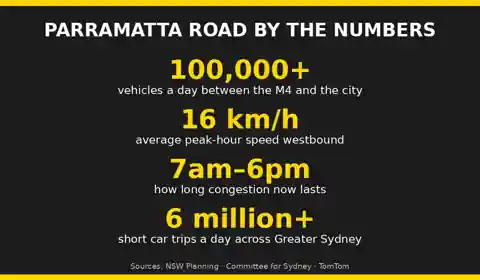
Yes, and it is arguably Sydney’s most famous one. Between the M4 at Concord and the city it carries more than 100,000 vehicles a day, yet it is choked by traffic signals, a variable road width and a huge number of direct property driveways. The result is a corridor that moves neither cars nor people well: westbound peak-hour traffic has been clocked crawling at around 16 km/h, and congestion now stretches roughly 7am to 6pm. That’s slower than a confident rider on an e-bike.
Why do stroads make Sydney’s traffic worse, not better?
Every driveway and signal on a stroad is a point where traffic has to slow, merge or stop — so adding lanes just moves the bottleneck along. It’s the same trap as building new motorways to fix Sydney traffic: more capacity fills up with more driving. Even the NSW Government’s own plan concedes the problem. WestConnex was designed to pull about 4,600 trucks and 20,000 cars a day off Parramatta Road so the corridor could finally be rebuilt as a proper street. The lesson is simple: you can’t engineer your way out of a stroad by making it faster; you fix it by giving people a genuine alternative to driving on it.
Street vs road vs stroad, at a glance
| Street | Road | Stroad | |
|---|---|---|---|
| Job | A place to stop & spend | Fast link between places | Tries to do both |
| Speed | Low (10–30 km/h) | High (80 km/h+) | Medium, stop-start |
| Edges | Shops, homes, people | No frontage | Driveways, signals, car yards |
| Result | Wealth & street life | Efficient travel | Slow, unsafe, costly |
How does an e-bike beat the stroad?
By not playing the stroad’s game. Every day Sydneysiders make more than 6 million car trips shorter than 5 km — and over 2 million shorter than 2 km. Those are exactly the trips a stroad handles worst and an e-bike handles best. Instead of idling on Parramatta Road, you slip onto the Inner West’s back streets and separated paths, skip the parking hunt, and arrive on time. An e-bike also flattens the excuses: a pedal-assist bike like the Cyberbikes Centauro pairs a 250W motor with a 48V 25Ah (1200Wh) Samsung battery for real range, a welded rear rack rated to 50kg for the shopping, and full suspension for Sydney’s patchy tarmac. It’s tuned to Australia’s e-bike rules — 25 km/h pedal-assist under EN 15194 — so it’s legal on the paths that let you dodge the gridlock entirely. If a car sits idle most of the week, the maths for swapping it is compelling; our complete guide to car-free e-bike commuting and rent-to-own in Sydney walks through it.
Frequently Asked Questions
What is a stroad?
A stroad is a hybrid of a street and a road that combines the high speeds of a road with the frequent driveways, shops and intersections of a street, so it performs both roles poorly. The term was coined by Charles Marohn of the urban-planning group Strong Towns.
Is Parramatta Road a stroad?
Yes. Parramatta Road carries more than 100,000 vehicles a day between the M4 and the city yet crawls at around 16 km/h in peak hour, while lined with shops, car yards and driveways — the classic stroad pattern of highway speeds meeting high-street frontage.
Can an e-bike beat Parramatta Road traffic?
For the millions of short trips Sydneysiders make each day, yes. On the Inner West’s separated paths and back streets, an e-bike sidesteps stalled traffic and parking, and often matches or beats a car door-to-door on trips under 5 km.
Cyberbikes sits right on the stroad — 281 Parramatta Road, Leichhardt — so we watch it crawl past every day. Swap one car trip a week for an e-bike ride and see what changes. The Centauro is a good place to start, and in Sydney it’s available rent-to-own from $99.99/week.
#Cyberbikes #eBikeSydney #Leichhardt #ParramattaRoad #Stroad #UrbanPlanning #CarFreeSydney #Centauro #InnerWest