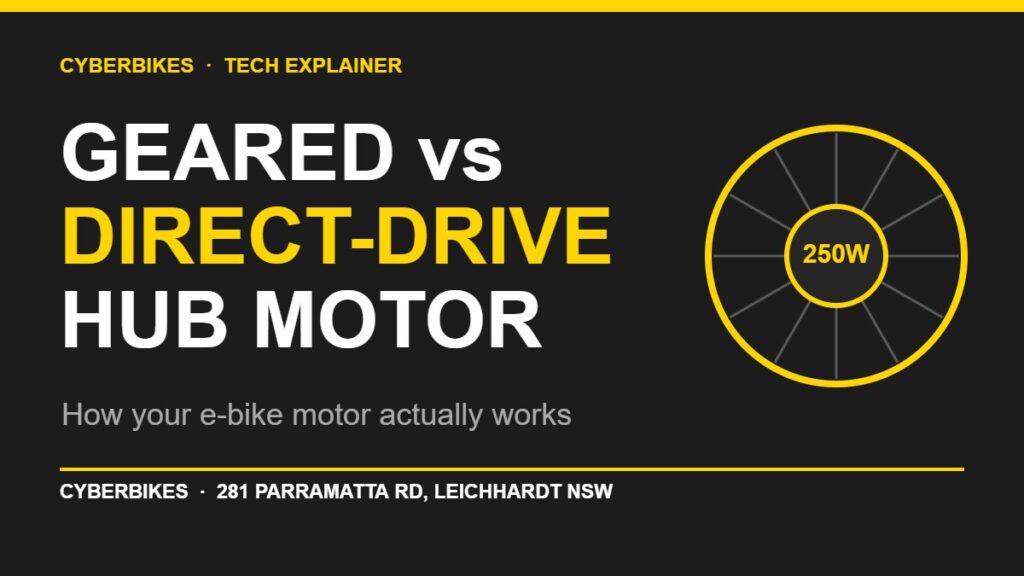
The quick answer: a geared hub motor hides small planetary gears inside the wheel, so a fast-spinning motor is stepped down to deliver strong low-speed torque in a light, compact package that freewheels when you stop. A direct-drive hub motor bolts the wheel straight onto the spinning motor body — no gears, essentially one moving part — so it is heavier and lower-torque but silent, extremely durable, and the only type that can do regenerative braking. For most everyday riders in Sydney, a geared hub wins on weight and hill-climbing grunt; direct-drive suits high-speed, high-mileage riders who prize silence and longevity.
Geared vs direct-drive hub motor: the short answer
Both live inside the wheel and both are permanent-magnet brushless machines, so from the outside they can look identical. The difference is entirely internal — and it shapes how the bike feels, what it weighs, how quiet it is, and whether it can claw energy back on the way down a hill. Here is the trade-off at a glance.

| Trait | Geared hub | Direct-drive hub |
|---|---|---|
| Weight | ~50% lighter for the same power | Large and heavy |
| Low-speed torque | High (gears multiply it) | Lower |
| Drag when off | Almost none (freewheels) | Always engaged, some drag |
| Regen braking | Not possible | Possible |
| Noise | A faint gear whir | Near silent |
| Moving parts / wear | Gears can wear over time | One moving part, very durable |
How a direct-drive hub motor works
A direct-drive hub is about as simple as an electric motor gets. Picture holding the axle still and letting the body of the motor spin instead — then lace a bicycle rim onto that spinning body. There are no moving parts other than the wheel itself. Magnets sit around the inside of the hub shell and the copper windings are fixed to the axle; alternating current through those windings drags the shell (and your wheel) around.
The catch is speed. A bike wheel only turns at roughly 200 rpm, and an electric motor’s power density rises with the speed between its magnets and windings. To make useful power and torque at such low rpm, a direct-drive motor has to be physically big and heavy. It is also always mechanically engaged, which is a double-edged sword: it makes regenerative braking possible, but it means you are always dragging the motor along — a resistance the folks at Grin Technologies (ebikes.ca) measure as a cogging torque of roughly 0.3 to 1 newton-metre even when the power is off.
How a geared hub motor works
A geared hub motor solves the low-rpm problem with a planetary gear set. Inside, a small motor spins fast — often over 3,000 rpm — and the gears reduce that down to wheel speed. Because a fast little motor can make the same power as a big slow one, geared hubs are typically about half the weight of an equivalent direct-drive unit and often produce more torque. Grin notes a well-made geared hub can reach up to around 80 N·m, versus roughly 35 N·m for a typical direct-drive machine.
Nearly every geared hub also has a freewheel (a one-way clutch) built in. That means the wheel spins freely when the motor is off — no drag, so the bike coasts and pedals like a normal bicycle — but it also rules out regen, because the motor is disconnected the moment you stop driving it. The downsides are extra moving parts that can wear, a faint audible whir, and usually a higher price. Almost all are single-speed.
Torque vs watts: why the motor’s size fools people
Here is the part that trips up a lot of shoppers: two bikes can both be badged “250W” and feel completely different. Watts are just volts times amps — a measure of electrical power flowing in, not of the shove you feel. Torque, on the other hand, is set by the current through the windings and, crucially, by any gearing. A motor’s pulling force is proportional to current (twice the current, twice the torque), while the voltage it needs rises with speed. That is why a geared 250W hub, multiplying torque through its gears, can pull away from a standstill harder than a direct-drive 250W hub, even though the wattage label is identical. If you want the deeper dive on that label, see our guide to what a 250W e-bike motor rating really means. We also broke this down in a short video from our Leichhardt workshop:
Which hub motor is better for Sydney commuting?
For the average Inner West rider — stop-start traffic, a few sharp climbs around Leichhardt and Balmain, and a bike you sometimes lift over a gutter or onto a train — a geared hub is the sweet spot. It is lighter, coasts freely when you are pedalling under your own steam, and its low-speed torque makes hills feel flat. Direct-drive hubs earn their keep on longer, faster, flatter runs where their silence, near-zero maintenance and regenerative braking on descents matter more than weight. Neither is “better” outright; they are tuned for different jobs. If you are weighing hub motors against a mid-drive instead, our piece on why mid-drive e-bikes wear chains so fast is a useful companion.
What hub motor does the Cyberbikes Centauro use?
Our Centauro e-bike runs a 250W rear hub motor paired with a 48V 25Ah (1200Wh) Samsung battery, tuned for smooth pedal assistance up to the legal 25 km/h. Lightweight 250W step-through commuters like this typically favour a geared hub design for exactly the low-speed pull that shopping runs and Sydney climbs demand. The Centauro backs that motor with full suspension (100mm front, 120mm rear), hydraulic disc brakes, a frame-welded rear rack rated to 50kg, a 150kg total load limit and integrated GPS tracking, and it holds UL 2849 and UL 2271 certification with an ISO 4210 frame. It sells for $4,249, with rent-to-own available.
E-bike hub motors and NSW law
In NSW, a legal pedal-assist e-bike (a “pedalec” to EN 15194) is limited to 250W continuous rated power with assistance cutting out at 25 km/h. A separate category allows a power-assisted bicycle with a motor up to 200W. Any throttle must not drive the bike beyond a walking pace of about 6 km/h on its own. Both geared and direct-drive hubs can be built to meet these limits — the motor type is a ride-feel choice, not a legal one, provided the power and speed figures comply.
Frequently Asked Questions
Is a geared or direct-drive hub motor better for hills?
For steep Sydney hills a geared hub motor usually feels stronger at low speed. Its internal gears let a small, fast-spinning motor deliver high torque at the wheel, so it climbs well without overheating. Direct-drive hubs make their torque differently and can bog down and heat up on long, slow climbs.
Can a hub motor recharge the battery when you brake?
Only a direct-drive hub motor can do regenerative braking, because it is always mechanically connected to the wheel. Geared hub motors have an internal freewheel that disconnects the motor when you stop pedalling or braking, which removes drag but also makes regen impossible. Regen typically recovers only a small percentage of range.
Why do two 250W e-bikes feel so different to ride?
The wattage rating only describes continuous electrical power, not torque or gearing. A geared 250W hub can pull harder from a standstill than a direct-drive 250W hub because its internal reduction multiplies torque. That is why the motor type, winding and gearing matter more than the headline watt number.
Want to feel the difference for yourself? Come in for a test ride at Cyberbikes, 281 Parramatta Road, Leichhardt, and we will let you compare how different motors pull away and climb. Browse the Centauro e-bike online, or call us on 0491 794 668.
#Cyberbikes #eBikeSydney #electricBikeLeichhardt #hubMotor #eBikeTech #Centauro