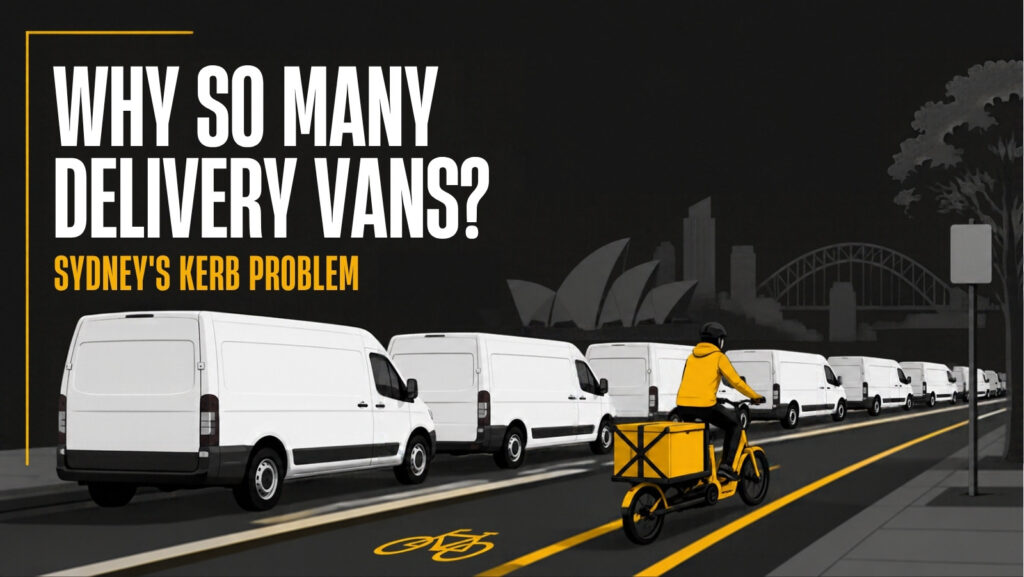
Sydney delivery vans are multiplying because online shopping grew faster than the kerb did. Transport for NSW expects Sydney’s freight task to rise by around 50% by 2036, and the World Economic Forum research TfNSW cites in its own Last Mile Toolkit projects a 78% increase in last-mile deliveries between 2020 and 2030, which works out at roughly 36% more delivery vehicles on the street. Nobody built the loading space, the consolidation depots or the bike lanes to absorb that. So the parcel that could travel the final three kilometres on a cargo bike travels it in two tonnes of metal instead, parked across a lane while the driver walks up three flights of stairs.
That is not a driver problem. Couriers are paid per drop and given nowhere legal to stop. It is a design problem, and Sydney has the tools to fix it sitting unused.
How many more delivery vans is Sydney about to get?
Enough to change how the city feels. The figures in the Transport for NSW Last Mile Toolkit are blunt: last-mile delivery already accounts for more than 50% of total supply chain and logistics costs of getting goods into a city, and the WEF modelling it quotes has urban delivery emissions rising 32% and congestion over 21% by 2030 if nothing changes.
Demand is concentrated, too. TfNSW puts the CBD’s peak delivery window at 9am to midday — the same hours the city most needs its street space for everything else. One case study in the Toolkit records a single CBD street taking 80 bread deliveries a day. And the customer base keeps growing: the City of Sydney had 71,841 registered businesses in 2019, up 14.7% since 2015, on ABS figures.
Stack those together and you get the street you already ride on: a van in the bike lane, a van on the crossing, a van with hazards on in a live traffic lane, and a queue behind it.
Why does a parcel need a two-tonne van for the last three kilometres?
It doesn’t. It needs one because the van that did the 40 km trunk run from the warehouse also does the 3 km of doorsteps at the end. There is no handover point, so the vehicle sized for the motorway ends up crawling through Surry Hills looking for somewhere to stop.
Split the trip and the maths changes completely. A cargo e-bike carries a crate of parcels at the same average speed as a van in congested inner-Sydney traffic, parks in a fraction of the space, and stops directly outside the address instead of 80 metres away. Under NSW rules it is legally a bicycle — Transport for NSW allows e-bikes up to 500 W maximum continuous rated power with motor assistance cutting out at 25 km/h (throttle-only operation must cut out at 6 km/h). From 1 March 2029 that drops to 250 W with EN 15194 certification required. No registration, no licence, no parking space.
What is a microhub, and why does Sydney barely have any?
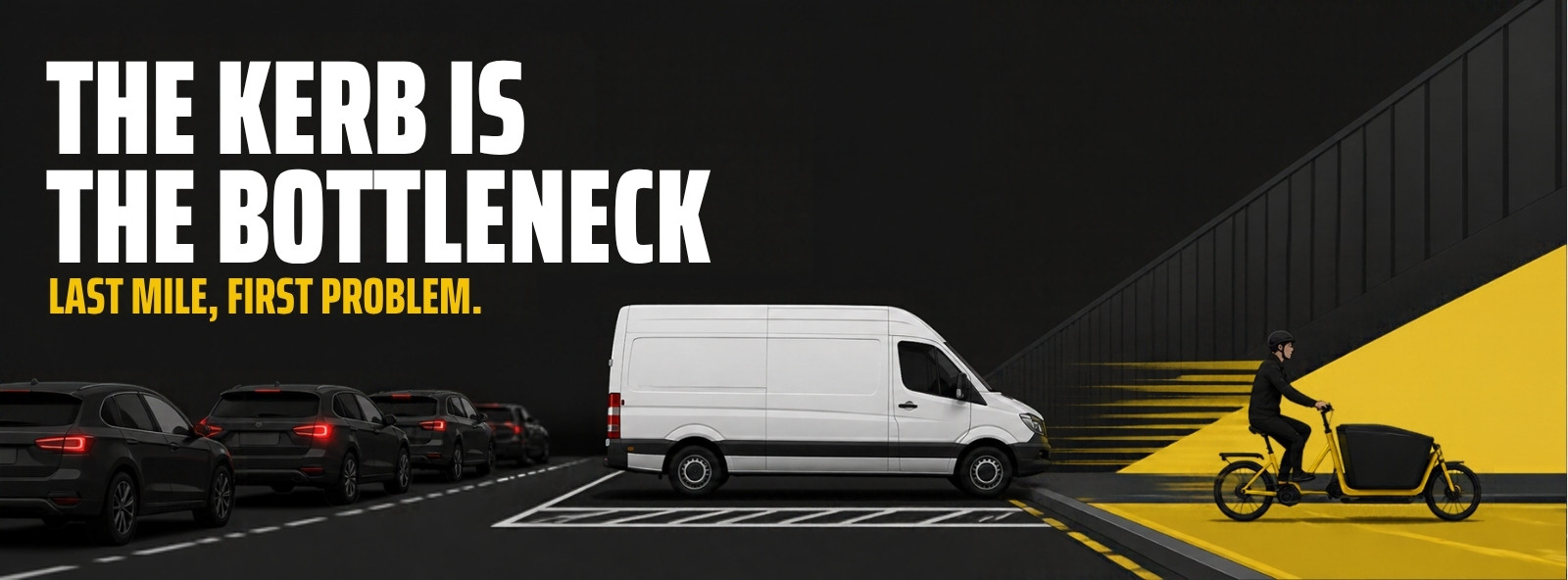
A microhub is the handover point. It is a small space near the customers where a big consolidated vehicle drops goods, which are then delivered the last stretch by cargo bikes, walkers and small low-emission vehicles. Transport for NSW says plainly that this cuts vehicle kilometres travelled and emissions.
Here is the part that should annoy you: Sydney already proved it works. TfNSW has partnered with the City of Sydney since 2016 on a microhub on the CBD fringe, shifting deliveries from vans to cargo bike couriers, and reports it eased congestion and cut emissions. The NSW Department of Planning then passed the Local Distribution Premises legislation in June 2022 specifically to make microhubs easier to build.
Ten years on from the trial, you cannot name a network of them. One demonstration site and an enabling planning instrument is not a policy — it is a pilot that was allowed to stay a pilot. Meanwhile the city kept approving the warehouses, the apartments and the retail that generate the parcels.
Who actually gets Sydney’s kerb space?
Mostly, stationary private cars — and the policy that governs the rest is more revealing than the traffic. The City of Sydney’s Central Sydney On-Street Parking Policy, approved 7 April 2025, sets a priority order for kerb uses. Pick-up and drop-off comes first, then point-to-point transport such as taxis, then business loading and servicing third. Loading zones allow goods vehicles up to 30 minutes.
Read that list again and notice what is missing. There is no category for cargo-bike loading. The policy mentions that the City may add a small number of dedicated on-street bicycle parking spaces, and names no figure. So a business that wants to run deliveries by bike gets a 30-minute van bay or nothing — the cheapest, cleanest, quietest way to move a parcel has no designated place to stop in the most congested square kilometre in Australia.
Street space is finite and it is allocated by decision, not by nature. If you want the longer argument about how that allocation gets made, we wrote it up in who decides how Sydney divides its road space.
What would actually cut the number of vans?
Four things, none of them exotic, all of them already in use somewhere:
- Build the microhub network. The Local Distribution Premises pathway exists. Use it — require a distribution space in large mixed-use developments the way car parking was once required.
- Create a cargo-bike loading category. Add it to the kerb hierarchy with its own short-stay bays, so bike freight is a recognised road user rather than an exception.
- Price the kerb honestly. A 30-minute loading bay in the CBD is enormously valuable public land. Charge accordingly and watch operators find smaller vehicles.
- Finish the separated network. Cargo-bike freight scales only where riders are safe at 20 km/h carrying 80 kg, and that means continuous protected lanes, not paint that ends at the hard part.
None of this is anti-freight. Sydney needs deliveries — the argument is about what size vehicle does the last three kilometres, and right now the answer is set by the absence of alternatives rather than by anyone’s choice.
The same logic holds for your own trips. At Cyberbikes in Leichhardt we spend most of our days fitting people out for exactly this swap — the Centauro runs a Super 250 W rear hub motor, a 48 V 25 Ah (1200 Wh) Samsung lithium-ion battery with UL 2271 certification, full suspension, hydraulic brakes and a welded rear rack, which is enough bike to retire a lot of car trips. If you want the full argument for going car-light, start with our guide to car-free e-bike commuting in Sydney.
Frequently Asked Questions
Are cargo e-bikes legal for commercial delivery in NSW?
Yes. An e-bike that meets the NSW definition is treated as a bicycle, so no registration or licence is required to use it commercially. Transport for NSW currently allows a maximum continuous rated power of 500 W with motor assistance cutting out at 25 km/h, and throttle-only operation cutting out at 6 km/h. From 1 March 2029 the limit becomes 250 W and only EN 15194 certified e-bikes will be allowed on NSW roads. Helmets are mandatory for riders and passengers.
Does Sydney have delivery microhubs now?
Only in a limited way. Transport for NSW has partnered with the City of Sydney since 2016 on a microhub on the fringe of the Sydney CBD, where deliveries are transferred from vans to cargo bike couriers, and it reports reduced congestion and emissions. The NSW Department of Planning passed Local Distribution Premises legislation in June 2022 to support more of them, but Sydney does not yet have a city-wide microhub network.
How much is Sydney’s freight task expected to grow?
Transport for NSW and the Greater Sydney Commission forecast Sydney’s freight task to increase by about 50% by 2036, based on a projected 1.3 million additional residents. The World Economic Forum research cited in the TfNSW Last Mile Toolkit projects a 78% rise in last-mile deliveries between 2020 and 2030, implying roughly 36% more delivery vehicles, a 32% rise in delivery emissions and over 21% more congestion.
If you’re ready to be part of a car-lighter Sydney, come see us at Cyberbikes, 281 Parramatta Road, Leichhardt.
#CyberbikesSydney #eBikeSydney #LastMile #CargoBike #SydneyTraffic #UrbanFreight #Leichhardt #CarFreeSydney #BikeLanes #Micromobility