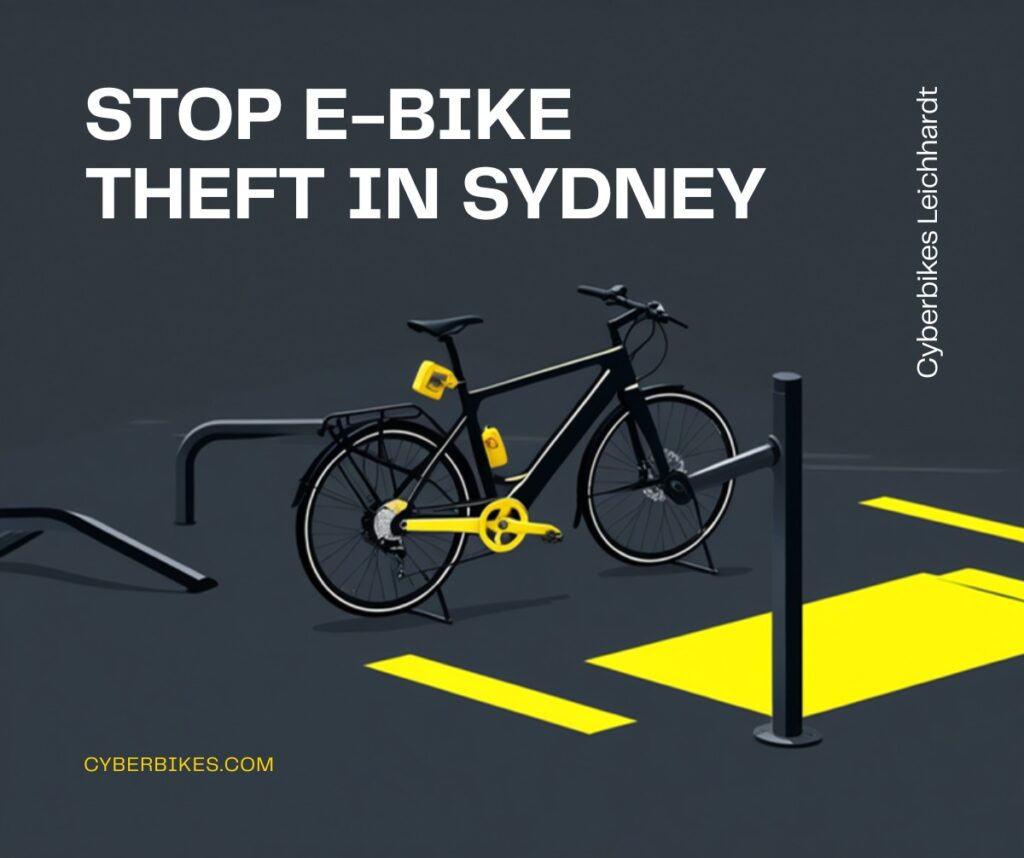
The most effective way to stop e-bike theft in Sydney is to lock the frame and at least one wheel to a permanent, fixed rack with a hardened D-lock — then record the serial number and register the bike so it can be identified if it resurfaces. The lock you choose does most of the work: Bicycle NSW warns that cable locks are “easily cut with bolt cutters”, while D-locks force a thief to bring noisy tools like angle grinders. Everything else — where you park, what you take off the bike, what you have written down — decides whether you get it back.
Which lock actually stops e-bike theft in Sydney?
Treat the lock as the price of entry, not an accessory. Bicycle NSW is blunt about the difference: cable locks are “lightweight and portable” but “easily cut with bolt cutters”, while D-locks (U-locks) are “durable and resistant to cutting” and “require more effort and noisy tools like angle grinders to break”. Noise and time are what actually deter a thief on a public street.
| Lock type | How it fails | Use it for |
|---|---|---|
| Thin cable lock | Cut silently with bolt cutters | Never as your only lock |
| Hardened D-lock / U-lock | Needs an angle grinder — loud and slow | Your main, everyday lock |
| Heavy chain | Needs an angle grinder; heavy to carry | Long stays and overnight |
How should you lock the bike to the rack?
Bicycle NSW’s rule is to “loop the lock through both the frame and at least one wheel”. NSW Government guidance goes further: “carry a good bicycle lock and ensure that you secure the wheels and the frame”, and “always lock your bicycle to a permanent fixture that cannot be manipulated to remove the lock”. A rack that can be unbolted, or a sign post the bike can be lifted over, is not a fixed point. If you are leaving the bike for hours, the official advice is to consider “removing the front and rear wheels and pairing these with the frame”.
What should you take off the bike before you walk away?
NSW Government guidance is to “remove all non-fixed items, such as lights, panniers and pumps”, and to “use bicycle parking facilities when they are available”. On an e-bike there is one more thing worth taking with you: the battery. It is the single most valuable removable part on the bike, and a bike without one is a far less appealing target. The Centauro Long Range we sell at Leichhardt runs a 48V 25Ah (1200Wh) Samsung lithium-ion pack — that is the component you least want to replace.
How do you register an e-bike so it can be recovered?
Recovery depends almost entirely on paperwork you create before the theft. NSW Government guidance says to find the serial number “on the underside of the bicycle frame”, note identifying features like “colour, stickers, engravings and any unique aspect”, and “take a photo of you and your bicycle”. Bicycle NSW recommends BikeVAULT, a free service it calls “one of the most effective ways to recover a stolen bike” — a registered serial number is what lets police and second-hand buyers match a recovered frame back to you.
If the worst happens, report it to NSW Police on the Police Assistance Line, 131 444, with the serial number and your photographs.
Do you have to register an e-bike in NSW by law?
No — and it is worth separating the two ideas. A legal pedal-assist e-bike in NSW is treated as a bicycle: up to 250W of continuous rated power with motor assistance cutting out at 25 km/h. There is no compulsory registration, no number plate and no licence. Voluntary registration of your serial number is a theft-recovery measure, not a legal obligation. The Centauro is built to that standard — its listed specification is a 250W rear hub motor with assistance to 25 km/h — so it stays a bicycle in the eyes of the law while still being worth locking properly.
Does the bike itself make theft harder?
Partly. A bike that is certified, serial-numbered and traceable is harder to resell quietly, and a bike you actually want to look after tends to get locked properly. The Cyberbikes Centauro Long Range lists UL 2849 for the electrical system, UL 2271 for the battery, and ISO 4210 MTB compliance, plus an 18-month limited warranty — documentation that ties a specific frame to a specific owner. It is rated to a 150kg maximum rider and cargo load, with a rear rack rated to 50kg, so it is a genuine commuter and cargo bike rather than something you leave out of sight.
Frequently Asked Questions
Do you need to register an e-bike in NSW?
No. A legal pedal-assist e-bike in NSW, rated to 250W with assistance cutting out at 25 km/h, is treated as a bicycle, so there is no compulsory registration or licence. Voluntary registration is different: recording your frame serial number with a free service such as BikeVAULT gives police and second-hand buyers a way to identify the bike if it is stolen and resold.
What lock is best for an e-bike in Sydney?
A hardened D-lock is the practical minimum. Bicycle NSW notes that cable locks are easily cut with bolt cutters, while D-locks require more effort and noisy tools like angle grinders. Loop the lock through both the frame and at least one wheel, and always attach it to a permanent fixture that cannot be unbolted or lifted over.
What should you do if your e-bike is stolen in Sydney?
Report it to NSW Police on the Police Assistance Line, 131 444, with your serial number, photographs and any distinguishing features. NSW Government guidance recommends recording the serial number from the underside of the frame and photographing yourself with the bike before anything happens, because that record is what makes recovery possible.
Not sure your lock is up to it, or want your serial number recorded properly before summer? Bring the bike into Cyberbikes at 281 Parramatta Road, Leichhardt — we will check how you are locking it and get the details written down while you wait.
#ebikeSydney #ebiketheft #CyberbikesLeichhardt #InnerWestSydney #electricbikeSydney #bikesecurity #CentauroEbike #SydneyCommute