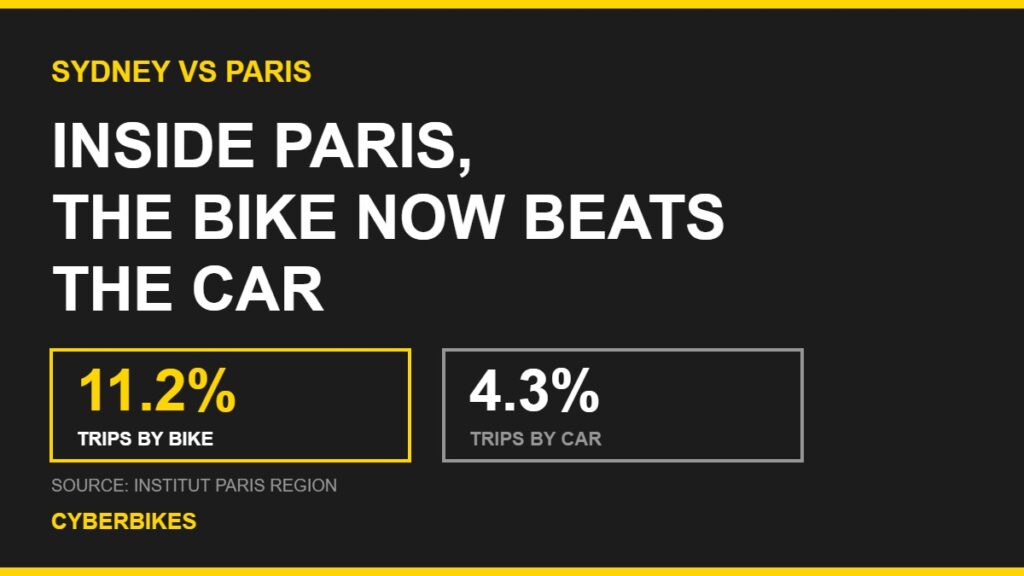
Sydney bike lanes are not losing to Paris because Sydneysiders don’t want to ride. They’re losing because Paris spent about €250 million on a six-year cycling plan and Sydney spends roughly $7 a head. The result is measurable: inside the city of Paris, 11.2% of trips are now made by bike against just 4.3% by car, according to an Institut Paris Région travel survey reported in April 2024. Paris didn’t out-culture us. It out-budgeted us, and then it out-built us.
That gap matters for anyone riding an e-bike out of Leichhardt, Marrickville or Newtown, because the thing stopping most people from swapping a car trip isn’t fitness or weather. It’s a network that keeps ending.
How did Paris end up with more bike trips than car trips?
By treating protected bike lanes as ordinary transport infrastructure rather than a discretionary extra. The City of Paris cycling plan for 2021–2026 commits more than €250 million to 180 km of new protected lanes — 130 km of new routes plus 52 km of pop-up “coronapistes” made permanent — on top of a network that already exceeded 1,000 km. The same plan funds more than 130,000 new bike parking spaces, because a trip you can’t park at the other end is a trip you don’t take.
The previous 2015–2020 plan was €150 million. So Paris didn’t have a single miracle year; it had a decade of compounding budgets. The payoff shows in the numbers: across Paris and its inner suburbs, bike trips have reached 14% against 11.8% by car, and bike lane usage rose 34% between 2020 and 2024, according to counter data analysed by Eco-Counter.
Run the arithmetic per resident and the picture sharpens. Spread €250 million across six years in a city of roughly 2.1 million people, and Paris is investing about €20 per resident per year in cycling.
What is Sydney actually spending on bike lanes?
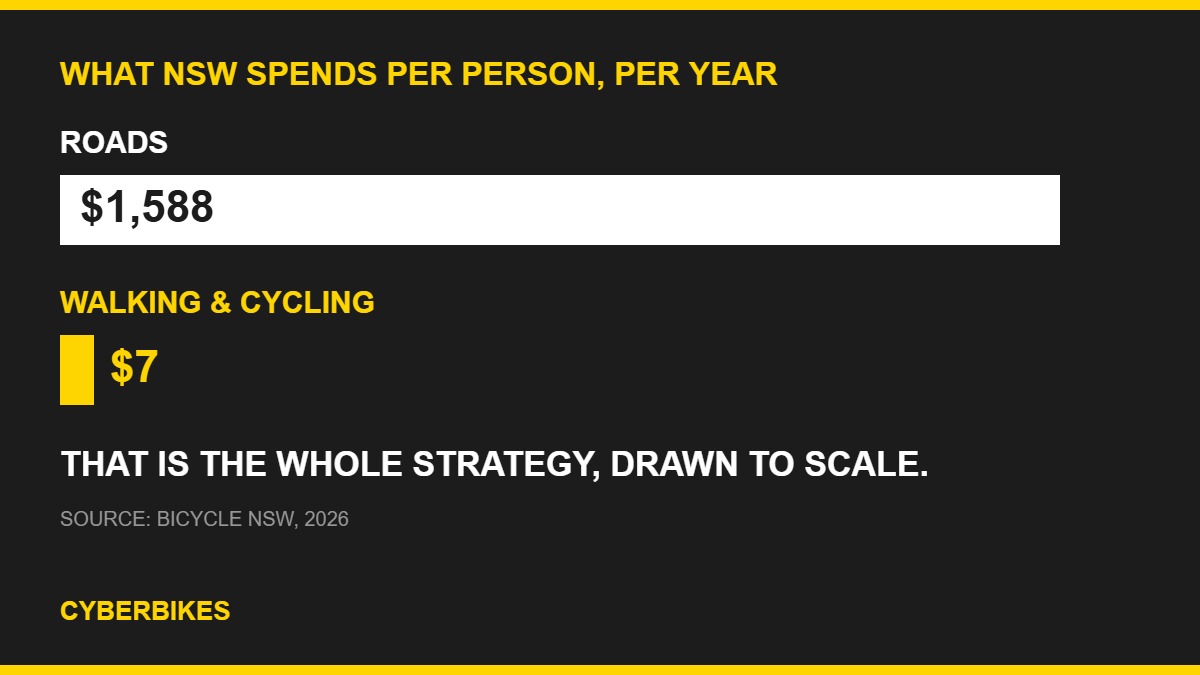
About $7 per person per year. Bicycle NSW puts the Get NSW Active program at $60 million a year, which works out to $7 a head — against $44 billion of public spending on roads nationally in 2023–24, or about $1,588 per person. Better Streets’ read of the NSW 2025–26 budget is blunter still: walking and cycling together came in at under 0.2% of total transport expenditure.
That is not a funding shortfall. It’s a statement of priorities written in dollars. And it makes the demand side of the ledger look remarkable by comparison.
Is anyone actually riding in Sydney?
Yes — and the growth is happening despite the funding, not because of it. The City of Sydney’s March 2025 count recorded 55,030 bike trips across 78 intersections, a record, up 7% on the 51,271 counted in March 2024 and up 187% on the 19,152 counted in March 2010. The Bourke Street cycleway in Surry Hills alone averaged 1,758 trips a day.
Where separated infrastructure appears, riders appear with it. City of Sydney data shows a 36% jump on the Castlereagh Street cycleway within six months of it being extended north to King Street. Build one kilometre of protected lane and the trips show up in a single season. That is the least mysterious finding in transport policy, and it keeps being treated as a surprise.
Why do Sydney bike lanes still feel like a dare?
Because the network is funded as a series of disconnected projects rather than a continuous system. A protected lane that delivers you into a 60 km/h arterial with a painted gutter strip hasn’t made the trip safe; it has moved the scary part further along. We’ve written about why every Sydney bike lane just stops — the short version is that continuity is the product, and we keep buying fragments of it.
Paris’s insight was structural: it reallocated road space on streets that already existed, rather than waiting for spare land to appear. Rue de Rivoli didn’t get wider. It got re-divided. That is the lever Sydney has been least willing to pull, and it is the only one that is genuinely free — we already own the road.
What would the Paris playbook look like on Parramatta Road?
Three things, none of them exotic. First, continuous protected lanes on the corridors people actually travel — the Inner West to the CBD spine, not a loop around a park. Second, secure parking at both ends, which is the unglamorous half of Paris’s 130,000-space commitment. Third, a legal framework that matches the vehicle: in NSW an e-bike may have a maximum 500 W continuous rated power with assistance cutting out at 25 km/h and throttle-only power ending at 6 km/h, with EN 15194 certification becoming mandatory from 1 March 2029. Those are sensible, modest limits. The problem was never the bikes.
For riders, the practical answer is that the 25 km/h assisted trip already beats the car for most Inner West journeys — which is exactly the argument we lay out in our complete guide to car-free commuting and rent-to-own in Sydney. Our own Centauro is built to those NSW rules: a 250 W rear hub motor, assistance to 25 km/h, throttle to 6 km/h, a 48V 25Ah (1200 Wh) Samsung battery, and EN 15194, UL 2849, UL 2271 and ISO 4210 certification, with a 150 kg rider-and-cargo limit. Legal, certified, and capable of carrying the shopping — the vehicle is ready. The lane is the missing part.
Frequently Asked Questions
Does Paris really have more bike trips than car trips?
Inside the city of Paris, yes. An Institut Paris Région travel survey reported in April 2024 found 11.2% of trips within Paris were made by bike against 4.3% by car. Across Paris and its inner suburbs the figures were 14% by bike and 11.8% by car. The comparison covers trips within the area, not trips into Paris from the wider region.
How much does NSW spend on cycling compared with roads?
Bicycle NSW puts the Get NSW Active program at $60 million a year, about $7 per person, against roughly $1,588 per person spent on roads across Australia in 2023–24. Better Streets’ analysis of the NSW 2025–26 budget found walking and cycling combined made up less than 0.2% of total transport expenditure.
Is cycling in Sydney actually growing?
Yes. The City of Sydney’s March 2025 count recorded a record 55,030 bike trips across 78 intersections, up 7% on March 2024 and up 187% on March 2010. Counts rise sharply wherever separated cycleways are extended — the Castlereagh Street cycleway saw a 36% increase within six months of its northern extension.
Paris proves the ceiling isn’t cultural. It’s budgetary, and it’s a choice that gets remade every year. If you’re ready to be part of a car-lighter Sydney, come see us at Cyberbikes, 281 Parramatta Road, Leichhardt.
#EbikeSydney #CyberBikes #SydneyCycling #BikeLanes #ParisCycling #CarFreeSydney #InnerWest #Leichhardt #ActiveTransport #UrbanPlanning