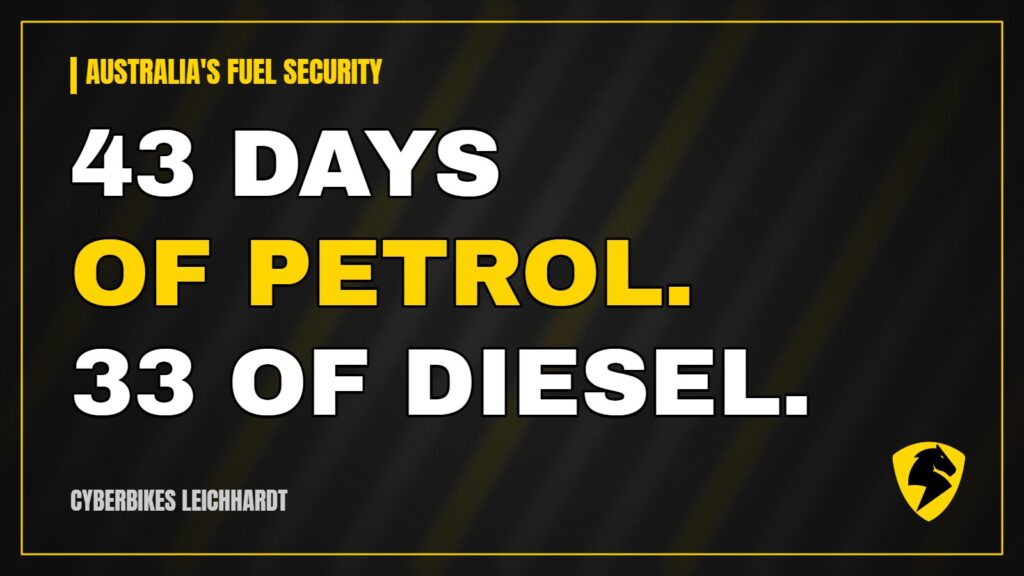
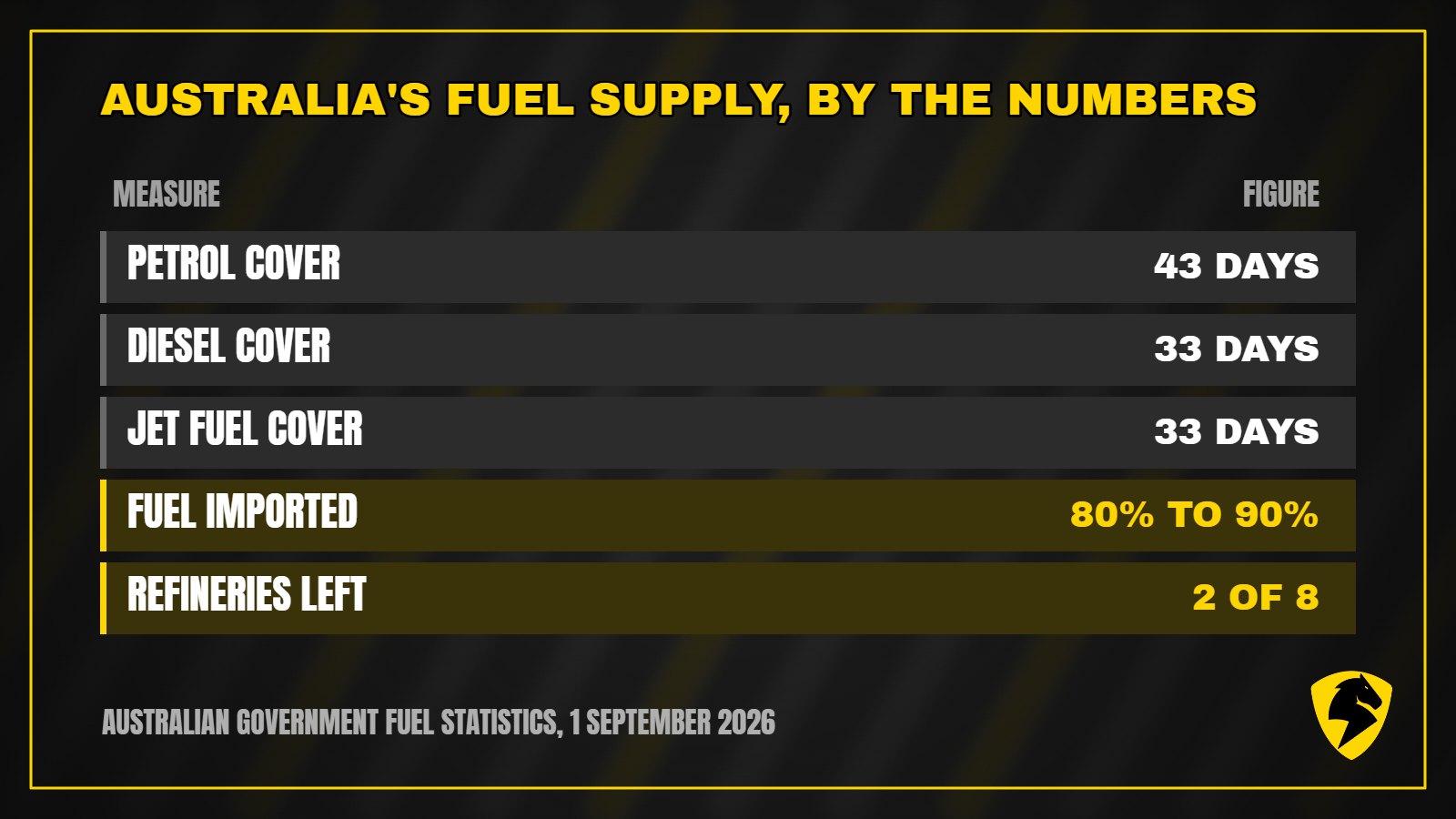
As at 1 September 2026, Australia held 43 days of petrol, 33 days of diesel and 33 days of jet fuel. That is the whole of Australia’s fuel security, and those numbers are not stock sitting safely in tanks at Botany. They include fuel still floating on ships that have not arrived yet.
Meanwhile, in Havana, people are getting to work on electric tricycles with solar panels bolted to the roof. It looks improvised because it is. It is also the single clearest picture available of what a country does when the tankers stop coming, and Australia should be studying it rather than smiling at it.
What did Cuba just show the rest of us?
Cuba produces only about 40 per cent of the fuel it needs. When United States sanctions tightened, tanker arrivals collapsed from roughly eight a month to a single ship in late March, according to reporting from Havana by the Associated Press. Blackouts now run up to 12 hours a day, and black market petrol has reached about five US dollars a litre, Gulf News reports.
What filled the gap was not a government programme. It was electric tricycles. They cost between 2,000 and 4,000 US dollars, run on gel or lithium batteries, and an owner can add a solar panel for around 500 dollars so the vehicle charges itself when the grid is down. The AP describes them as the primary means of transport for hundreds of thousands of people. Reuters found the same thing, quoting one operator: “We make 16 trips a day. There is no fuel. This is the only means of transportation supporting this area.”
Note what the solar panel is actually doing. It is not there to save the planet. It is there because a vehicle that makes its own energy cannot be cut off by a shipping lane.
How exposed is Australia’s fuel security right now?
Uncomfortably. Australia imports around 80 to 90 per cent of its liquid fuel. Two refineries are left, Viva Energy at Geelong and Ampol at Lytton in Brisbane, down from eight in 2005, and between them they cover roughly 20 per cent of national supply. Everything else comes by sea.
The origin list matters as much as the volume. Petrol arrives mostly from Singapore (54.7%), South Korea (22.5%), India (11.5%) and Malaysia (10%); diesel from South Korea (28.8%), Singapore (15.4%), Malaysia (14.4%) and Taiwan (12%). Those routes funnel through the same handful of straits, and roughly one fifth of the world’s seaborne oil and LNG passes through the Strait of Hormuz alone.
Who gets hit first if the tankers stop?
Not the people you would expect. Dr Lurion De Mello of Macquarie Business School puts the problem plainly: “Australia’s risk is strategic, not geological. We do not lack access to oil. We lack secure access to ships.” He also makes the point that matters most about the headline number: “When the government says we have 39 days of petrol, that includes fuel already on tankers heading towards Australia.”
The order of impact runs agriculture first, then emergency services, freight, and regional areas where rationing starts earliest. Long before any of that becomes a crisis, the ordinary commuter feels it as price, because a market that is 90 per cent imported prices like one.
This is a policy failure, not a personal one. Nobody driving to Homebush chose a national fuel supply chain. Decades of planning built a city where the school run, the shopping trip and the commute all need imported liquid fuel, then left the question of where it comes from to somebody else. The fix is not to lecture drivers. It is to give the short trip an alternative that does not need a tanker.
Is Pakistan the closer warning for Australia?
Probably, because Pakistan is not under embargo. It simply got expensive. After an 18 per cent hike petrol reached 458 rupees a litre, and a median-wage household now spends 31 per cent of its daily income on a single litre. The country did not wait for a plan.
Electric two-wheelers went from 90,000 units and 5 per cent of the two-wheeler market last year to more than 10 per cent of monthly sales, Reuters reported. The government’s PAVE scheme, which subsidises a fifth of the purchase price and lends the rest interest free, drew about 270,000 applications, nearly seven times its first-phase target. One retailer explained the rush in a sentence Australians should sit with: “People have this fear that maybe in the near future, they might not get petrol at all.”
Sri Lanka did it faster in 2022, when the fuel crisis pushed large numbers of Colombo commuters onto bicycles. In all three countries the pattern is identical: the switch happens anyway. It just happens under duress, badly, and at the worst possible price.
What actually makes a Sydney trip fuel-proof?
Energy, and the honest arithmetic of it. A full charge of a 48V 25Ah e-bike battery is 1,200 watt-hours, or 1.2 kWh. Petrol carries roughly 9.7 kWh of chemical energy per litre, so one 60 litre tank holds about 580 kWh. That single tank is the energy equivalent of roughly 485 full e-bike charges.
The e-bike is not slightly more efficient. It is in a different category, because it moves 30 kilograms instead of 1,800. And 1.2 kWh is a quantity one rooftop panel can produce. No Australian household is going to refine its own diesel, but charging a bike off its own roof is entirely ordinary, which is precisely what Havana worked out the hard way.
The Cyberbikes Centauro cargo and commuter e-bike is built to that spec: a 250W rear hub motor, a 48V 25Ah (1200Wh) Samsung battery certified to UL 2271, an ISO 4210 frame, a UL 2849 electrical system and a 150kg rider and cargo rating. That last number is the one that matters in a fuel shock, because it is the difference between a bike and a bike that replaces the second car. For the full picture we keep a running guide to car-free commuting in Sydney and a breakdown of what owning a car in Sydney really costs.
So what should Sydney actually do?
Build the reserve, by all means. But a reserve buys days, and it buys them once. The only thing that permanently reduces exposure is cutting the number of daily trips that need imported liquid fuel at all, and the cheapest trips to convert are the short ones. They are not a lifestyle problem. They are the national fuel stockpile being burned two kilometres at a time.
Which makes protected bike lanes a fuel security measure, not a nice-to-have. Every separated kilometre is a trip that a tanker no longer has to supply. Cuba is doing this with no grid, no subsidy and no plan. Australia has a grid, the best solar resource of any developed country and 43 days of notice. It would be an unusual kind of failure to be out-prepared by an island running on 12-hour blackouts.
Where these numbers come from
Days of cover: the Australian Government’s official fuel statistics, as at 1 September 2026. Import share, refinery count and country-of-origin breakdown: the NRMA’s fuel supply chain explainer. Strait of Hormuz share and the quotes from Dr De Mello: Macquarie University. Pump prices are tracked by the Australian Institute of Petroleum. Fuel figures move; check them before you quote them.
Frequently Asked Questions
How many days of fuel does Australia have?
As at 1 September 2026 the Australian Government’s fuel statistics reported 43 days of petrol, 33 days of diesel and 33 days of jet fuel in consumption cover. Those figures include fuel already on tankers bound for Australia, not just fuel sitting in storage on shore.
How much of Australia’s fuel is imported?
Around 80 to 90 per cent. Two refineries remain in operation, Viva Energy’s Geelong plant and Ampol’s Lytton refinery in Brisbane, down from eight in 2005, and together they cover roughly 20 per cent of national supply. Most petrol arrives from Singapore, South Korea, India and Malaysia; most diesel from South Korea, Singapore, Malaysia and Taiwan.
Can an e-bike really replace car trips in a fuel shortage?
For short trips, yes. A full charge of a 48V 25Ah e-bike battery is 1.2 kWh of electricity, which can come from the grid or from a rooftop solar panel. Petrol holds roughly 9.7 kWh per litre, so a single 60 litre tank carries about 580 kWh, the energy equivalent of roughly 485 full e-bike charges. The e-bike does far more with far less, and none of it has to arrive by ship.
Swap one car trip a week for an e-bike ride and see what changes. We are at Cyberbikes, 281 Parramatta Road, Leichhardt.
#fuelsecurity #ebikesydney #energysecurity #Leichhardt #InnerWest #Cuba #Pakistan #micromobility #carfreesydney #cyberbikes