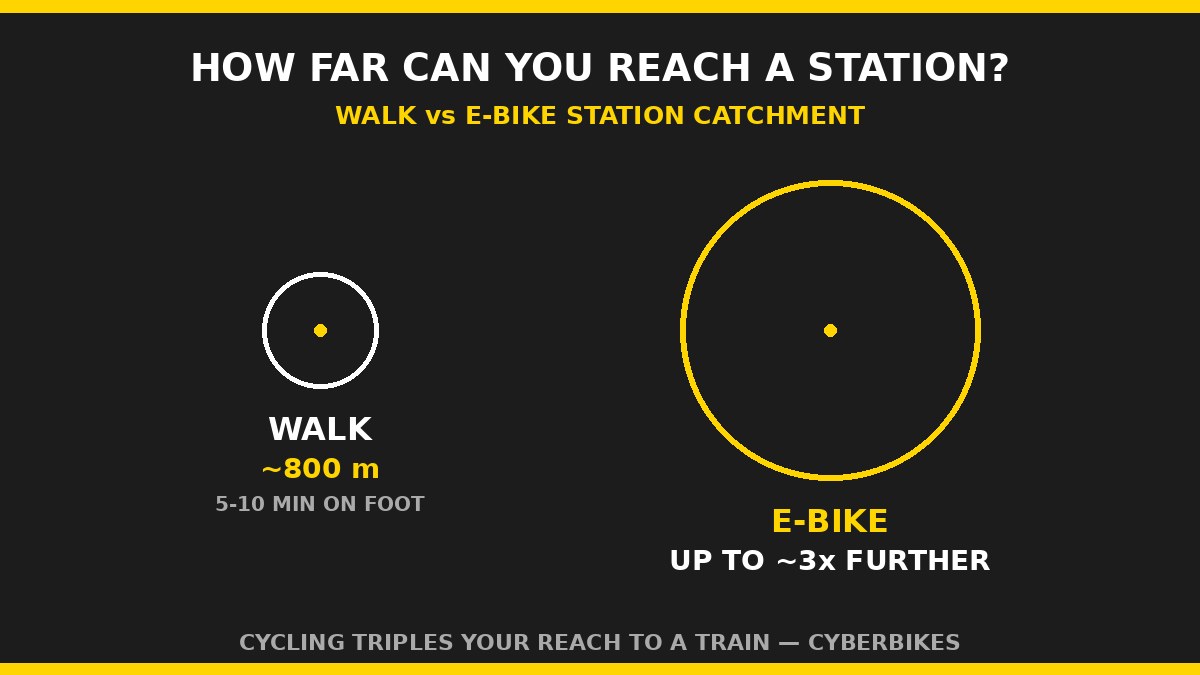
Yes — for most Sydneysiders, the last mile is the real reason they still drive. Sydney’s trains and metro are genuinely good, but a station only helps if you can reach it. The short gap between your front door and the platform — the “last mile” — is what keeps a car in the driveway, and an e-bike closes it by extending how far you can comfortably reach a station roughly threefold compared with walking.
What is Sydney’s last-mile problem?
The last mile is the short first-and-final leg of every public-transport trip: home to station, then station to work. Transport planners size a station’s walking catchment at roughly 400 to 800 metres — a five-to-ten-minute walk — because beyond that, most people simply won’t walk. The behaviour bears this out: around 79% of walking trips to Sydney rail stations are one kilometre or less. Live outside that ring and the train stops feeling convenient, so people drive the whole way instead — even though a large share of Sydney commutes are under five kilometres. Multiply that across a metropolis and you get the congestion that, on Bureau of Infrastructure and Transport Research Economics figures, costs Sydney billions of dollars a year in lost time.
How much further can an e-bike get you to a station?
About three times further. Research on bicycle–transit integration finds that cycling extends transit access roughly threefold compared with walking — turning a single station’s modest walking circle into a catchment several times larger. An e-bike matters more than a regular bike here because pedal assist erases the two things that stop Sydneysiders riding: hills and heat. You reach the platform in minutes, not sweaty and not out of breath, then roll onto the same train you would have caught anyway. It is the cheapest, fastest way to widen a station’s reach without laying a metre of new track — the core idea behind our complete guide to car-free commuting in Sydney.
Is a last-mile e-bike legal in NSW?
Yes. In New South Wales, a road-legal e-bike is a pedal-assist bike (a “pedelec”) whose motor helps only while you pedal and cuts out at 25 km/h. It needs no licence, no registration and no insurance, and you can ride it in bike lanes, on shared paths and park it at a station bike rack. That legal status is the whole point of bike-and-ride: your last-mile vehicle carries none of a car’s overheads, yet covers ground a walk never could.
Bike-and-ride vs park-and-ride: which actually works for Sydney?
Park-and-ride sounds tidy, but it does not scale. A single car parking space takes up around 25 square metres and costs thousands to build, and most Sydney station car parks fill well before 8am — so the “fix” runs out of room exactly when demand peaks. Bike-and-ride flips the maths: several bikes fit in one car bay, the vehicle adds no congestion, and it costs a few cents of electricity to run.
| Last-mile option | Space per commuter | Congestion added | Running cost |
|---|---|---|---|
| Park-and-ride (car) | ~25 m² parking bay | Adds a car trip | Fuel, rego, parking |
| Bike-and-ride (e-bike) | A few m² of rack | None | Cents of electricity |
On the numbers, it is not close — which is also why an e-bike beats a car for most Sydney commutes once you factor in time, cost and parking.
What makes an e-bike practical for the Sydney last mile?
A last-mile bike has to be easy to hop on, tough enough for daily use, and able to carry more than just you. The Cyberbikes Centauro, built and serviced at our Leichhardt shop, is designed for exactly that: a step-through full-suspension frame you can mount in work clothes, a 250W rear hub motor, and a 48V 25Ah (1,200Wh) Samsung battery — UL 2271-certified — so a full week of station runs does not leave you charging every night. A rear rack welded to the frame and rated to 50 kg handles the shopping on the way home, and integrated GPS tracking keeps it secure at the rack. At $3,999.99 outright, or rent-to-own from $99.99 a week, it costs a fraction of running a second car just to reach the train.
Frequently Asked Questions
How far will people cycle to a train station?
Most people comfortably ride three to five kilometres to a station, versus the roughly 800 metres most will walk — about three times the reach. An e-bike widens that further by making hills and heat a non-issue.
Is bike-and-ride better than driving to the station?
For space and cost, yes. A bike needs a fraction of a car parking space and adds no congestion, and unlike Sydney’s station car parks — which routinely fill before 8am — a bike rack rarely runs out of room.
Do you need a licence for a last-mile e-bike in NSW?
No. A road-legal pedal-assist e-bike that cuts motor assistance at 25 km/h needs no licence, registration or insurance in NSW, and can use bike lanes and shared paths.
Swap one park-and-ride for a bike-and-ride this week and see how much shorter your commute really feels. If you are curious what going car-light would look like for you, come and see us at Cyberbikes, 281 Parramatta Road, Leichhardt — the Centauro is a good place to start.
#Cyberbikes #ebikeSydney #LastMile #BikeAndRide #CarFreeSydney #Leichhardt #Centauro #SustainableTransport