
Yes — a superblock could work in Sydney’s Inner West, and the evidence says it would pay off. A superblock is a cluster of streets where through-traffic is filtered out so local roads become calm, low-speed places to walk and ride. Trials in Barcelona and London have cut air pollution, crashes and car trips while keeping every home reachable by car. Given the Inner West already runs 40 km/h local limits and is fighting rat-runs, it is one of the most superblock-ready places in Australia.
What exactly is a superblock?
Coined in Barcelona (superilla), a superblock takes roughly nine city blocks and diverts through-traffic to the perimeter roads. Inside, streets stay open to residents, deliveries and emergency vehicles, but drivers can no longer use them as a shortcut. The reclaimed road space becomes footpaths, greenery, seating and safe riding room. In the UK the same concept is called a low-traffic neighbourhood, or LTN — a name Sydneysiders will hear more often as councils borrow the playbook.
The point isn’t to ban cars. It’s to stop a quiet residential street from carrying thousands of vehicles a day that were only ever passing through.
What does the evidence actually show?
This is where superblocks stop being a nice idea and become measurable. Barcelona’s health institute, ISGlobal, modelled the city’s full 503-superblock plan and estimated it could prevent about 667 premature deaths a year, cut nitrogen-dioxide air pollution by around 24%, and add roughly 200 days of life expectancy per resident (published in Environment International, 2019). Most of that benefit comes from cleaner air, quieter streets and cooler temperatures.
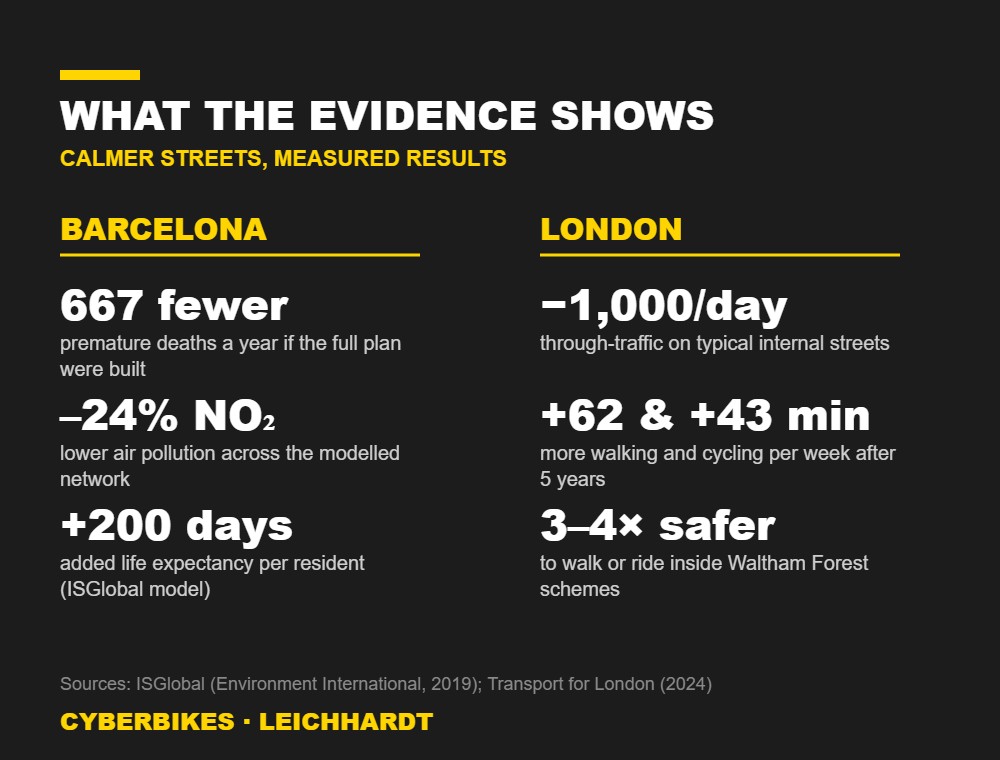
London’s rollout gives us the real-world before-and-after. Transport for London’s 2024 evidence review found typical internal streets dropped to well under 1,000 vehicles a day, and after five years outer-London residents were walking 62 minutes and cycling 43 minutes more each week. In Waltham Forest, streets became three to four times safer to walk or ride, car ownership fell about 6%, and — tellingly — there was no lasting jam on the boundary roads.
Would it work in Sydney’s Inner West?
The groundwork is already here. Inner West Council has cut many local streets to 40 km/h and is trialling traffic-calming to stop rat-running through residential blocks, exactly the problem superblocks are built to solve. NSW’s Movement and Place framework — the state’s own planning guidance — says local streets should prioritise people over through-traffic. A tight grid of terraces around Leichhardt, Annandale, Marrickville or Dulwich Hill is close to the Barcelona template: short blocks, mixed shops and homes, and plenty of trips under three kilometres that don’t need a car at all. Modest filters at a few corners could turn those into calm neighbourhoods without walling anyone in. It’s the natural next step beyond simply dropping local street speed limits to 30 km/h.
Where do e-bikes fit in?
Superblocks and e-bikes are made for each other. Once a street is calm and low-speed, the biggest barrier to cycling — fast traffic — disappears, and the hills and distances that put Sydneysiders off pedalling stop mattering because the motor does the work. That’s the whole argument in our car-free e-bike commuting and rent-to-own guide: better streets plus electric assist is what actually shifts people out of cars. A cargo-capable commuter like the Cyberbikes Centauro — 48V 25Ah Samsung battery, a UL 2271-certified pack and a 150 kg rider-plus-cargo rating — can carry the shopping or a kid without ever touching a boundary road. Ride one out of our Leichhardt shop and you’re already on some of the Inner West’s calmest streets.
Are these streets legal and safe to ride?
Completely. In NSW a legal e-bike is a power-assisted pedal cycle capped at 250W that cuts motor assistance at 25 km/h, with a throttle limited to 6 km/h — no registration, licence or insurance required, and a helmet is mandatory. Calmer streets make that safer still, but the courtesies don’t change: keep left, use a bell near people, and ease off around walkers, kids and dogs. Superblocks lower the speed of cars, not the responsibility of everyone sharing the space.
Frequently Asked Questions
What is a superblock?
A superblock is a cluster of about nine city blocks where through-traffic is filtered out, so the internal streets become low-speed spaces for walking, playing and cycling. Cars can still reach every address, but they can no longer cut through. It is the same idea as a London-style low-traffic neighbourhood.
Do superblocks just push traffic onto surrounding roads?
Some traffic shifts to boundary roads at first, but London’s evidence shows overall driving falls over time as people swap short car trips for walking, cycling and public transport. Waltham Forest residents cut car ownership by about 6% between 2015 and 2019.
Are e-bikes legal to ride on Inner West streets?
Yes. In NSW a power-assisted pedal cycle is capped at 250W and cuts assistance at 25 km/h, needs no registration or licence, and a helmet is mandatory. That makes an e-bike a legal, practical way to make the most of calmer local streets.
A car-lighter Inner West isn’t a fantasy — it’s a filter at a few corners and a better way to make short trips. If you’re ready to be part of that shift, come see us at Cyberbikes, 281 Parramatta Road, Leichhardt, and take a Centauro for a ride.
#Cyberbikes #Leichhardt #InnerWest #Superblock #LowTrafficNeighbourhood #eBikeSydney #CarFreeSydney #UrbanPlanning #Centauro