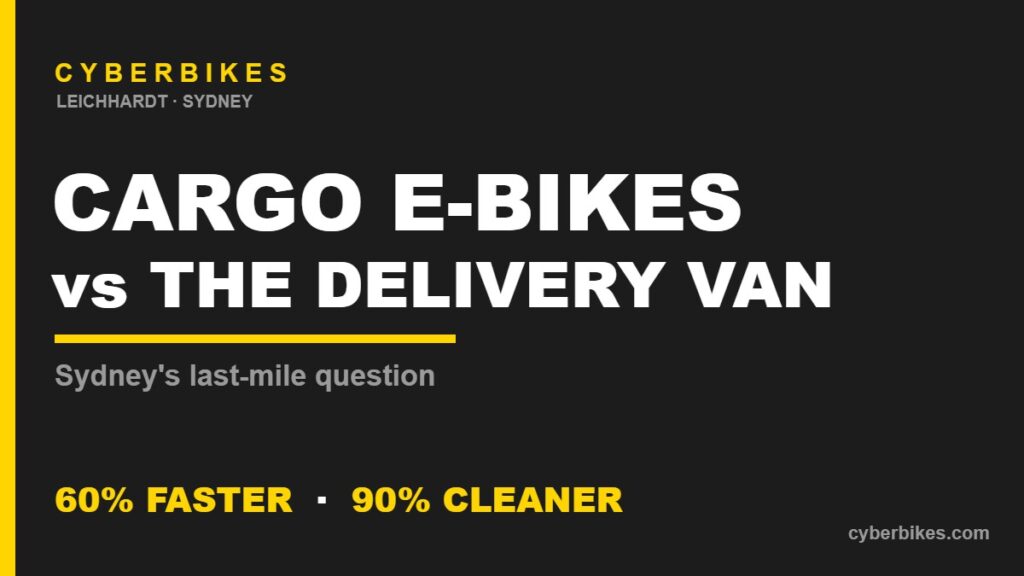
Yes — across dense inner Sydney, cargo e-bikes can realistically replace a large share of delivery-van trips. European research from the CycleLogistics project estimated that around half of all motorised freight trips in cities could shift to bikes and cargo bikes, and London GPS data shows electric cargo bikes deliver roughly 60% faster than vans in the city centre while producing about 90% fewer emissions. For the last few kilometres of a parcel’s journey — exactly where Sydney’s streets are most clogged — a cargo e-bike often beats a van outright.
That last-mile leg is the expensive, polluting, congestion-making part of every online order. And in a city that is stacking up more deliveries every year, it is also the part a bike is best placed to fix. Here is what the evidence says, and what it would take to work on Parramatta Road rather than in a research paper.
Why are Sydney’s streets filling up with delivery vans?
Because we are ordering more than ever. Australia Post’s 2025 eCommerce Report found 9.8 million households shopped online, spending a record $69 billion — up 12% year on year, and the network processed a record 5.8 million parcels in a single day over the Black Friday weekend. Every one of those parcels ends its trip on a vehicle, and most of them on a van.
The freight task behind that is growing fast. Transport for NSW forecasts the Greater Sydney freight task to increase by almost 50% by 2036, part of a statewide jump from 480 million tonnes in 2016 to a projected 618 million tonnes. The vehicles doing the hauling have multiplied too: Australia’s diesel fleet — which includes most vans and light trucks — has more than tripled since 2008 to over 6 million vehicles, according to the Bureau of Infrastructure and Transport Research Economics. More vans, circling for kerb space and double-parking in bike and bus lanes, is not a plan. It is what happens when nobody chooses one.
Are cargo e-bikes really faster than vans?
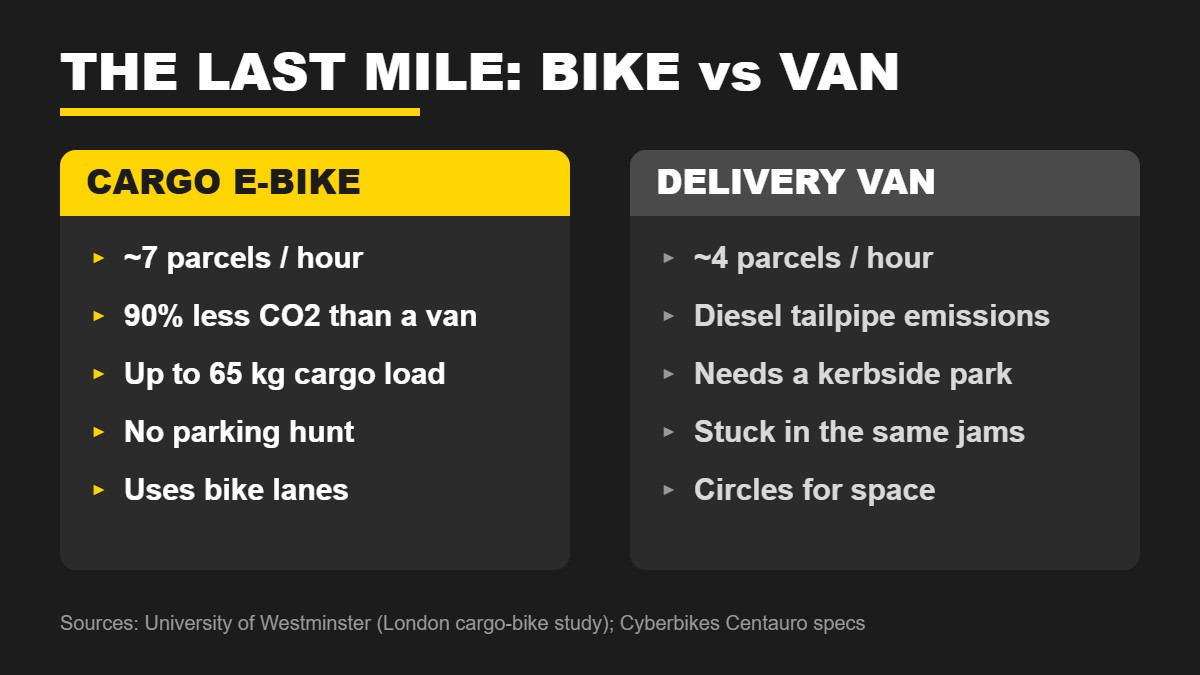
In city centres, yes. A University of Westminster study tracked a fleet of 55 electric cargo bikes run by London operator Pedal Me and found they made deliveries about 60% faster than vans — completing nearly seven drops an hour against four for a van, or roughly 1.6 times the productivity. The reason is simple: a van’s top speed is irrelevant in stop-start inner-city traffic. What actually eats the clock is hunting for a park, walking the parcel from a distant kerb, and sitting in the same congestion everyone else is stuck in.
A cargo bike skips most of that. It rolls up to the door, uses bike lanes and quiet back streets, and parks in a fraction of the space. Over a dense delivery round of many short hops — the shape of most inner-Sydney runs — those saved minutes compound into a genuine speed advantage.
How much cleaner and quieter are they?
Dramatically. The same Westminster research measured about 90% lower carbon emissions from cargo bikes than diesel vans — and they came out cleaner even than electric vans, once you count the energy and materials in a two-tonne vehicle. The researchers estimated that shifting just 10% of van-kilometres to cargo bikes in London could cut around 133,300 tonnes of CO2 a year.
The benefits are not only climate ones. A cargo bike takes up a fraction of the road and kerb space, so it eases the congestion that vans create rather than adding to it. It has no tailpipe pumping fumes past footpaths, cafés and school gates, and it is near-silent. In a city where transport is one of the fastest-growing sources of emissions, swapping the last mile is some of the easiest carbon we could cut.
Could cargo e-bikes actually work for Sydney businesses?
The inner city is close to a best-case scenario for it. Suburbs like the CBD, Leichhardt, Newtown and Surry Hills have the density, the short trip distances and a growing network of separated bike lanes that cargo logistics thrives on. The law is friendly, too: in NSW a compliant e-bike needs no licence, no registration and no insurance, with motor assistance cutting out at 25 km/h, and it is allowed on bike paths and in bike lanes — Transport for NSW sets out the rules.
The load capacity is there as well. The Cyberbikes Centauro, which we build and service at our Leichhardt shop, carries up to 50 kg on a rear rack welded straight to the frame, plus an optional 15 kg front basket, for a total rider-and-cargo rating of 150 kg. A 250W motor and a 48V 25Ah (1200Wh) Samsung battery give it the range to run a full delivery round on one charge. That is enough for a café’s morning supply run, a florist’s deliveries or a courier’s parcels — hauled without a van, a fuel bill or a parking fine. If you want the bigger picture on ditching four wheels for two, our complete guide to car-free e-bike commuting and rent-to-own in Sydney walks through the numbers.
None of this makes vans vanish overnight — heavy or bulky freight will always need them. But for the millions of small, local parcels criss-crossing inner Sydney every day, the cargo e-bike is the faster, cleaner, cheaper tool. The technology is proven. What is missing is the decision to use it.
Frequently Asked Questions
Can you really fit enough cargo on an e-bike?
More than most people expect. A purpose-built cargo e-bike like the Centauro carries up to 50 kg on its welded rear rack plus 15 kg in an optional front basket, within a 150 kg total rider-and-cargo rating — comfortably enough for parcels, groceries, tools or a trade’s daily kit. Heavy pallet freight still needs a truck, but the typical inner-city delivery is small and light.
Are cargo e-bikes legal for deliveries in NSW?
Yes. A compliant e-bike in NSW needs no licence, registration or insurance, and its motor assistance must cut out at 25 km/h. It can use bike lanes and shared paths just like any bicycle, which is a large part of why it moves so well through congested streets. Transport for NSW publishes the full requirements.
Are cargo bikes actually faster than vans in real traffic?
In dense city centres, yes. A University of Westminster study of a London cargo-bike fleet found deliveries were about 60% faster than by van, because bikes avoid the parking search and kerbside delays that slow vans in heavy traffic. On open motorways a van wins — but the last mile is not a motorway.
Sydney’s last-mile problem is really a road-space problem — and the fix is already parked in our Leichhardt showroom. Swap one van run for a cargo e-bike ride and see what changes. Come talk to us at Cyberbikes, 281 Parramatta Road, Leichhardt, or take the Centauro for a spin.
#Cyberbikes #CargoEbike #Centauro #EbikeSydney #Leichhardt #LastMile #CarFreeSydney #SustainableDelivery #UrbanFreight