E-bikes are legal across Australia — including NSW — as long as they meet the rules for a power-assisted bicycle: no licence, no registration and no insurance required. The catch is the fine print on power and speed, and NSW is currently a little different from the national standard. This guide breaks down exactly what’s legal to ride in 2026, what’s changing in 2029, and how to make sure the e-bike you buy in Sydney keeps you on the right side of the law.
What this guide covers
- Are e-bikes legal in Australia?
- The two legal e-bike categories in Australia
- E-bike laws in NSW: the current rules
- Do you need a licence or registration?
- How fast can an e-bike legally go?
- Pedelec vs throttle: what’s the difference?
- Is a 500W e-bike legal in NSW?
- What’s changing in 2029?
- What makes an e-bike illegal — and what happens?
- Where can you legally ride an e-bike?
- Helmets, footpaths and age rules
- Do e-bikes need insurance?
- How to check an e-bike is road-legal before you buy
- Are Cyberbikes’ e-bikes legal?
- The best road-legal e-bike in Sydney
- E-bike laws by Australian state (quick reference)
- Can you modify or derestrict an e-bike?
- E-bike vs e-scooter: why the rules differ
- E-bike rules for food-delivery riders
- Do the same laws apply to cargo e-bikes and carrying kids?
- Frequently asked questions
Are e-bikes legal in Australia?
Yes — e-bikes are legal in every state and territory, provided they meet the national definition of a power-assisted pedal cycle. When a bike fits that definition, the law treats it exactly like an ordinary bicycle: you can ride it on roads, in bike lanes and on shared paths without a licence, registration or insurance. The only reason e-bikes ever land riders in trouble is when the bike is more powerful or faster than the law allows, at which point it stops being a “bicycle” and becomes an unregistered motor vehicle. That distinction is the single most important thing to understand before you buy.
The two legal e-bike categories in Australia
Nationally, there are two types of e-bike that count as bicycles:
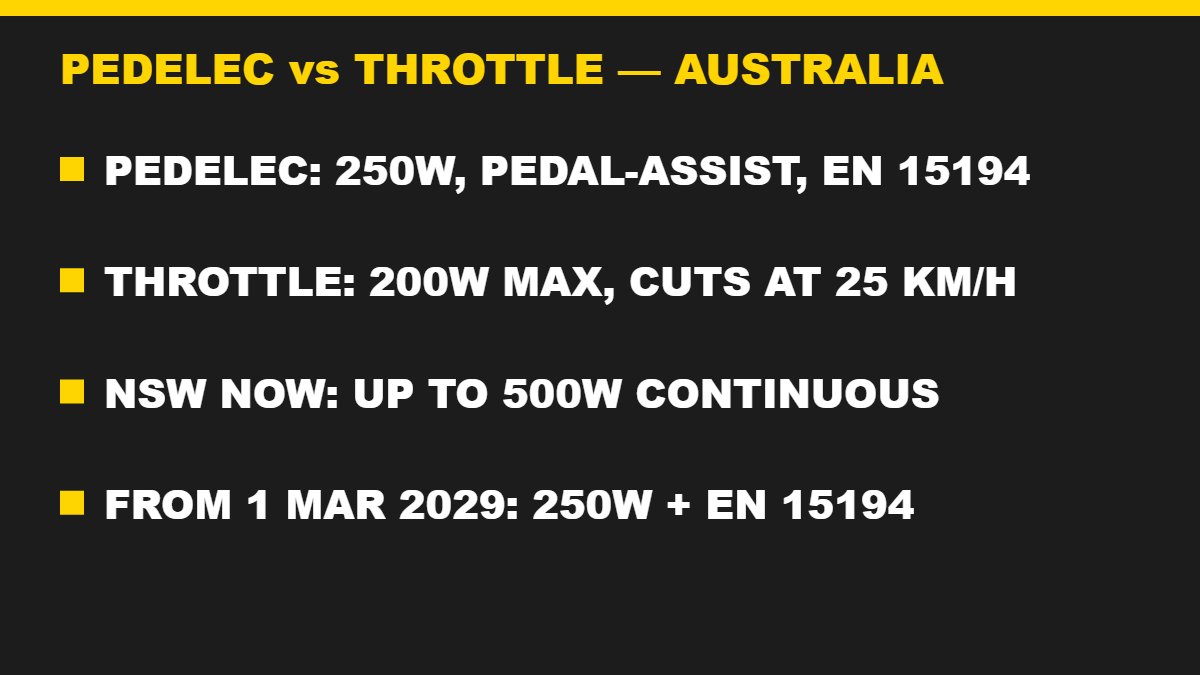
| Category | Max motor power | How the motor works | Speed cut-off |
|---|---|---|---|
| Pedelec (EPAC) | 250W continuous | Pedal-assist only — motor helps while you pedal | 25 km/h |
| Throttle-assisted | 200W max | Throttle can work without pedalling | 25 km/h |
The pedelec is the standard most quality e-bikes are built to, and it must be certified to European Standard EN 15194 — the safety benchmark the Federal Government recognises for imported e-bikes. The 200W throttle category is older and more limited; anything with a throttle that keeps driving you along above walking pace with a bigger motor falls outside it.
E-bike laws in NSW: the current rules
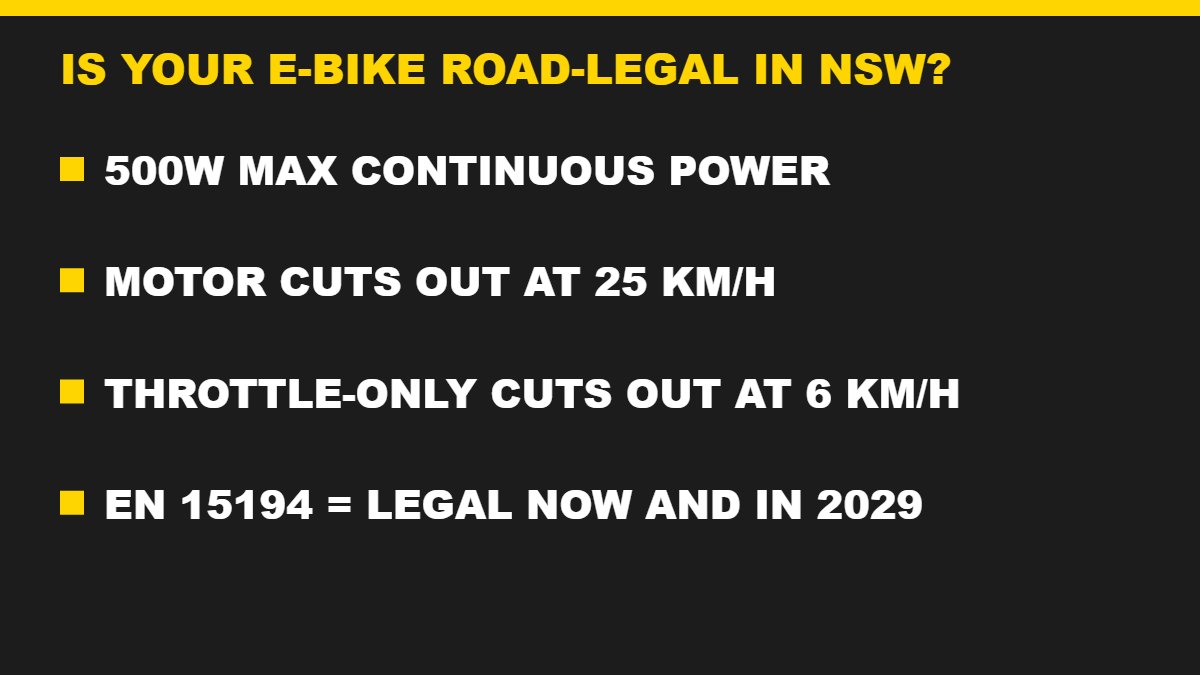
NSW is currently more generous on power than the national pedelec figure. According to Transport for NSW, a road-legal e-bike in NSW right now must have all three of the following:
- A maximum continuous rated power of 500 watts.
- A motor that only assists while you pedal and cuts out at 25 km/h.
- Any throttle-only function (no pedalling) that cuts out at 6 km/h — essentially a walk-assist.
A bike that breaks any of these limits is illegal in NSW even if the power or speed is restricted by an app, switch or code. In other words, a 1000W bike “limited” in software is still illegal. The safest choice — and the one that’s future-proof — is a bike certified to EN 15194.
Do you need a licence or registration?
No. Because a compliant e-bike is legally a bicycle, you do not need a driver or rider licence, you don’t register it, there are no number plates, and you don’t need compulsory third-party (CTP) insurance. There’s no minimum licence age either, since no licence exists to hold. What you do need is an approved helmet and a willingness to follow the same road rules as any cyclist. This applies right across Australia for bikes that meet the pedelec or 200W throttle definitions.
How fast can an e-bike legally go?
The motor must stop assisting at 25 km/h. That doesn’t mean you’re capped at 25 km/h — you can pedal faster than that under your own leg power, exactly like on a normal bike, especially downhill. The rule is simply that the electric motor can’t propel you beyond 25 km/h. Any bike whose motor keeps pushing past that speed is not a legal e-bike, regardless of what the marketing says.
Pedelec vs throttle: what’s the difference?
A pedelec gives you assistance only while you’re pedalling; the harder you work, the more the motor helps, and it eases off as you approach 25 km/h. A throttle bike lets you drive the motor without pedalling, like a scooter. In Australia, throttle-only operation above 6 km/h in NSW (or above the 200W limit nationally) pushes a bike out of the legal e-bike category. This is why premium commuter e-bikes — including the pedal-assist bikes we sell in Leichhardt — are built as pedelecs: they deliver strong, natural assistance and stay firmly legal.
Is a 500W e-bike legal in NSW?
Yes, for now. NSW allows up to 500W of continuous rated power today, as long as the motor cuts out at 25 km/h and any throttle-only mode cuts out at 6 km/h. This is more than the 250W national pedelec figure, which is why some bikes sold as “NSW legal” are 500W. Keep in mind two things: first, that generous 500W allowance is scheduled to end (see below); and second, a bike being sold elsewhere in Australia at 500W without EN 15194 certification may not be legal in other states. If you ride interstate, a certified pedelec is the safer bet.
What’s changing in 2029?
From 1 March 2029, NSW will lower the maximum continuous power to 250W and require every road e-bike to be EN 15194 certified. In March 2026 the state also tightened the legal definition and introduced tougher enforcement powers, but the 500W ceiling stays in place until the 2029 change. The practical takeaway for anyone buying now: choose an EN 15194-certified e-bike and you’re legal today and after 2029, with no need to replace your bike when the rules shift.
What makes an e-bike illegal — and what happens?
An e-bike becomes illegal in NSW if it has any of these: more than 500W continuous power, a throttle-only function that works above 6 km/h, or a motor that keeps providing power above 25 km/h. Software limiters don’t count — if the hardware can exceed the limits, the bike is illegal, and tampering to unlock more power makes it worse. Under enforcement laws introduced in 2026, NSW Police and authorised officers can seize illegal e-bikes and dispose of them. Beyond the legal risk, these bikes usually can’t be registered as motorcycles either, so there’s no simple “just get a licence” workaround — the smart move is to buy legal from the start.
Where can you legally ride an e-bike?
A legal e-bike can go wherever a regular bicycle can: on public roads, in bike lanes, on cycleways and on shared paths, following the same rules as any cyclist. Note that e-bikes are not the same as e-scooters — privately owned e-scooters have separate, stricter rules in NSW. As long as your bike meets the e-bike definition, you have the full run of Sydney’s growing bike-path network, from the Inner West to the harbour.
Helmets, footpaths and age rules
An approved, properly fastened helmet is mandatory for every rider, and any passenger must wear one too. On footpaths, the NSW rule is that riders aged 16 or over must not ride on the footpath unless they’re supervising a child under 16 (some other states are more permissive, so check locally when travelling). Children can ride e-bikes, but the same helmet and road rules apply. Because no licence is required, there’s no licence age — but common sense and the footpath rule still apply.
Do e-bikes need insurance?
Legal e-bikes need no compulsory insurance — no CTP, no registration, nothing. That said, e-bikes are valuable, so many Sydney riders choose to add their bike to home-and-contents cover or take out standalone bicycle/theft insurance. It’s optional, not a legal requirement, but worth considering for a premium commuter bike you rely on daily.
How to check an e-bike is road-legal before you buy
Not every e-bike sold online in Australia is road-legal, so check before you buy. Ask the retailer three questions: What is the continuous rated power? Does the motor cut out at 25 km/h? Is it certified to EN 15194? Look for the EN 15194 EPAC mark, be sceptical of any bike advertising “unrestricted” modes or throttle speeds above walking pace, and remember that a software cap on an over-powered motor doesn’t make a bike legal. Buying from a physical Sydney shop that stands behind compliance — rather than a faceless overseas listing — is the easiest way to be certain.
Are Cyberbikes’ e-bikes legal?
Yes. The Cyberbikes Centauro is a pedal-assist e-bike built to the current NSW limits and the EN 15194 safety standard, so it’s road-legal now and future-proof for the 2029 change. It’s the bike we ride and recommend for Sydney commuting, cargo hauling and weekend trails — powerful, comfortable, and fully within the law. If you’re ever unsure whether a bike you’re considering is compliant, bring it (or its specs) into our Leichhardt shop and we’ll tell you straight.
The best road-legal e-bike in Sydney
If you want a single bike that ticks every legal box and still handles real Sydney riding — hills, cargo, wet roads and long commutes — the Centauro is our pick. It pairs a 250W rear-hub motor and a 48V, 25Ah Samsung battery with full suspension and a step-through frame, all inside the road-legal envelope — a true pedelec at $3,999.99. You can buy it outright or spread the cost with rent-to-own from $99.99 a week, with no licence or paperwork to worry about because it’s a legal e-bike.
Shop the Centauro → Rent-to-Own from $99.99/week →
E-bike laws by Australian state (quick reference)
The national framework is consistent, but the details vary slightly by state. Across Victoria, Queensland, South Australia, Western Australia, Tasmania, the ACT and the NT, the legal e-bike is a 250W pedelec certified to EN 15194 (pedal-assist, cutting out at 25 km/h), with an older 200W throttle-assisted category also recognised. In all of these, no licence, registration or insurance is required. NSW is the current outlier, allowing up to 500W continuous until 1 March 2029, after which it aligns with the 250W EN 15194 standard. Wherever you ride, the 25 km/h motor cut-off and mandatory helmet rules apply. If you regularly cross state borders — say riding in NSW and Victoria — a certified 250W pedelec is the safest choice because it’s legal everywhere, today and after the 2029 changes.
Can you modify or derestrict an e-bike?
No — and this is where a lot of riders get caught out. It is illegal to remove or bypass the speed limiter, fit a bigger motor, or run a “dongle” that lets the motor assist past 25 km/h. The law looks at what the bike is capable of, not what mode it’s set to, so a powerful motor that’s merely software-limited is still illegal. Derestricting your e-bike can void the manufacturer’s warranty, invalidate any insurance, and — in NSW — expose you to seizure of the bike and fines. It also makes the bike genuinely more dangerous, because the brakes, frame and tyres were certified for pedelec speeds. If you want more range or grunt, buy a bike that legitimately delivers it within the rules rather than modifying one that doesn’t.
E-bike vs e-scooter: why the rules differ
People often lump e-bikes and e-scooters together, but NSW treats them very differently. A compliant e-bike is legally a bicycle with full access to roads, bike lanes and shared paths. Privately owned e-scooters, by contrast, have historically been restricted to designated trial areas in NSW and are not automatically legal to ride in all public places. The key legal difference is the pedals: an e-bike is fundamentally a bicycle that a motor assists, while an e-scooter has no pedals and is powered by the motor alone. If you want a vehicle you can ride anywhere a bike can go, without navigating scooter-trial boundaries, a road-legal e-bike is the more flexible and future-proof option.
E-bike rules for food-delivery riders in Sydney
Food-delivery riders are one of the biggest e-bike user groups in the inner city, and the rules for them are stricter in practice. A delivery rider must use a road-legal e-bike — the same 500W/25 km/h NSW limits apply — and, because of safety concerns, is also expected to wear a high-visibility vest and an approved helmet, and to have completed rider training. Illegal, over-powered delivery bikes are a specific enforcement target, and getting caught can mean losing the bike you rely on for income. For anyone riding all day, every day, a reliable, genuinely legal pedelec with a big battery — like the Centauro’s 48V, 25Ah pack — is both the compliant and the practical choice.
Do the same laws apply to cargo e-bikes and carrying kids?
Yes. A cargo e-bike is still an e-bike in the eyes of the law, so it must meet the same power and speed limits — up to 500W in NSW, motor cutting out at 25 km/h — and needs no licence or registration. When you carry passengers, including children, each passenger must wear an approved, correctly fitted helmet, and you must not carry more people than the bike is designed and equipped for. Purpose-built cargo and family e-bikes have longer frames, sturdier racks and child-seat mounting points designed for exactly this. The step-through, full-suspension Centauro is a popular choice for Sydney parents doing the school run because it stays road-legal while comfortably handling the extra load.
Frequently asked questions
Are e-bikes legal in Australia?
Yes, in every state and territory, provided they meet the pedelec (250W, EN 15194) or 200W throttle definition and cut assistance at 25 km/h. Bikes exceeding those limits are treated as motor vehicles and are generally illegal on roads and paths.
Do you need a licence for an e-bike in NSW?
No. A legal e-bike is treated as a bicycle — no licence, registration, plates or CTP insurance. A helmet is mandatory and normal bicycle road rules apply.
Is a 500W e-bike legal in NSW?
Yes for now — NSW allows up to 500W continuous, with the motor cutting out at 25 km/h and any throttle at 6 km/h. From 1 March 2029 the limit drops to 250W with mandatory EN 15194 certification.
How fast can an e-bike legally go?
The motor must stop assisting at 25 km/h. You can pedal faster under your own power, but the motor can’t propel you beyond 25 km/h.
Ride legal with Cyberbikes in Leichhardt
Still not sure whether a bike is road-legal? That’s exactly what we’re here for. Come in for a test ride at Cyberbikes, 281 Parramatta Road, Leichhardt, call us on 0491 794 668, or browse the Centauro online. We’ll make sure whatever you ride keeps you legal, safe and on the road.
#eBikeSydney #CyberBikes #ElectricBikeLeichhardt #NSWeBikeLaw #eBikeLawsAustralia #CentauroEbike #RideLegal