
Trust the voltage. On an e-bike battery, voltage is a quantity your controller actually measures, while the percentage on your display is an estimate calculated from that voltage — usually sampled while current is flowing, which is precisely when voltage is least honest. But here is the part most riders miss: neither number tells you how far you can ride. That job belongs to a third number, watt-hours, and it is the one almost nobody looks at.
At Cyberbikes in Leichhardt we see this every week. A rider brings a bike in convinced the battery is dying because the gauge “drops two bars on the Norton Street climb and comes back at the lights”. The pack is usually fine. The gauge is just doing arithmetic on a moving target.
What does the percentage on your e-bike display actually measure?
In most e-bike systems, the state-of-charge display is derived from pack voltage. There is no fuel float inside a lithium pack — the controller reads volts and maps that reading onto a curve to produce a number or a row of bars.
That mapping is the weak link. Grin Technologies’ battery reference at ebikes.ca describes lithium polymer cells as having “a linearly declining voltage from 4.2 to 2.9 volts/cell during the course of the discharge”, with a nominal figure “on the order of 3.7V”. A 48V pack is thirteen of those cells in series, so the arithmetic lands like this:
| Per cell | 48V pack (13 cells) | What it means |
|---|---|---|
| 4.2 V | ≈ 54.6 V | Fully charged, straight off the charger |
| 3.7 V | ≈ 48.1 V | Nominal — the number printed on the label |
| 2.9 V | ≈ 37.7 V | Bottom of the discharge, BMS cut-out territory |
Your display’s percentage is a curve fitted between those landmarks. Near the top and bottom of the range the voltage moves quickly and the estimate is reasonably sharp. Through the long middle it moves slowly, so a tiny voltage error becomes a large percentage error. That is why four bars is almost never four quarters of your ride.
The alternative is coulomb counting — measuring amp-hours in and out rather than inferring them from volts. That is what Grin’s Cycle Analyst does, and it is why a dedicated meter reads so much more steadily than a stock display.
Why does the voltage drop the moment you pull away?
Because every battery has internal resistance, and pulling current through resistance costs voltage. Grin’s motor simulator documentation puts it plainly: “As you move the cursor to lower speeds where more current is drawn from the battery, you’ll see the voltage on the battery pack sag due to internal resistance.”
How much it sags depends on how hard you are asking. The ebikes.ca battery guide notes that a pack rated for only 1C continuous — about 4 amps on a small pack — subjected to 10–20 amp draws will see the voltage “sag considerably, leading to slower performance”. Big, well-built packs with quality cells sag far less at the same current, which is one of the practical reasons cell quality is worth paying for.
Current is also what cooks a motor. Grin’s motor power ratings page spells out the I²R relationship: “If you double the current through the windings in order to have double the torque and power from the motor, then you increase the amount of copper heat being generated by a factor of FOUR.” Double the torque, quadruple the heat. That is the whole reason a motor’s continuous rating and its peak output are different animals.
So on a Sydney hill, three things happen at once: current climbs, pack voltage sags, and the display converts that sagged voltage into a percentage as if you were coasting. The bars fall. At the next red light, current drops to zero, voltage recovers, and the bars come back. Nothing was lost. Nothing was found.
Which number actually predicts your range?
Watt-hours. Volts tell you electrical pressure, amp-hours tell you charge, and only their product tells you energy. Grin states the formula directly: “The watt-hours stored in a battery pack is approximated by taking the actual amp-hours and multiplying it by the pack voltage” — their worked example being a 24V 8Ah pack that “can deliver 192 watt-hours”.
Run that on a real bike. The 2026 Cyberbikes Centauro carries, per its current spec sheet, a 48V 25Ah Samsung pack — listed as 1200Wh, and 48 × 25 confirms it.
Now you need consumption. The ebikes.ca energy table gives typical pedal-assisted riding as 9–12 Wh/km. Divide:
- 1200 Wh ÷ 12 Wh/km ≈ 100 km
- 1200 Wh ÷ 9 Wh/km ≈ 133 km
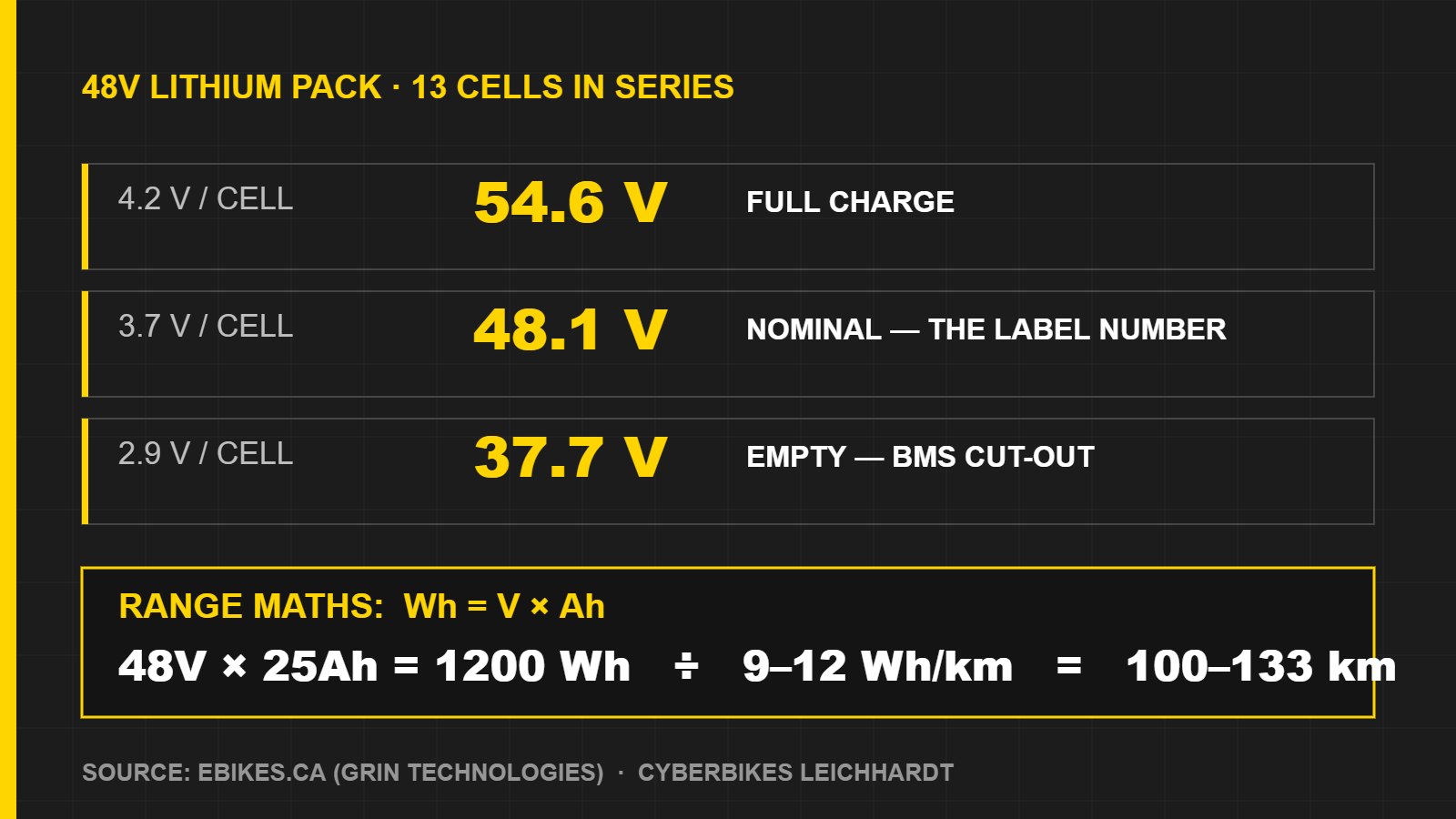
That is a range estimate built from two measured numbers and one published consumption figure, not from a marketing claim. Push the assist higher, load 50 kg on the rack, ride into a southerly, or sit at the 25 km/h assist limit all the way down Parramatta Road, and your Wh/km climbs — which shortens the range without anything being wrong with the battery. Grin’s motor simulator will plot exactly that trade-off, including predicted Wh/km and range, before you spend a dollar.
If two packs with the same 48V label behave differently on your commute, the explanation is usually in this arithmetic and in cell quality — we unpacked that in why two 48V e-bike batteries can feel different.
Does a bigger battery make your e-bike illegal in NSW?
No. New South Wales regulates power, not stored energy. Transport for NSW sets the limit for a power-assisted pedal cycle at a maximum continuous rated power of 500 watts, with the motor cutting assistance at 25 km/h and any throttle-only function cutting out at 6 km/h. From 1 March 2029, NSW moves to 250 W and “only EN 15194 certified e-bikes will be allowed on NSW roads”.
Nothing in that list caps watt-hours. A 1200 Wh pack on a 250 W motor is legal; a 500 Wh pack on a 1000 W motor is not. Transport for NSW is explicit that a bike is illegal with “more than 500W maximum continuous power (more than 250W from 2029)”, a throttle working above 6 km/h, or “a motor that continues to provide power above 25 km/h” — and software-limiting an over-spec motor does not fix it. Always read the current rules at transport.nsw.gov.au.
Worth noting on the Centauro spec sheet: a 250W rear hub motor, and compliance listed against EN 15194 for e-bike power and speed, UL 2849 for the e-bike system, UL 2271 for the battery, and ISO 4210 for the frame. It already sits under the rule that arrives in 2029.
How do you read your battery gauge like a mechanic?
Four habits turn a vague gauge into a useful instrument.
- Read voltage at rest. Switch on, don’t pedal, don’t touch the throttle, and note the number. A resting reading is the only one comparable week to week.
- Watch the sag, not the bars. Note resting voltage, then voltage during a steady climb. That gap is your pack’s real-world internal resistance. If the gap grows over months at the same load, the cells are ageing — long before the percentage tells you.
- Track Wh/km, not percentage. If your display shows consumption, it is the single most predictive number you have. Percentage answers “how much is left” badly; Wh/km answers “how far will it go” well.
- Don’t diagnose on a full charge. Straight off the charger every pack looks healthy. Capacity loss shows up in the second half of the discharge.
If the sag gap has widened, the bike shuts down with charge apparently remaining, or the gauge jumps around erratically, that is a battery and BMS check, not a guessing game. For the full picture on chemistry, charging and pack longevity, our definitive guide to e-bike batteries is the deeper reference.
Frequently asked questions
Is voltage or percentage more accurate on an e-bike battery?
Voltage is the measured value and the percentage is an estimate derived from it, so voltage is more reliable — especially when read at rest with no current flowing. The percentage is least accurate through the middle of the discharge, where pack voltage changes very slowly.
Why does my e-bike battery percentage go back up after a hill?
Because voltage sagged under load and then recovered. Internal resistance drops the pack voltage while high current flows, and your display converts that lower voltage into a lower percentage. When you stop drawing current, voltage rises again and so does the reading. No charge was regained.
How do I calculate the real range of my e-bike battery?
Multiply pack voltage by amp-hours to get watt-hours, then divide by your consumption in watt-hours per kilometre. Grin Technologies puts typical pedal-assisted riding at 9–12 Wh/km, so a 48V 25Ah pack of 1200 Wh works out to roughly 100–133 km at that consumption, less with heavy loads, hills or headwinds.
Bring the numbers to us
Resting voltage, sag under load and Wh/km take about ten minutes to check properly, and they will tell you more about your pack than a month of watching bars. Roll into Cyberbikes, 281 Parramatta Road, Leichhardt for a test ride and we will run the numbers on your bike while you are there. Call 0491 794 668, Tuesday to Saturday, or browse the range at cyberbikes.com. Rent-to-own starts from $99.99 a week.
Sources: ebikes.ca battery guide, ebikes.ca motor power ratings, ebikes.ca motor simulator (Grin Technologies), Transport for NSW, and the live Cyberbikes Centauro product page.
#EbikeSydney #CyberbikesLeichhardt #EbikeBattery #WattHours #CentauroEbike #ElectricBikeAustralia #RentToOwnEbike