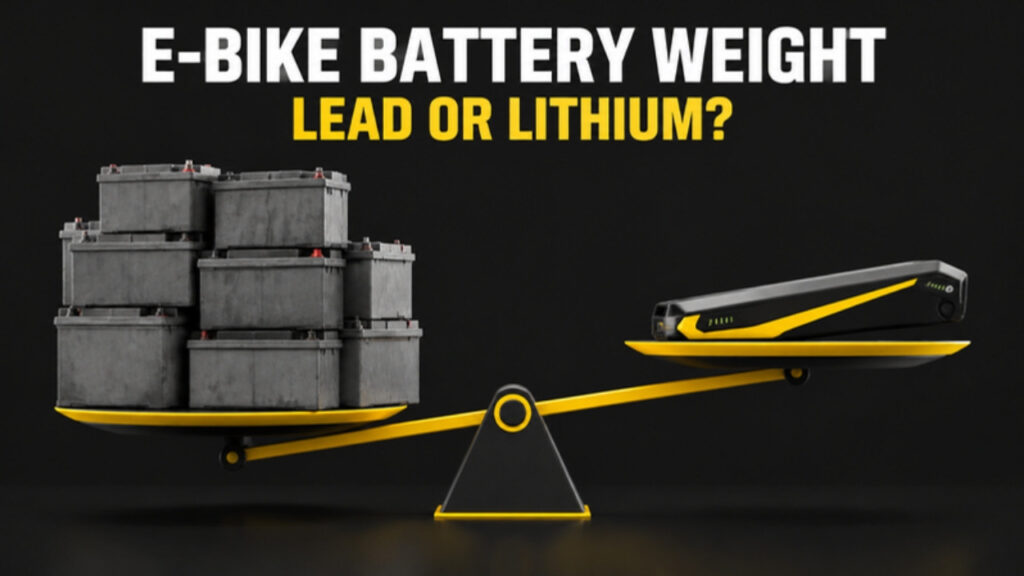
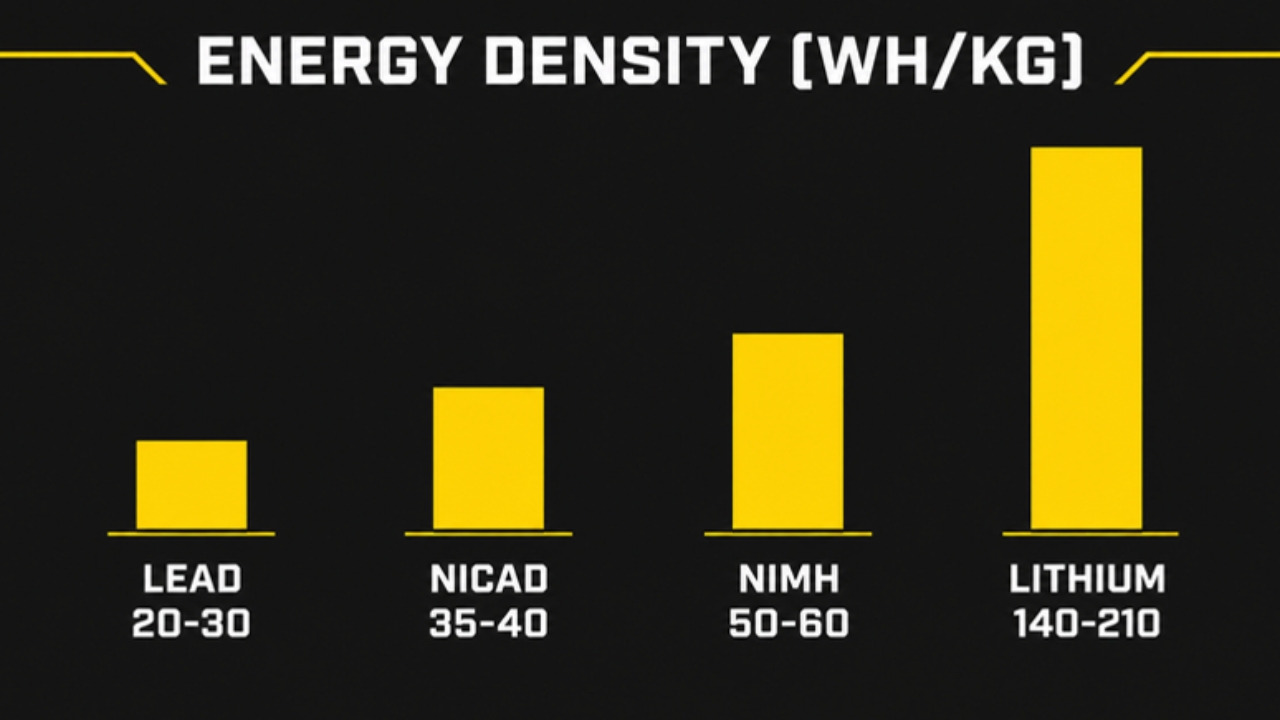
E-bike battery weight comes down to one number: energy density. A modern lithium pack stores 140 to 210 watt-hours per kilogram, while lead-acid manages only 20 to 30 Wh/kg. That means the 1,200Wh battery on a Cyberbikes Centauro weighs roughly 6 to 9kg, while the same stored energy in lead would be 40 to 60kg of batteries — more than the entire 37kg bike. Nickel chemistries sit in between at 35 to 60 Wh/kg. Those figures come from Grin Technologies’ battery reference at ebikes.ca, and they are the reason every e-bike you can legally ride in Sydney today runs on lithium.
This post answers four related questions riders actually ask at our Leichhardt workshop: how heavy a battery has to be for the range you want, why lead never delivers its printed capacity, whether volts or amp-hours set the weight, and how many kilograms of battery a real Sydney commute needs. If you want the full background first, our definitive guide to e-bike batteries covers chemistry, charging and lifespan end to end.
How much does an e-bike battery weigh for the range you want?
Work backwards from watt-hours. Energy density in watt-hours per kilogram tells you how heavy a pack must be to hold a given amount of energy, and ebikes.ca puts complete lithium-ion packs at 140 to 210 Wh/kg, NiMH at 50 to 60 Wh/kg, NiCad at 35 to 40 Wh/kg and lead acid at 20 to 30 Wh/kg.
Run the 1,200Wh Centauro pack through those numbers and the picture is brutal:
- Lithium-ion: 1,200Wh ÷ 140–210 Wh/kg = roughly 6 to 9kg.
- NiMH: 1,200Wh ÷ 50–60 Wh/kg = roughly 20 to 24kg.
- Lead acid: 1,200Wh ÷ 20–30 Wh/kg = roughly 40 to 60kg — and that is the optimistic version, for reasons covered in the next section.
A 40kg battery on a bicycle is not a heavy bike, it is a different vehicle. The whole Centauro, battery included, weighs 37kg and carries 150kg of rider and cargo. Swap lithium for lead and the battery alone outweighs the bike, the rack capacity goes to the battery instead of your shopping, and nobody is lifting that up a flight of stairs in a Newtown terrace.
Why does a lead-acid pack never deliver its rated amp-hours?
Because of the Peukert effect: the harder you discharge a lead-acid battery, the less capacity it actually gives you. Grin’s figures are blunt — a 7Ah gel cell “usually delivers about 4 amp-hours of actual capacity”, and a 12Ah lead pack delivers approximately 8 amp-hours under e-bike loads. That is roughly 57 to 67 per cent of the number on the label.
So the honest lead-acid comparison is worse than 40 to 60kg. To get 1,200Wh of usable energy out of lead you would need to buy around 1.5 times the nominal capacity, pushing the pack past 60kg. Lithium does not behave this way: a good 18650 or 21700 cell delivers close to its rated capacity at normal e-bike currents, which is why the rated watt-hours on a quality pack are a number you can plan a ride around.
Cycle life compounds it. Grin notes lead acid gives you around 200 cycles in deep-discharge use, while LiFePO4 manufacturers claim 1,500 to 2,000. Buying the cheap chemistry means buying it again, several times, and carrying 40kg in between.
Do volts or amp-hours decide e-bike battery weight?
Neither on its own. Watt-hours decide it, and watt-hours are volts multiplied by amp-hours. A 24V 8Ah pack holds 192Wh. A 48V 4Ah pack also holds 192Wh. Same chemistry, same energy, same weight, same cost — ebikes.ca makes exactly this point, and it kills the showroom habit of comparing amp-hours between bikes running different voltages.
The Centauro’s 48V 25Ah pack is 48 × 25 = 1,200Wh. A 36V 20Ah pack on another bike is 720Wh. The second bike has 80 per cent of the amp-hours and 60 per cent of the energy, and it will weigh correspondingly less. Amp-hours alone tell you nothing until you know the voltage.
Voltage still matters for how the bike feels — it sets how fast the motor can spin before it runs out of headroom — but it does not change the kilograms per watt-hour. That is set by the cells.
How many kilograms of battery does a Sydney commute actually need?
Start with consumption. Grin’s energy-use table gives three brackets: 6 to 8 Wh/km for minimal assist on a slower setup, 9 to 12 Wh/km for typical assist with pedalling, and 14 to 20 Wh/km when you are hauling a load, not pedalling, or going fast.
Take a 12km each-way run from Leichhardt into the CBD and back — call it 24km. At a typical 9 to 12 Wh/km that is 216 to 288Wh a day. At lithium’s 140 to 210 Wh/kg, the battery holding one day’s commute weighs somewhere between 1 and 2kg. The same day’s riding in lead acid is 7 to 14kg of battery, every day, before the Peukert derating.
It also explains the Centauro’s claimed range. The product page quotes up to 120km at 25km/h on a flat road with a 75kg rider and no headwind; 1,200Wh divided by the 9 to 12 Wh/km typical bracket lands at 100 to 133km, so the claim sits where the physics says it should. Hills, headwinds, cargo and high assist levels push you toward the 14 to 20 Wh/km bracket and the number drops accordingly — which is the honest answer to “why didn’t I get the advertised range”.
Does carrying a bigger battery cost you range?
A little, and far less than people fear. Adding 3kg of cells to a system already carrying an 80kg rider plus a 37kg bike raises total mass by roughly 2.5 per cent. Rolling resistance and climbing energy scale with weight, so on flat ground the penalty is close to noise; on a long climb up to Stanmore or Summer Hill it is real but small. The extra watt-hours you gained are far larger than the extra watt-hours the weight costs you. That is why bigger packs keep winning.
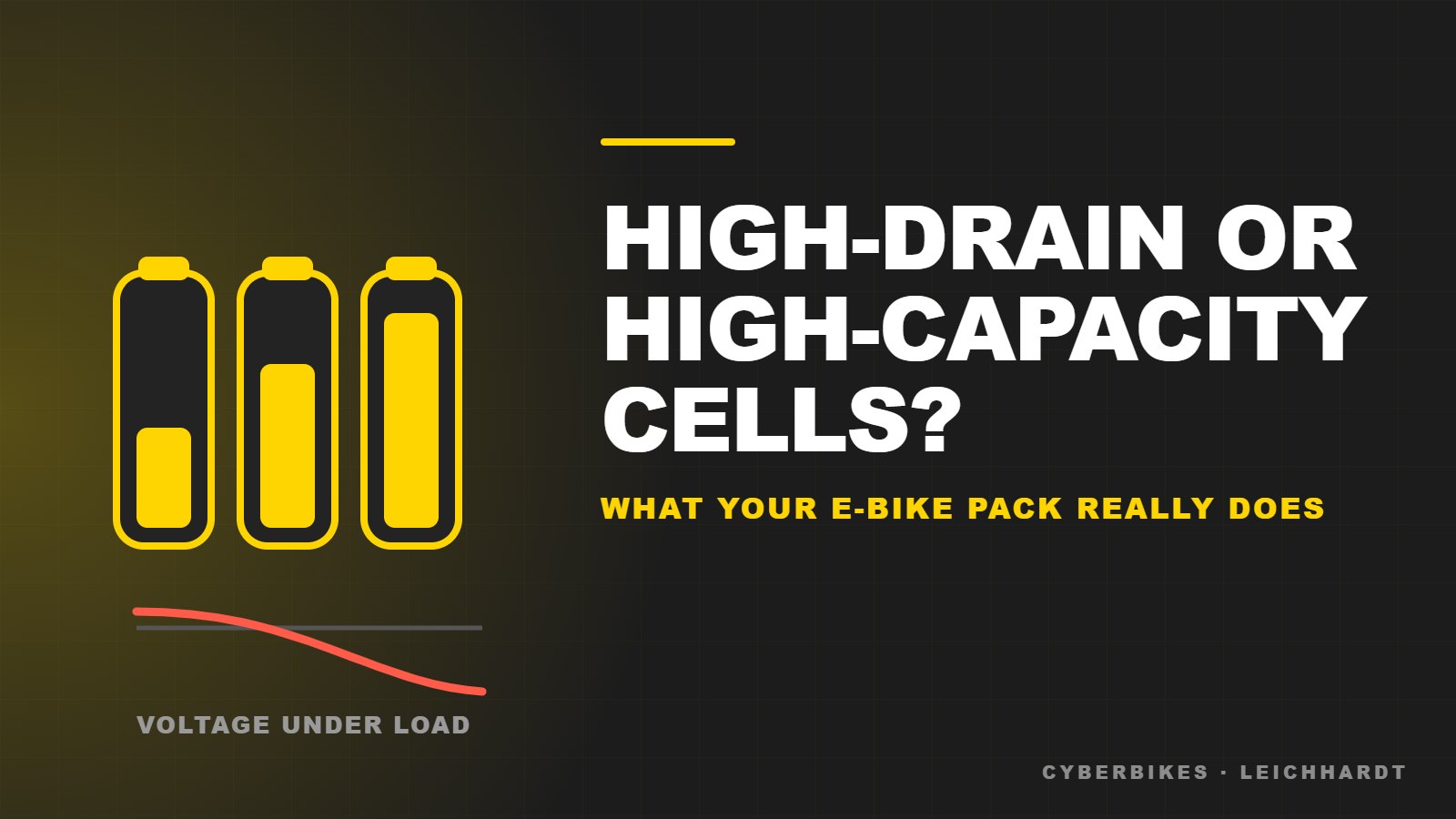
Weight is not the only thing a pack has to get right, though. The C rate — the discharge current expressed as a multiple of capacity — decides whether the cells can supply what the controller asks for without sagging. A 25Ah pack asked for 20A is working at 0.8C, which is an easy life for quality cells. A 7Ah pack asked for the same 20A is at nearly 3C, sags under load and ages faster. We dug into that trade-off in our post on high-drain versus high-capacity e-bike cells.
What does all this mean for a legal e-bike in NSW?
Battery weight is not what the law looks at — motor power and speed are. Transport for NSW currently requires a road-legal e-bike to have a maximum continuous rated power of 500W (dropping to 250W from 1 March 2029), motor assistance that stops at 25km/h, and any throttle-only function cutting out at 6km/h. Bikes outside those limits are illegal even if the power is restricted by an app, switch or code, and since 21 August 2026 police have expanded powers to seize them. From 1 March 2029, only EN 15194 certified e-bikes will be allowed on NSW roads.
So the pack is where you buy range, and the motor is where the law draws the line. Grin’s long-running argument in their piece on motor power ratings is that watt ratings are close to meaningless as a performance measure anyway — the same hub motor gets sold as 250W, 500W and 1000W, because there is no standard way to rate it. What you can measure honestly is watt-hours in the pack and watt-hours per kilometre on the road.
The Cyberbikes Centauro is built to that line: a 250W continuous rear hub motor, assist cut at 25km/h, throttle limited to 6km/h, and a 48V 25Ah (1,200Wh) Samsung pack certified to UL 2271 inside a UL 2849 system and an ISO 4210 frame. It is $4,249 online as a bike-in-box, or $150 more assembled and safety-checked at the shop. Most e-bike packs sold today hold 400 to 1,000Wh; 1,200Wh is deliberately at the top of that range, because carrying the extra 2kg of cells is cheaper than running out of battery in Ashfield.
Frequently Asked Questions
How much does an e-bike battery weigh?
A lithium-ion e-bike pack stores 140 to 210 watt-hours per kilogram, so a typical 500Wh pack weighs about 2.5 to 3.5kg and a large 1,200Wh pack like the Centauro’s weighs roughly 6 to 9kg. Lead-acid holds only 20 to 30 Wh/kg, so the same 1,200Wh in lead would weigh 40 to 60kg.
Why don’t e-bikes use lead-acid batteries any more?
Weight and cycle life. Lead-acid stores roughly seven times less energy per kilogram than lithium, loses a third or more of its rated amp-hours to the Peukert effect under e-bike currents, and gives only around 200 deep-discharge cycles compared with 1,500 to 2,000 claimed for LiFePO4. The weight of lead needed for a 40 to 50km range is simply too much for a bicycle.
Does a bigger e-bike battery make the bike slower?
Barely. A few extra kilograms of cells on a bike-plus-rider system of 110kg or more changes rolling resistance and climbing effort by a couple of per cent, while the extra watt-hours add far more range than the extra weight consumes. Speed is set by motor power, voltage and the 25km/h legal assist cut-off in NSW, not by pack size.
Weigh it yourself at Cyberbikes Leichhardt
Numbers on a page are one thing; lifting a 1,200Wh pack out of a frame is another. Come and do it. Cyberbikes is at 281 Parramatta Road, Leichhardt NSW 2040, open Tuesday and Thursday 10am–3pm, Wednesday and Friday 10am–5pm and Saturday 10am–4pm, closed Sunday, Monday and public holidays. Test rides are free and take about 30 minutes — book online or call 0491 794 668, and bring the hill you actually have to climb.
#CyberbikesLeichhardt #EBikeSydney #EBikeBattery #CentauroEBike #ElectricBikeSydney #EBikeRange #InnerWestSydney