For everyday riding, slower and shallower wins: charging an e-bike battery to about 80% on a moderate-current charger is the easiest way to stretch its service life, and Grin Technologies reports that partial-charge profiles can yield “thousands of cycles”. A full charge is not damaging — you simply do not need one every night. Here is the engineering behind that, and what it means for a Sydney commute.
At Cyberbikes Leichhardt we plug in a lot of batteries, and e-bike battery charging is where riders pick up the most misinformation. So let’s bundle the four questions we actually get asked at the counter on Parramatta Road: how long a charge should take, whether fast charging hurts, why the last stretch crawls, and what charging to 80% costs you in range. If you want the full background on cells, chemistry and pack construction first, our definitive guide to e-bike batteries is the deep end of this pool.
How long should charging an e-bike battery take?
Charge time is energy divided by power, and both numbers come from arithmetic you can do on your phone. Energy in a pack is watt-hours = volts × amp-hours. Charging power is watts = volts × amps. Divide the first by the second and you have your hours, plus a tail at the end we’ll get to.
Take our own bike. The 2026 Cyberbikes Centauro product page lists a 48V 25Ah (1200Wh) Samsung lithium-ion battery and a charge time of “about 5 hours from empty to full”. Work backwards: 1200Wh over roughly 5 hours is about 240W of average charging power, which at 48V nominal is in the neighbourhood of 5A. That is a deliberately unhurried charger for a big pack, not a weakness.
For comparison, Grin’s Cycle Satiator — a reference-grade programmable charger — spans 0–8A and 0–360W, and Grin notes maximum current is 8A for 24V and 36V packs and 7A for 48V packs, because the 360W ceiling caps current as voltage rises. Even a premium charger is a few hundred watts, not a few thousand.
What that means on the road: you rarely charge from empty. The Centauro page claims up to 120 km at 25 km/h, measured on a flat road with a 75 kg rider and no headwind — conditions worth repeating, because they’re ideal ones. Take that at face value and 1200Wh ÷ 120 km is about 10 Wh/km. A 20 km round trip from Leichhardt into the CBD is therefore roughly 200Wh, or about 50 minutes on a 240W charger. Most riders never see the five-hour figure.
Does fast charging wreck an e-bike battery?
Here we’ll be straight with you: Grin’s own charger documentation does not quantify how charge rate affects longevity, and we’re not going to invent a number to fill the gap. What Grin does document is the other side of the coin — depth of charge. Their guidance is that most lithium batteries “last much longer if not always charged to full”, at the cost of some range, and they suggest running a primary profile at about 80% with a secondary 100% profile for long trips.
What is firmly physical is heat. Resistive heating scales with the square of current: Grin’s power-ratings page puts it bluntly for motors — double the current and “you increase the amount of copper heat being generated by a factor of FOUR”. The same I²R relationship governs every cable, contact and connector in the charge path. That’s why Grin caps its own hardware: the DC jack and RCA adapters should generally be limited to 4–5A, while the 5.5 × 2.5 mm plug is rated for 7A.
- Use the charger that came with the pack. Its current is matched to the pack’s BMS and the connector.
- Don’t improvise a higher-current plug. A connector run past its rating gets hot four times faster when you double the current.
- Charge where you can see it — not on carpet, not blocking an exit, not overnight unattended on a bike you’ve modified.
- Let a hot pack cool after a hard climb before plugging in.
Why does the last 20% of the charge take so long?
Because the charger changes job. Early on it pushes a constant current and the pack voltage climbs; near the top it holds a constant voltage and the current tapers away. The tapering phase is slow by design, and it is also where the battery management system does its most delicate work.
Grin’s documentation gives the hard cell-level limit: if any cell group exceeds 4.2V, the BMS interrupts charging and the Satiator reports a “Power Fault”, with cell imbalance named as the usual cause. That’s a useful diagnostic for any e-bike, not just one on a Satiator.
What that means on the road: if your charge consistently stops early or the pack reads full but dies fast, suspect an imbalanced pack before you blame the charger. And because balancing happens at the top of the charge, an occasional full charge is worth doing even if you normally stop at 80%. Imbalance that keeps returning is a workshop job — bring it to us at Leichhardt rather than cycling it harder.
Charge to 80% or 100% — what does it cost in range?
Less than most riders fear, and you can calculate it exactly. Using the Centauro’s listed 1200Wh and the 10 Wh/km implied by its own stated range figure:
| Charge level | Usable energy | Range at 10 Wh/km | Approx. charge time at 240W |
|---|---|---|---|
| 100% | 1200 Wh | ~120 km | ~5 h from empty |
| 80% | ~960 Wh | ~96 km | ~4 h from empty |
| Daily 20 km commute | ~200 Wh | — | ~50 min |
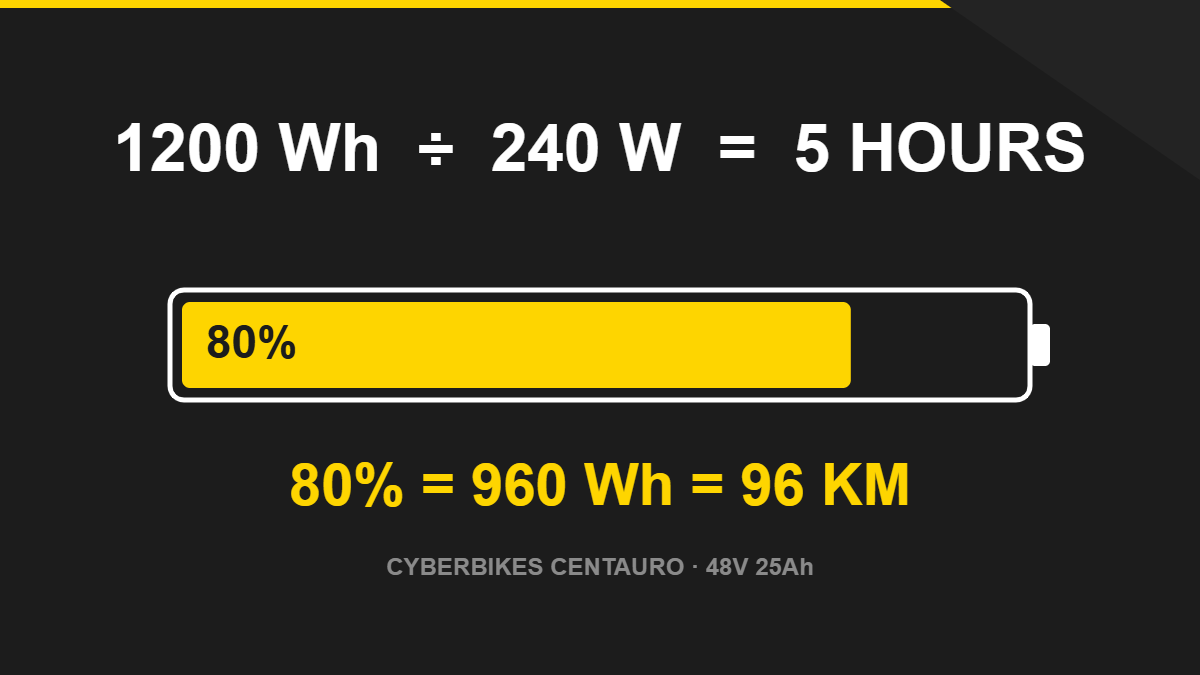
So the 80% habit costs a rider doing 20 km a day precisely nothing, because 960Wh is still nearly five days of commuting. Save the 100% charge for the weekend run.
The bigger variable isn’t your charger — it’s your Wh/km, and that’s set by how hard the motor has to work. Grin’s power-ratings page makes the point that torque, not power, is what heats a motor, and gives the conversion Power (W) ≈ Torque (Nm) × RPM × 0.104: the same 20 Nm costs about 209W at 100 rpm but about 628W at 300 rpm. Hills, headwinds, cargo and stop-start traffic all raise the torque demand, which is why real-world Wh/km on Parramatta Road beats any flat-road lab figure. Grin’s trip simulator and motor simulator let you model your own route rather than trusting a brochure. If you want the voltage-versus-capacity side of this in depth, we unpacked it in volts or amp-hours and what really sets your range.
Does charging affect whether your e-bike is legal in NSW?
No — charging habits and battery size have no bearing on legality. NSW law regulates power and speed, not watt-hours. Read live from Transport for NSW, the current rules are:
- 500W maximum continuous rated power now — dropping to 250W from 1 March 2029.
- Pedal assistance must stop above 25 km/h.
- Throttle-only operation must cut out at 6 km/h.
- From 1 March 2029, only EN 15194 certified e-bikes will be allowed on NSW roads; Transport for NSW advises choosing EN 15194 now because it is “legal now and in the future”.
- Exceeding those limits is illegal even if an app, switch or software restricts the power or speed.
- Since 21 August 2026, police and authorised officers have expanded seizure powers for illegal e-bikes.
That 2029 date is why we care about it today. The Centauro product page lists a 250W rear hub motor with EN 15194 compliance, pedal assist that cuts out at 25 km/h and a throttle limited to 6 km/h — inside the limits now and still inside them after March 2029. The page also lists UL 2849 for the e-bike system, UL 2271 for battery safety and ISO 4210 for the frame, alongside a 37 kg kerb weight, 150 kg maximum rider-and-cargo load, 4-piston hydraulic brakes with 180 mm × 2.3 mm rotors, and 100 mm front / 120 mm rear suspension travel. Note the pairing: a big 1200Wh pack and a modest 250W motor is exactly the combination that is both legal and long-range, because capacity buys distance while rated power is what the law limits.
See the Centauro in action
Frequently Asked Questions
Should I charge my e-bike battery to 100% every time?
No. Grin Technologies advises that most lithium batteries last much longer if they are not always charged to full, suggesting a primary profile around 80% and a 100% profile for long trips. On a 1200Wh pack, 80% still leaves about 960Wh — roughly 96 km at 10 Wh/km. Do an occasional full charge, because cell balancing happens at the top of the charge.
How long does it take to charge a 48V 25Ah e-bike battery?
A 48V 25Ah pack holds 1200Wh, and the Cyberbikes Centauro product page lists about 5 hours from empty to full, which works out to roughly 240W of average charging power. A typical 20 km commute uses about 200Wh, so a daily top-up takes closer to 50 minutes than five hours.
Why does my e-bike charger stop before the battery is full?
Usually cell imbalance. Grin’s charger documentation explains that if any cell group exceeds 4.2V the battery management system interrupts charging and reports a power fault, with imbalance named as the usual cause. If it keeps happening, have the pack checked rather than repeatedly forcing a charge.
Does a bigger battery make an e-bike illegal in NSW?
No. Transport for NSW regulates continuous rated power and speed, not battery capacity: 500W maximum continuous rated power now and 250W from 1 March 2029, pedal assistance stopping above 25 km/h, and throttle-only operation cutting out at 6 km/h. A large watt-hour battery on a 250W motor is fully legal.
Try one before you buy one
Charging maths is easier to trust when you’ve felt the bike. Cyberbikes runs rent-to-own from $99.99 per week, so you can put a Centauro through a month of real Sydney commuting — hills, headwinds, cargo and all — and watch your own Wh/km instead of ours. Book a test ride at 281 Parramatta Road, Leichhardt, browse the range at cyberbikes.com, or call 0491 794 668, Tuesday to Saturday. Bring your current battery and we’ll check it for imbalance while you ride.
#Cyberbikes #EbikeSydney #EbikeBattery #Leichhardt #ElectricBike #EbikeCharging #SydneyCommute #RentToOwn #Centauro #EbikeTech