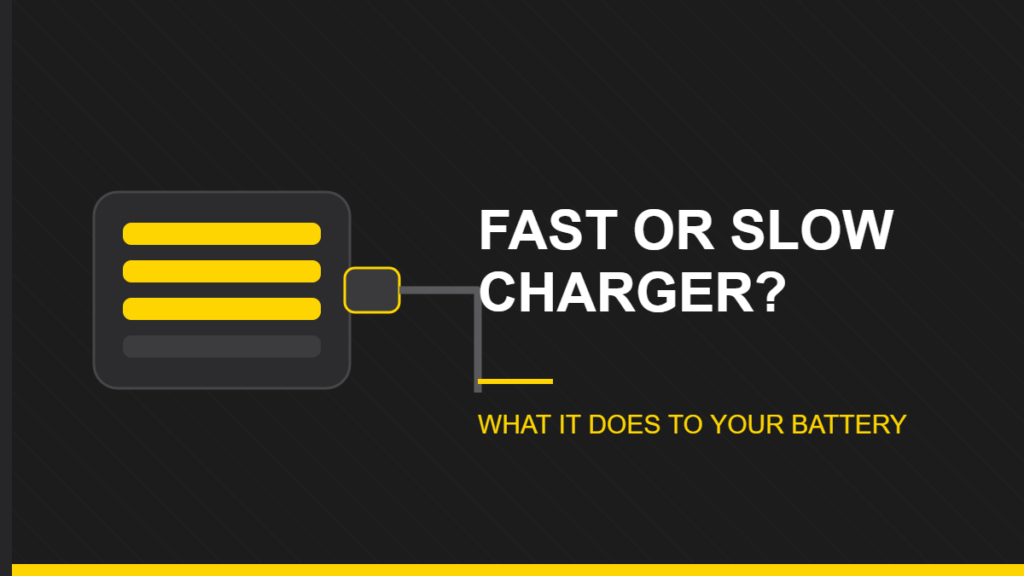
A faster e-bike charger does not damage a healthy battery — but the voltage you stop at matters far more than the amps you start with. Charging a 48V 25Ah pack at 5A instead of 2A roughly halves the time and adds only a modest amount of heat. What genuinely shortens pack life is parking it at 100% every single day. Grin Technologies, who build the programmable Cycle Satiator charger, put it plainly: “Most lithium batteries are capable of vastly improved cycle life if they are not fully charged to saturation all the time” (ebikes.ca).
That sentence reorders the question. Riders ask us at the Leichhardt shop almost every week whether the bigger charger in the box is quietly killing their battery. It usually isn’t. The 100% habit is. Here is the engineering, and what it means for your commute down Parramatta Road.
How long should an e-bike battery actually take to charge?
Your e-bike charger can only work as fast as one piece of arithmetic allows, and it is the same one that sets your range. Energy in a pack is watt-hours = volts × amp-hours. The Cyberbikes Centauro runs a 48V 25Ah Samsung pack, which its spec sheet lists as 1200Wh. Multiply it out yourself: 48 × 25 = 1200. The number on the page is the number the physics gives you.
Charging power is watts = volts × amps. A charger pushing 2A into a 48V pack delivers roughly 96W; one pushing 5A delivers roughly 240W. Divide the pack energy by the charging power and you get the theoretical time: 1200Wh ÷ 240W = 5 hours, and 1200Wh ÷ 96W = 12.5 hours. The Centauro product page states charging takes “About 5 hours from empty to full”, which lines up with the 240W figure — so the supplied charger is delivering roughly 5A. (That amp figure is our arithmetic from the stated 1200Wh and 5-hour numbers; the charger’s current is not itself listed on the page.)
Real charge times run longer than the sum, because no charger is 100% efficient and because the final stretch deliberately slows down. Grin quote 95% efficiency at full load for their own unit, which is high for the category. Losses become heat.
Why does the last 20% take so long?
Because a lithium charger runs two distinct phases, and only the first one is fast.
- Constant current (CC). The charger pushes its full rated amps — 2A, 5A, whatever it has — and pack voltage climbs steadily. This phase does most of the work and covers roughly the first 80%.
- Constant voltage (CV). Once the pack reaches its full-charge voltage, the charger holds that voltage and the current tapers away toward zero. The pack is nearly full, so it accepts charge slowly.
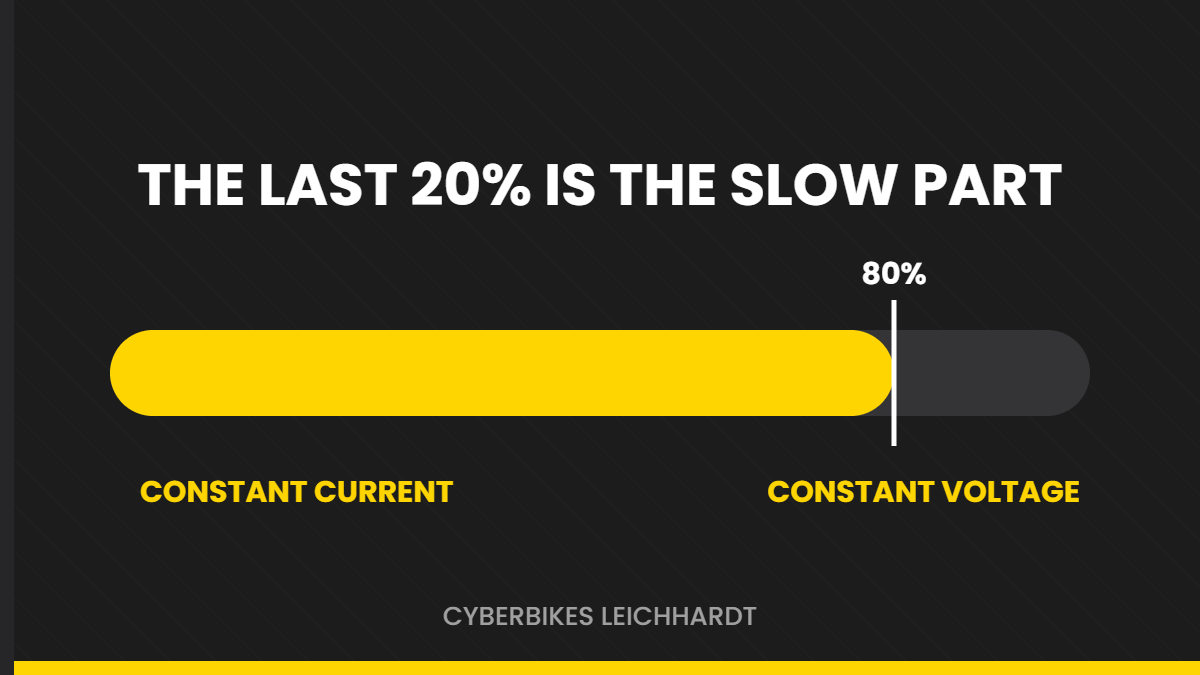
This is why a “fast” charger is only fast for the early part of the job. Doubling your charger from 2A to 5A barely touches the CV tail — it compresses the CC phase. If you charge to 80% and unplug, you skip the slow phase almost entirely and get the biggest time saving a bigger charger can give you.
It is also why Grin’s Satiator lets you store two profiles: “program your primary profile to give an 80% charge, and have a secondary profile that does a 100% charge when you need full range”. Their stated goal is “a battery that lasts thousands of cycles but still goes the distance when you need it”.
Does a fast e-bike charger make the battery run hot?
Some, and the relationship is not linear — it is squared. Every cell, connector and length of wire has internal resistance, and current flowing through resistance produces heat according to I²R. Grin spell out what that exponent does in their motor power-ratings write-up: “If you double the current through the windings in order to have double the torque and power from the motor, then you increase the amount of copper heat being generated by a factor of FOUR (the I²R relationship)” (ebikes.ca power ratings). The same square law governs charging current through a pack’s internal resistance.
So going from 2A to 5A is 2.5× the current and therefore about 6× the resistive heating inside the pack. That sounds alarming until you put a number on the starting point. Charging currents on a 25Ah pack are small relative to what the same pack delivers on a hill — a 250W motor at 48V pulls around 5A continuously, and a hard acceleration pulls far more. Your battery routinely handles higher current going out than any sane charger sends in. The heat that matters for pack longevity is sustained heat at high state of charge, not the mild warmth of a 5A charge.
Two practical consequences. First, charge somewhere ventilated and not in direct Sydney summer sun — heat plus a full pack is the combination that ages cells. Second, if a charger or a connector ever gets genuinely hot to the touch rather than warm, that is resistance where there should not be any. Stop and get it looked at.
Fast charger or slow charger: which should you buy?
Match the e-bike charger to how you actually ride, not to the biggest number available.
| Your pattern | Sensible charge rate | Why |
|---|---|---|
| Short commute, charges overnight | 2–3A | You have 8 hours. Lower current, less heat, zero benefit from speed. |
| Long commute, one charge a day | 4–5A | Refills a 1200Wh pack in roughly 5 hours; back on the road the same evening. |
| Delivery or cargo, two charges a day | 5A+, programmable | Turnaround time is the whole job. Charge to 80% between shifts. |
| Bike stored for weeks | Any, stop near 50–60% | Storage voltage matters more than charge speed. |
A note on shopping: use the e-bike charger designed for your pack’s voltage and chemistry, from the bike’s maker or a reputable programmable unit. A mismatched charger is a far bigger risk than a fast one. The Centauro’s battery is UL 2271-certified with the electrical system to UL 2849, and the bike also lists ISO 4210 and EN 15194 — those certifications assume the matched charging system.
See it checked in thirty seconds
A pack that used to reach your destination with two bars left and now arrives empty is telling you something a charger cannot fix. That is capacity fade, and it is measured in watt-hours, not in how quickly the light turns green.
What does this mean for range on a Sydney commute?
Charge speed does not change your range. Energy does. The Centauro’s page claims “Up to 120 km at 25 km/h, measured on a flat road with a 75 kg rider and no headwind” — divide 1200Wh by 120km and the test implies roughly 10 Wh/km. That is a best-case flat number; hills, headwind, a heavier load and higher assist all push consumption up, which is exactly what Grin’s motor simulator is built to model — it outputs Wh/km, predicted range and even how long a motor takes to reach 150°C.
Work it backwards for your own trip. Leichhardt to the CBD and home is roughly 14 km round trip. At even a pessimistic 20 Wh/km that is 280Wh — under a quarter of the pack. You would never need a fast charger for that ride. You would need a charger that lets you stop at 80%, because at 280Wh a day the pack’s enemy is calendar ageing at high voltage, not cycle count.
If you want the full picture on cells, cycles, winter losses and replacement costs, our definitive guide to e-bike batteries goes deeper than any single post can, and the section on amp-hours versus watt-hours explains why Wh is the only battery number worth comparing between bikes.
Does charging have anything to do with NSW e-bike law?
Not directly — but the bike you charge has to be legal. Transport for NSW currently sets a maximum continuous rated power of 500 watts, with assistance that must not provide power above 25 km/h and any throttle-only function cutting out at 6 km/h. From 1 March 2029 the limit drops to 250W and only EN 15194 certified e-bikes will be allowed on NSW roads. Transport for NSW is blunt about workarounds: “E-bikes that exceed any of these limits are illegal, even if the power or speed is restricted by software (app, switch or code)” (transport.nsw.gov.au).
Battery capacity is not capped by that rule. A 1200Wh pack on a 250W motor is entirely legal — the law regulates how hard the motor pushes, not how much energy you carry. That is the distinction worth knowing: you buy range with watt-hours, not with watts.
Frequently asked questions
Is it bad to leave an e-bike battery on the charger overnight?
A quality charger stops when the pack is full, so the risk is not overcharging — it is that the battery then sits at 100% for hours. Grin note that lithium packs get “vastly improved cycle life if they are not fully charged to saturation all the time”. If you charge overnight regularly, use a charger or timer that stops around 80%, and charge in a ventilated space away from exits.
Will a 5A charger charge my e-bike twice as fast as a 2A one?
Close, but not quite. It roughly halves the constant-current phase, which covers about the first 80% of the charge. The constant-voltage tail at the top barely speeds up, because the pack itself limits how fast it will accept the last stretch. Grin describe their 7–8A unit as charging “in half the time of typical 4amp ‘fast’ chargers”, which is the same effect at a larger scale.
How do I work out my own e-bike charge time?
Multiply pack volts by amp-hours to get watt-hours, multiply pack volts by charger amps to get charging watts, then divide the first by the second and add roughly 20% for efficiency losses and the constant-voltage tail. A 48V 25Ah pack is 1200Wh; a 5A charger on 48V is about 240W; 1200 ÷ 240 = 5 hours, which matches the Centauro’s stated “about 5 hours from empty to full”.
Come and plug one in
The fastest way to settle an e-bike charger question is to put your hands on the hardware. Book a test ride at Cyberbikes Leichhardt, 281 Parramatta Road, and we will show you the charge curve on a real Centauro — 1200Wh, 37kg, 150kg load rating, four-piston hydraulic brakes. Call 0491 794 668, Tuesday to Saturday, or browse the range at cyberbikes.com. Rent-to-own starts from $99.99 a week.
#EbikeSydney #Cyberbikes #CyberbikesLeichhardt #EbikeCharger #EbikeBattery #CentauroEbike #ElectricBikeSydney #InnerWest #RentToOwn #EbikeCommute