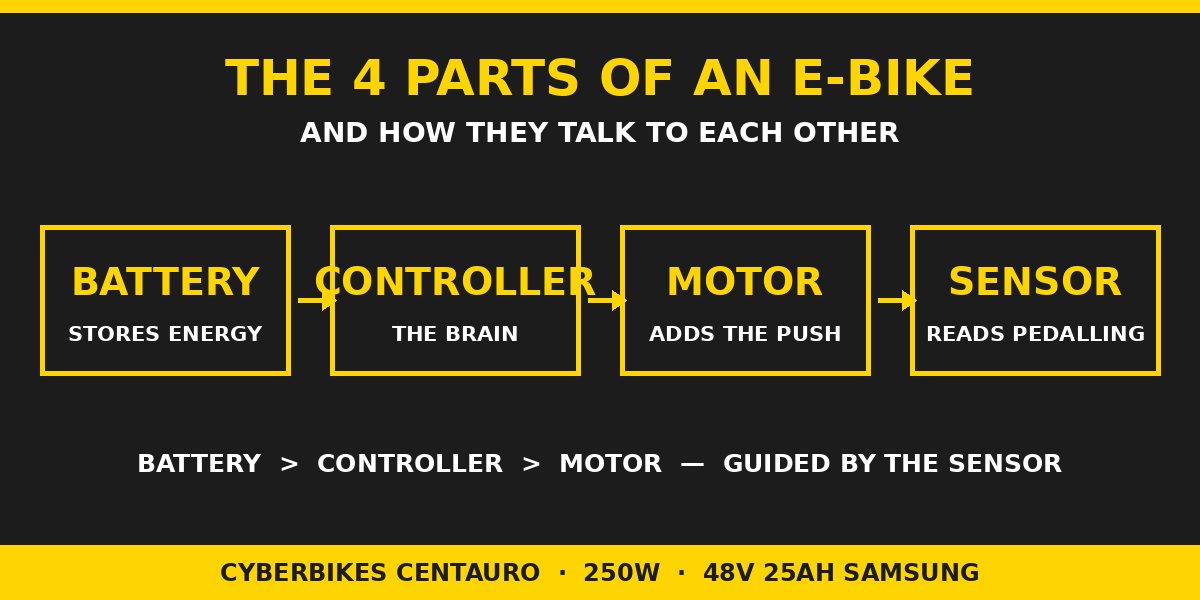
An e-bike works by combining your pedalling with power from an electric motor, which draws energy from a rechargeable battery. A controller acts as the brain, and a sensor tells that brain when — and how hard — you are pedalling, so the motor delivers assistance smoothly and legally. Get those four parts right and an e-bike feels less like a machine and more like a strong tailwind that never stops.
This is the most complete plain-English guide to how electric bikes actually work that you’ll find in Australia. We built it at Cyberbikes in Leichhardt, Sydney, from more than a decade of selling, renting and repairing e-bikes — so by the end you’ll understand every component well enough to buy the right bike without needing to read anything else. We’ll use real, verifiable specs from our own Centauro e-bike along the way, and reference independent technical authority (the engineers at ebikes.ca / Grin) where the physics matters.
What you’ll learn in this guide
- How does an electric bike actually work?
- What does the e-bike motor do?
- Hub motor vs mid-drive motor: which is better?
- What is an e-bike controller and what does it do?
- What do the watts and amps on an e-bike actually mean?
- What are e-bike sensors?
- Torque sensor vs cadence sensor: what’s the difference?
- How does pedal assist (PAS) work?
- Throttle vs pedal assist: what’s the difference?
- How does the battery power the whole system?
- What does the display or console do?
- How do the brakes talk to the motor?
- What is regenerative braking, and do e-bikes have it?
- How fast can an e-bike go, and what does NSW law allow?
- How do all the parts work together in one ride?
- Why do some e-bike systems last longer than others?
- Which e-bike system should you choose in Sydney?
- Frequently asked questions
How does an electric bike actually work?
An electric bike works exactly like a normal bicycle, with one addition: a small electric drive system that adds power on top of your own effort. There are four core parts. The battery stores energy. The motor converts that energy into rotation that helps drive the wheel. The controller decides how much power to send, moment by moment. And a sensor reads what you’re doing on the pedals and reports it to the controller. A display lets you choose how much help you want.
The key thing to understand is that a legal Australian e-bike is a pedal-assist machine, not a motorbike. It amplifies your pedalling rather than replacing it. When you stop pedalling — or hit the legal speed limit — the assistance eases off. That’s why riders describe a good e-bike as feeling “invisible”: the electronics work quietly in the background, and you just feel stronger.
What does the e-bike motor do?
The motor is the part that turns stored battery energy into forward movement. It sits either inside a wheel hub or in the centre of the frame at the cranks, and it spins when the controller sends it current. The more current the controller allows, the harder the motor pushes — up to the limits set by law and by the motor’s design.
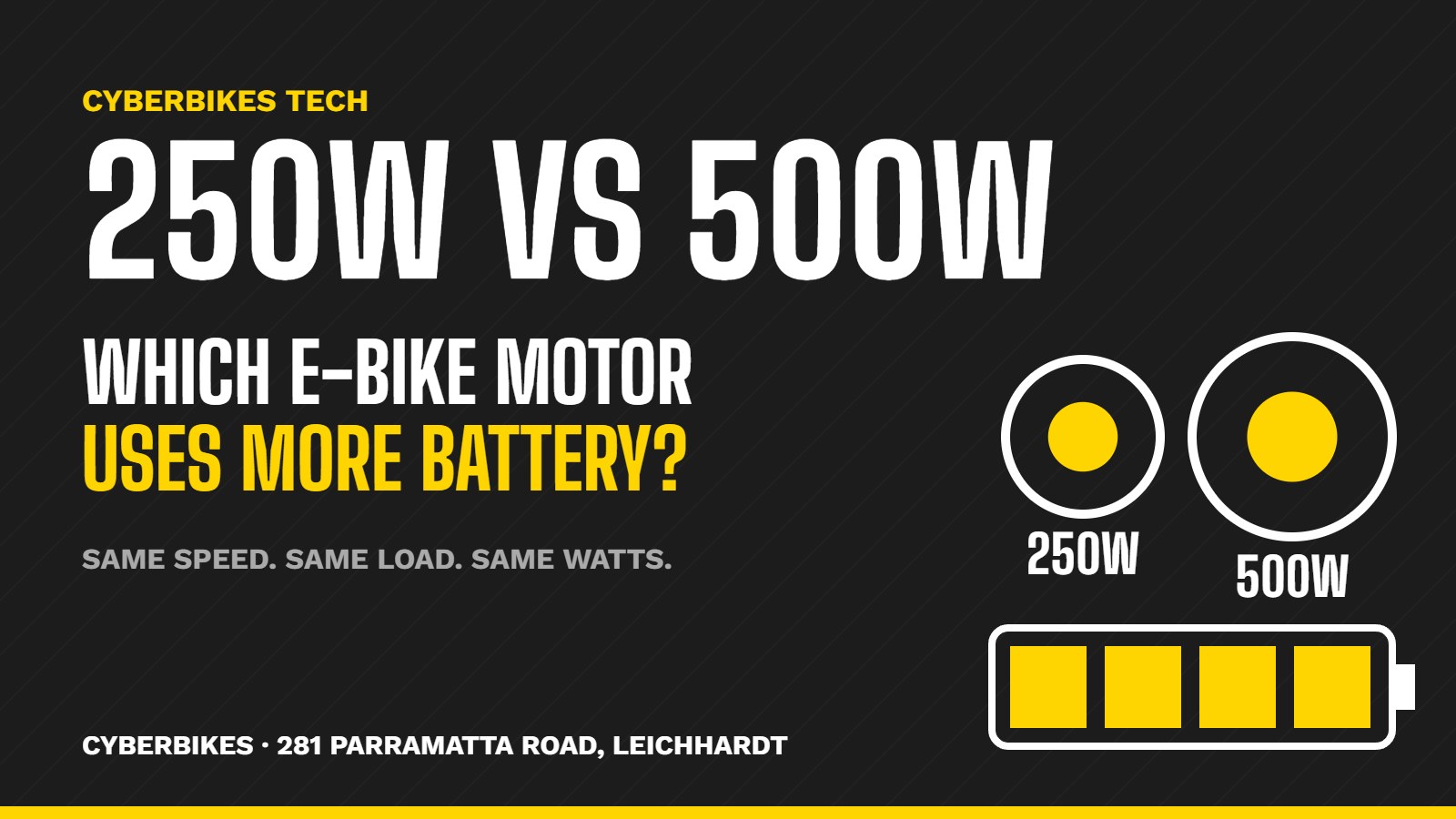
Australian road-legal e-bikes use a motor rated at 250W continuous, the figure defined by the European pedalec standard EN 15194 that Australia adopts. Our Centauro, for example, runs a 250W rear hub motor that’s certified to EN 15194 for power and speed. “250W continuous” doesn’t mean the motor can never draw more than 250 watts for a split second on a hill — it means 250W is the sustained, rated output. That rating is what keeps the bike classified as a bicycle rather than a registrable vehicle.
Hub motor vs mid-drive motor: which is better?
There are two main motor locations, and each has a clear personality.
A hub motor lives inside the front or rear wheel and drives that wheel directly. It’s simple, quiet, low-maintenance and doesn’t wear out your chain or gears, because it pushes the wheel rather than the drivetrain. Rear hub motors — like the one on the Centauro — give a natural “pushed from behind” feel that most commuters love. The trade-off is that a hub motor doesn’t use the bike’s gears, so it works hardest on very steep climbs.
A mid-drive motor sits at the cranks and puts its power through the chain and gears. Because it can use the bike’s gearing, it’s efficient on steep off-road climbs and keeps weight low and central. The trade-off is more wear on the chain and cassette, a higher price, and more complex servicing.
For everyday Sydney riding — commuting, shopping, bike paths and the occasional hill — a well-built rear hub motor is usually the smarter, lower-maintenance choice. For technical mountain-bike terrain, mid-drive earns its premium. Here’s the short comparison:
| Rear hub motor | Mid-drive motor | |
|---|---|---|
| Feel | Push from behind, smooth | Bike-like, uses your gears |
| Maintenance | Low — no extra drivetrain wear | Higher — wears chain & gears |
| Best for | Commuting, cargo, city, paths | Steep off-road climbing |
| Cost | More affordable | Usually more expensive |
| Servicing | Simple | More complex |
What is an e-bike controller and what does it do?
The controller is the brain of the e-bike. It’s a sealed electronic box, usually hidden in the frame, that sits between the battery, the motor, the sensors, the brakes and the display. Every decision about power flows through it: when to start the motor, how much current to release, when to cut power at the speed limit, and when to shut off if you grab the brakes.
The controller also protects the whole system. It watches battery voltage and stops the motor before the pack over-discharges, monitors motor temperature and current to prevent overheating, and manages smooth acceleration so the power doesn’t arrive as a jerk. As the engineers at ebikes.ca (Grin Technologies) explain, the controller’s job is essentially to translate a simple rider request — “help me a bit” or “help me a lot” — into precisely timed pulses of current to the motor’s windings. Get a cheap controller and you feel it as jerky, laggy, or overheating assistance. Get a good one and the bike simply feels intelligent.
What do the watts and amps on an e-bike actually mean?
Watts (W) measure power — how much work the motor can do. Amps (A) measure electrical current — how much electricity is flowing at a given moment. Volts (V) measure the “pressure” pushing that current. They’re linked by a simple rule: watts = volts × amps.
So a bike running a 48V battery and a controller that allows about 15 amps of current is delivering roughly 720 watts of peak electrical power to the motor on demand, even though its rated continuous output is 250W. That gap between peak and continuous is normal and legal — the continuous rating is what defines the bike’s road-legal class, while short bursts of higher current are what get you moving from a standstill or over a short rise. Higher voltage (like 48V) is generally more efficient than lower voltage, because it delivers the same power with less current, which means less heat and less energy lost in the wiring.
What are e-bike sensors?
A sensor is the part that tells the controller what you’re doing so the motor can respond appropriately. Without a sensor, the controller would be blind — it wouldn’t know whether you’re pedalling gently, sprinting, or coasting downhill. The two sensors that matter most are the pedal-assist sensor (which detects pedalling) and the brake sensor (which cuts the motor the instant you brake). Some bikes also have a speed sensor at the wheel to enforce the legal speed cut-off precisely.
Torque sensor vs cadence sensor: what’s the difference?
There are two ways an e-bike can detect your pedalling, and the difference is one you can feel on every ride.
A cadence sensor detects whether you are pedalling. As soon as the pedals turn, it tells the controller “rider is pedalling” and the motor delivers power at whatever assist level you’ve selected. It’s simple, robust and affordable, and it gives a strong, consistent push — a bit like a light switch turning on.
A torque sensor detects how hard you are pedalling, measuring the actual force you put through the pedals hundreds of times a second. It then scales the motor’s help to match your effort: pedal harder, get more; ease off, get less. This gives a more natural, bicycle-like feel and often better range, because the motor only works as hard as you do.
Neither is “wrong”. Cadence systems are proven, durable and easy to service — a real advantage for a bike that has to work every day. Torque systems feel more refined and premium. What matters most is how well the whole system is tuned, not just which sensor it uses.
How does pedal assist (PAS) work?
Pedal assist, or PAS, is the mode that defines a legal Australian e-bike. Here’s the chain of events, which happens in a fraction of a second every time you push the pedals: you start pedalling, the sensor detects it, the controller reads your selected assist level from the display, and the controller releases the right amount of battery current to the motor. The motor adds its push to your own, and you accelerate with far less effort. Stop pedalling and the assistance stops too.
Most e-bikes offer several PAS levels — typically 1 to 5. Level 1 sips power for maximum range; level 5 gives you the biggest boost for hills and headwinds. Learning to match your assist level to the terrain is the single biggest thing you can do to extend how far you ride on a charge.
Throttle vs pedal assist: what’s the difference?
Pedal assist only adds power while you’re pedalling. A throttle — usually a thumb lever or twist grip — adds power on demand, even if you’re not pedalling at all, like a motorbike. The distinction matters a lot in Australia because the law treats them differently.
Under the pedalec standard that Australia follows (EN 15194), assistance while pedalling cuts out at 25 km/h, and any throttle that works without pedalling is limited to 6 km/h — essentially a walk-along function for pushing the bike. That’s why compliant Australian e-bikes are pedal-first machines: the throttle, where fitted, is a low-speed helper, not the main way you ride. Our Centauro is built to exactly this standard: 250W continuous, 25 km/h pedal-assist cut-off, 6 km/h throttle.
How does the battery power the whole system?
The battery is the fuel tank. It stores electrical energy in lithium-ion cells and feeds it to the controller, which parcels it out to the motor. Three numbers describe any e-bike battery: volts (V), amp-hours (Ah) and watt-hours (Wh). Volts is the pressure, amp-hours is the capacity, and watt-hours — volts × amp-hours — is the true measure of how much total energy the pack holds, and therefore how far it can take you.
The Centauro uses a 48V 25Ah pack built from Samsung lithium-ion cells, which works out to 1200 watt-hours (48 × 25) — a genuinely large battery for an urban e-bike. Cell quality matters enormously here: name-brand cells like Samsung hold their capacity longer and behave more predictably than the anonymous cells in the cheapest bikes. Just as important is safety certification. The Centauro’s battery is certified to UL 2271, the recognised standard for e-bike battery safety, and the whole electrical system meets UL 2849. Those certifications are your assurance that the pack has been tested against overheating and fire risk — not a detail to skip when you’re charging a battery inside your home.
What does the display or console do?
The display is your dashboard and your remote control. At a glance it shows your speed, battery level, current assist level and often your distance and trip data. With its buttons you choose how much help you want, switch the lights on, and on many bikes access a walk-assist mode. Behind the scenes the display is in constant conversation with the controller — you press “+”, the display tells the controller to raise the assist level, and the controller adjusts the current to the motor. A clear, readable display makes managing your range and your ride effortless.
How do the brakes talk to the motor?
This is a safety feature many new riders don’t know about. E-bike brake levers usually contain a small brake sensor (motor cut-off switch). The instant you pull either lever, the sensor tells the controller to shut off motor power immediately — before the pads even bite. That means the motor can never fight your braking, and you always have full, predictable stopping control.
The mechanical braking still does the actual stopping, and here the hardware matters. The Centauro uses 4-piston hydraulic disc brakes with 180 mm rotors — serious stopping power that you want on any bike that’s heavier than a pushbike and often carrying cargo. Combined with the electronic cut-off, hydraulic brakes give you a bike that stops quickly and confidently, wet or dry.
What is regenerative braking, and do e-bikes have it?
Regenerative braking (“regen”) turns the motor into a generator while you slow down, feeding a little energy back into the battery instead of losing it all as heat. It sounds like free range, but the reality is modest: regen typically recovers only a small percentage of your energy, and it only works on certain direct-drive hub motors, not the geared hub or mid-drive motors used on most practical e-bikes. Its bigger real-world benefit is engine braking on long descents. For flat-to-rolling city riding, a bigger, better battery does far more for your range than regen ever will — which is why we focus on cell quality and capacity rather than marketing regen as a range miracle.
How fast can an e-bike go, and what does NSW law allow?
A road-legal e-bike in New South Wales is a power-assisted pedal cycle, and it’s governed by two numbers you should memorise: motor assistance while pedalling must cut out at 25 km/h, and throttle-only power (without pedalling) is capped at 6 km/h. Ride a compliant pedalec and you don’t need a licence, registration or insurance — it’s legally a bicycle, and you’re welcome on roads, bike lanes and shared paths where bicycles are allowed.
You can still pedal faster than 25 km/h under your own steam, of course — the law only limits motor assistance, not your legs. What makes a bike compliant is that it’s built and certified to the pedalec standard, EN 15194, with a rated 250W continuous motor. The Centauro is designed to meet EN 15194 for power and speed, along with UL 2849 (system), UL 2271 (battery) and ISO 4210 (frame) — the full set of certifications that separate a properly engineered e-bike from a grey-import gamble. If you take one legal fact from this guide: assist to 25 km/h, throttle to 6 km/h, and buy a bike that’s certified, not just advertised.
How do all the parts work together in one ride?
Let’s put it all together in the two seconds after you push off from a Sydney traffic light. You press the pedals. The sensor detects your pedalling (and, on a torque system, how hard). The display has already told the controller which assist level you chose. The controller reads the sensor, checks battery voltage and your speed, and releases a precise burst of current from the battery to the motor. The motor spins the rear wheel, adding its push to your legs, and you glide away from the lights ahead of the cars.
As you reach 25 km/h, the controller gently tapers the assistance to stay legal. When you spot a pedestrian and squeeze the brake, the brake sensor cuts the motor instantly and the hydraulic discs bring you to a smooth stop. Every one of those handoffs happens in milliseconds, invisibly. That seamless choreography — battery, controller, sensor, motor, brakes — is what “how an e-bike works” really means, and it’s why the quality of each component, and how well they’re tuned together, decides whether a bike feels magic or mediocre.
Why do some e-bike systems last longer than others?
Two e-bikes can share the same spec sheet and age completely differently, and it comes down to component quality and integration. Cheap bikes cut corners you can’t see: unbranded battery cells that fade fast, undersized controllers that overheat and throttle themselves, water-vulnerable connectors, and no genuine safety certification. Better bikes use name-brand cells (Samsung on the Centauro), properly rated controllers, sealed wiring, and real certification (UL 2271, UL 2849, ISO 4210, EN 15194).
Frame and hardware count too. The Centauro’s frame is 6061 aluminium alloy built to ISO 4210, with full suspension (100 mm front, 120 mm rear travel) to protect both you and the electronics from road shock. It’s rated to a 150 kg total load, with a welded rear rack good for 50 kg and integrated GPS tracking. Those aren’t luxuries — they’re what let a system survive years of daily Sydney commuting rather than months. When you buy an e-bike, you’re really buying how well its parts were chosen and how they’ll behave in year three, not just how it feels in the shop.
Which e-bike system should you choose in Sydney?
Now that you understand the parts, choosing is simple: look for name-brand battery cells, a properly rated 250W-compliant motor, hydraulic brakes with motor cut-off, full certification, and a frame and suspension built for real loads and real roads. That’s exactly how we designed the Cyberbikes Centauro.
The Centauro is a step-through, full-suspension e-bike built for Sydney commuting, cargo and everyday riding. It pairs a smooth 250W rear hub motor with a big 48V 25Ah (1200Wh) Samsung battery, 4-piston hydraulic brakes on 180 mm rotors, a 150 kg load rating with a welded 50 kg rear rack, integrated GPS tracking, and the full stack of safety certifications (UL 2849, UL 2271, ISO 4210, EN 15194). It was designed by our founder, Felipe Rodrigues, out of more than ten years selling, renting and repairing e-bikes in Sydney — so every component choice comes from watching what actually lasts on our roads. It comes with an 18-month warranty and a choice of four colours.
You can buy the Centauro outright for $3,999.99, or ride one now on our Sydney rent-to-own plan from $99.99 a week. The best way to understand how an e-bike works is to feel it: see the full Centauro specs and book a test ride here.
The bottom line
An e-bike works because four well-matched parts talk to each other constantly: a battery stores energy, a motor turns it into a push, a controller decides exactly how much push to give, and a sensor makes sure that push matches your pedalling — all kept legal by a 25 km/h assist cut-off and cut instantly by your brakes. Understand those parts and you’ll never be fooled by a flashy spec sheet again; you’ll know that cell quality, a properly rated controller, real certification and a strong frame are what actually make an e-bike worth owning. If you want a bike where all of that has already been sorted, come and feel the difference for yourself on a Cyberbikes Centauro.
Frequently asked questions
How does an electric bike work in simple terms?
An electric bike adds a motor and battery to a normal bicycle. When you pedal, a sensor tells a controller you’re riding, and the controller releases battery power to the motor so it boosts your pedalling. Stop pedalling or reach 25 km/h and the assistance eases off — it amplifies your effort rather than replacing it.
Do you still have to pedal an electric bike?
Yes. Legal Australian e-bikes are pedal-assist: the motor only helps while you pedal, and any throttle is limited to 6 km/h. You pedal as normal, just with far less effort, and you can still pedal faster than 25 km/h under your own power.
What is the difference between a hub motor and a mid-drive motor?
A hub motor sits in the wheel and drives it directly — simple, quiet and low-maintenance, ideal for commuting and cargo. A mid-drive motor sits at the cranks and uses the bike’s gears, which suits steep off-road climbing but wears the chain faster and costs more.
How far can an electric bike go on one charge?
Range depends mostly on battery watt-hours, your assist level, terrain and rider weight. A large pack like the Centauro’s 48V 25Ah (1200Wh) Samsung battery is built for long everyday range; using lower assist levels on flat ground stretches it further than high assist on hills.
Want to see exactly how these systems feel on the road? Visit Cyberbikes at 281 Parramatta Road, Leichhardt NSW, or call 0491 794 668 to book a test ride on the Centauro. We’ve spent over a decade making e-bikes make sense for Sydney riders.
#Cyberbikes #eBikeSydney #ElectricBike #Centauro #eBikeLeichhardt #HowEbikesWork #eBikeCommuting #RentToOwn