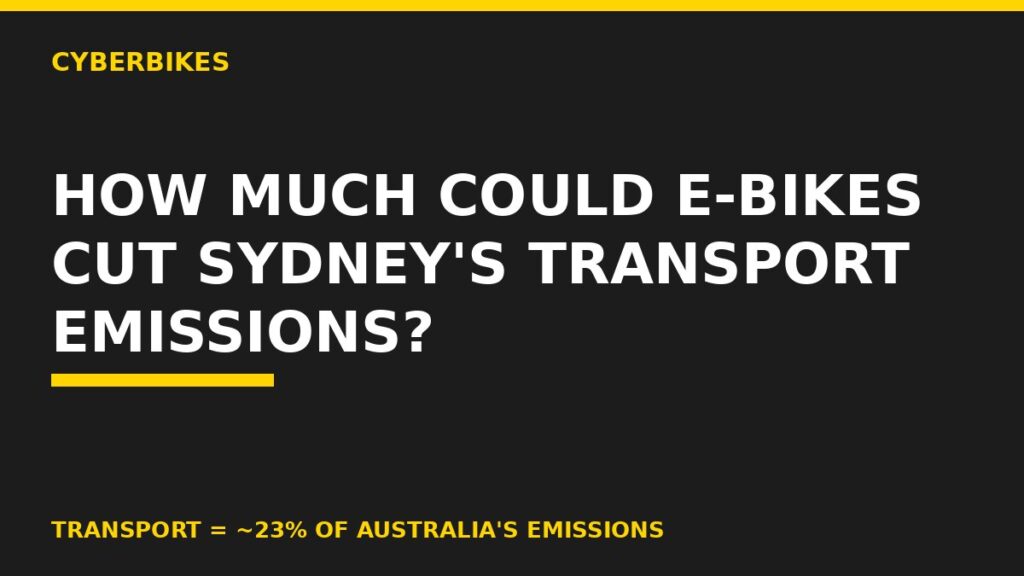
Transport now makes up around 23% of Australia’s greenhouse-gas emissions, and passenger cars alone throw off more than 10% of the national total. That makes Sydney’s transport emissions one of the city’s most stubborn — and most fixable — climate problems. Swap even a slice of our short car trips onto e-bikes and the maths moves fast: peer-reviewed research finds a 15% e-bike mode share could cut passenger-transport CO₂ by roughly 12%. At Cyberbikes in Leichhardt we watch it happen every week — a car commute quietly replaced by a battery and two wheels.
How big is Sydney’s transport emissions problem?
Transport is Australia’s third-largest source of greenhouse gases and one of the fastest-growing. According to the Department of Climate Change, Energy, the Environment and Water, it accounts for roughly a fifth of national emissions — about 23% in 2024–25 — and the road dominates. Passenger and light commercial vehicles make up around 60% of transport emissions, and passenger cars on their own are responsible for about 42% of the transport total, or more than 10% of everything the country emits.
Sydney is a car-shaped city: sprawling suburbs, wide arterials and a lot of trips that default to the car even when they’re short enough to ride. That’s exactly where the easy wins hide — not in the cross-city commute, but in the 2–8 km hop to the station, the shops or school.
How much cleaner is an e-bike than a car?
An e-bike produces around 13 grams of CO₂ per kilometre over its entire lifecycle; a car produces roughly 90 grams per passenger-kilometre once you count fuel, manufacturing and the electricity grid. That’s a 90–95% cut in emissions for every kilometre you shift off four wheels and onto two — and for a solo driver in a petrol car, real-world tailpipe figures run far higher again.
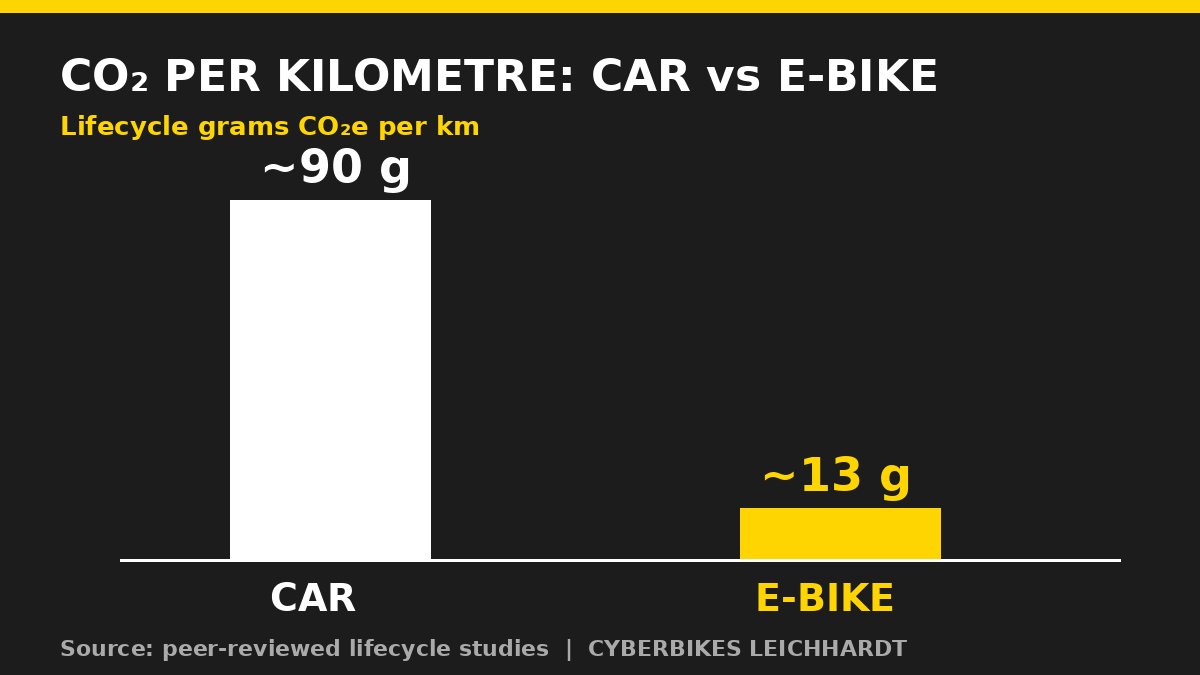
The comparison holds even on a coal-heavy grid, because an e-bike sips power — a full charge costs a few cents and moves you tens of kilometres. Detailed lifecycle analysis of e-bikes and car CO₂ reaches the same conclusion: nothing on the road comes close to an e-bike per passenger-kilometre.
Could e-bikes really move the needle for a whole city?
Yes — at scale the effect is real, not a rounding error. Modelling in a peer-reviewed study on the potential of e-bikes to replace passenger car trips found that a 15% e-bike share of person-kilometres travelled could deliver about a 12% reduction in passenger-transport CO₂. Surveys of e-bike owners back it up: in one Swedish study, 42–60% of rural riders and 71–86% of urban riders reported shifting trips off the car after buying an e-bike.
The reason is that e-bikes don’t just replace ordinary bike trips — they replace car trips, especially the medium-length ones that a regular bike feels like too much hard work for. If you want the full picture of what going car-lighter looks like in practice, see our guide to why short Sydney trips belong on an e-bike and the real numbers on what owning a car in Sydney actually costs.
What would it take to cut Sydney’s transport emissions?
Two things, mostly: safe places to ride and affordable bikes. Protected bike lanes turn “I’d ride if it weren’t terrifying” into actual trips, and an e-bike erases the hills, the heat and the sweat that keep people in the car. Get both right and a big chunk of Sydney’s short-trip emissions simply evaporates.
The affordable-bike part is where we come in. Our Cyberbikes Centauro is a 250W, NSW-legal (25 km/h pedal-assist) full-suspension commuter with a 48V 25Ah Samsung battery and a UL 2271-certified pack — priced at $3,999, or from $99.99/week rent-to-own so you can trade a car trip for a ride without a big upfront hit.
Frequently Asked Questions
Are e-bikes really better for the environment than cars?
Yes. Over their full lifecycle e-bikes emit around 13 grams of CO₂ per kilometre versus roughly 90 grams per passenger-kilometre for a car — a 90–95% reduction — because they weigh a fraction as much and use very little electricity.
How much CO₂ can switching to an e-bike save?
Every car kilometre you replace with an e-bike saves roughly 75–80 grams of CO₂. Across a city, research suggests a 15% e-bike mode share could cut passenger-transport emissions by about 12%.
Are e-bikes legal to ride in Sydney?
Yes. In NSW a road-legal e-bike is limited to 250W continuous with pedal-assist cutting out at 25 km/h. Helmets are mandatory, and you can ride on roads and shared paths just like a regular bicycle.
Sydney’s transport emissions won’t fall because of one policy or one gadget — they’ll fall one trip at a time. Swap a single car trip a week for an e-bike ride and see what changes. If you’re curious what going car-lighter would look like for you, come see us at Cyberbikes, 281 Parramatta Road, Leichhardt.
#Cyberbikes #EbikeSydney #Leichhardt #SydneyTransport #CarFreeSydney #ClimateAction #ActiveTransport #EbikeCommute