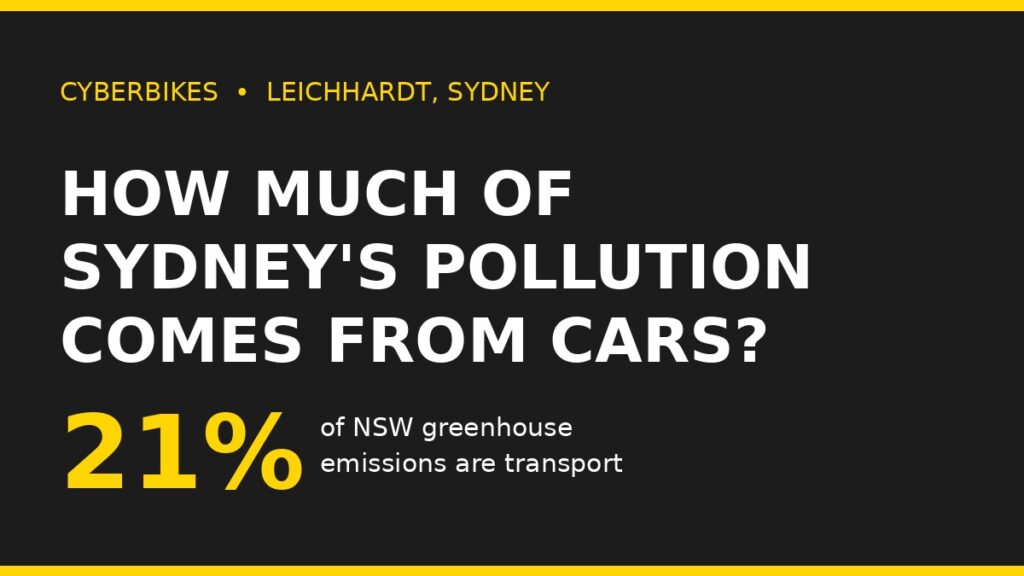
Short answer: most of it. Transport is responsible for about 21% of New South Wales’ greenhouse gas emissions, and roughly 89% of that comes from vehicles on the road — overwhelmingly private cars. In a car-dependent city like Sydney, that makes the daily commute one of the biggest climate levers an ordinary person actually controls. And swapping a few short car trips a week for an e-bike is one of the fastest ways to pull it.
At Cyberbikes in Leichhardt we hear the pushback constantly: “one bike won’t change anything.” Here’s the data behind why that’s the wrong way to look at it.
How much of Sydney’s air pollution actually comes from cars?
According to the NSW State of the Environment report, transport made up about 21% of the state’s greenhouse gas emissions, and road transport accounted for roughly 89% of that — around 20.9 million tonnes of CO₂-equivalent every year. Nationally, passenger and light vehicles — the cars and SUVs most of us drive — make up well over half of road transport emissions.
Electric cars aren’t rescuing us yet, either: EVs were just 0.8% of light vehicles registered in NSW as of early 2024. For the foreseeable future the Sydney car fleet runs on petrol and diesel — and it’s getting heavier and thirstier as buyers keep choosing large SUVs.
Why do cars pollute so much — even on short trips?
The average light vehicle in Australia emits about 191 grams of CO₂ per kilometre; even a brand-new car sold today averages around 156 g/km. Cold engines are least efficient in their first few minutes, so the 2–5 km hops that make up a huge share of city driving are some of the dirtiest kilometres a car ever does. Tailpipe gases are only part of it — brake and tyre wear throw fine particles into the air we breathe, and every parked car locks up street space that could move far more people. It’s worth understanding the real cost of running a car in Sydney before assuming it’s the cheap, obvious default.
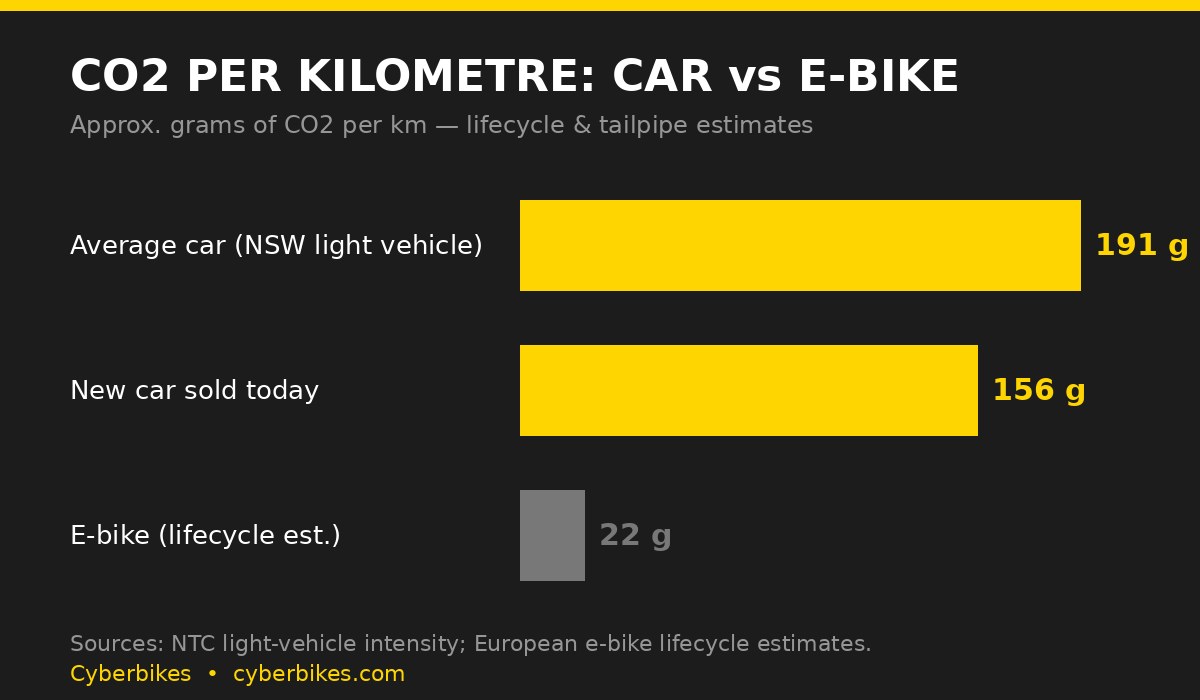
Car emissions vs an e-bike: the per-kilometre gap
An e-bike is not zero-emission — the battery and frame carry a manufacturing footprint, and charging draws from the grid. But it’s close. Lifecycle estimates put an e-bike at roughly 14–22 grams of CO₂ per kilometre, against about 240 grams per passenger-kilometre for a car in European comparisons. That’s an order-of-magnitude difference. Because the motor only ever assists up to 25 km/h, a rider covers a 5 km commute on a few cents of electricity and a rounding error of carbon. Cars also warm the city in ways a bike never does — more on how cars heat up Sydney’s streets.
Is an e-bike actually legal to ride to work in Sydney?
Yes. In NSW a power-assisted bicycle is treated as a bicycle — no registration, no licence, no insurance — provided the motor’s continuous rated power stays at or below 500W, assistance cuts out at 25 km/h, and any throttle-only function stops at 6 km/h, per Transport for NSW. From 1 March 2029 the limit tightens to 250W with EN 15194 certification. The Cyberbikes Centauro, with its 250W motor and UL 2271-certified 48V battery, sits comfortably inside those rules today and after 2029. Helmets, of course, are mandatory.
Can swapping trips really move the needle for Sydney?
Individually, no single ride saves the planet. Collectively, it’s one of the highest-impact changes a city can make — because e-bikes replace car trips, not other bike trips. Every commute shifted from a two-tonne car to a 30 kg e-bike strips out emissions, congestion and a parked car in one move. Paris, Amsterdam and Copenhagen didn’t cut driving by lecturing anyone; they built protected lanes and made the low-carbon choice the easy one. Sydney can do the same, one commute at a time.
Frequently Asked Questions
What percentage of Sydney’s emissions come from cars?
Transport accounts for about 21% of NSW greenhouse gas emissions, and road transport — mostly cars — makes up roughly 89% of that, so private cars are the single largest slice of Sydney’s transport pollution.
Are e-bikes really better for the environment than cars?
Yes. Lifecycle estimates put an e-bike at roughly 14–22 g CO₂ per km versus around 191 g/km for an average Australian car — roughly ten times less, even after accounting for battery manufacturing and charging.
Do you need a licence to ride an e-bike in Sydney?
No. In NSW a compliant e-bike (up to 500W, with assistance cutting out at 25 km/h) is treated as a bicycle, so it needs no registration, licence or insurance.
Swap one car trip a week for an e-bike ride and see what changes. If you’d like to feel the difference before committing, come and talk to us at Cyberbikes, 281 Parramatta Road, Leichhardt — or try the Centauro on rent-to-own from $99.99/week.
#Cyberbikes #eBikeSydney #Leichhardt #CarFreeSydney #SustainableTransport #eBikeCommute #SydneyCycling