Short answer: probably yes — but only if it comes with a genuine alternative. The Grattan Institute modelled that a $5-to-enter, $5-to-exit peak charge would cut the number of cars driving into Sydney’s CBD each morning by about 40%. A Sydney congestion charge would clearly shift traffic. The harder question is whether it’s fair — and that depends entirely on giving people a cheap, quick way into the city without a car. That’s exactly where the e-bike comes in.
What is a congestion charge, and how would it work in Sydney?
A congestion charge is simply a fee for driving into a busy area at a busy time. Road space in the CBD is scarce at peak hour, so you price it — the way you’d price any scarce, in-demand thing. In its 2019 report Right time, right place, right price, the Grattan Institute proposed drivers pay roughly $5 to enter the Sydney CBD in the morning peak (8:00–9:30am) and about $5 to leave in the afternoon peak (4:00–6:00pm), with smaller charges in the shoulder periods. Just as importantly, Grattan argued every dollar raised should go straight back into the streets — safer crossings, wider footpaths, and protected space for bikes.
Would it actually cut Sydney’s traffic?
The clearest real-world test is London. Since its congestion charge launched in 2003, traffic entering the central zone fell by roughly a fifth, while cycling climbed sharply — close to doubling in the years after launch — as people swapped short car trips for bikes and buses. It isn’t a magic fix, but the direction is consistent everywhere it’s been tried: price the peak, and a big chunk of drivers change how they travel.
| What London’s congestion charge changed | Result after launch |
|---|---|
| Traffic entering the charging zone | Down about 21% |
| Cycling inside the zone | Roughly doubled |
| Bus passengers in charging hours | Rose sharply |
| Road casualties | Fell |
What is congestion already costing Sydney?
More than most of us realise. According to BITRE, Sydney carries the highest avoidable congestion cost of any Australian city — around $6 billion a year in the mid-2010s, and projected to rise toward roughly $12 billion by 2030 as the city grows. “Avoidable” is the key word: it’s the wasted time, fuel and emissions we could dodge with better choices. A huge share of that is short trips that never needed a two-tonne car in the first place. Building more road just fills up again — which is why so much of the debate has moved from “add lanes” to “manage demand”.
Is a congestion charge fair — and where do e-bikes fit?
Here’s the honest trade-off: a flat charge hits hardest the people with the fewest options — shift workers, tradies and anyone without a decent train nearby. That’s the strongest argument against it. The fair version answers it directly: pair the charge with sensible exemptions, spend the revenue on better transport, and make the car-free option genuinely good. And for a surprising number of Sydney trips, that option is an e-bike.
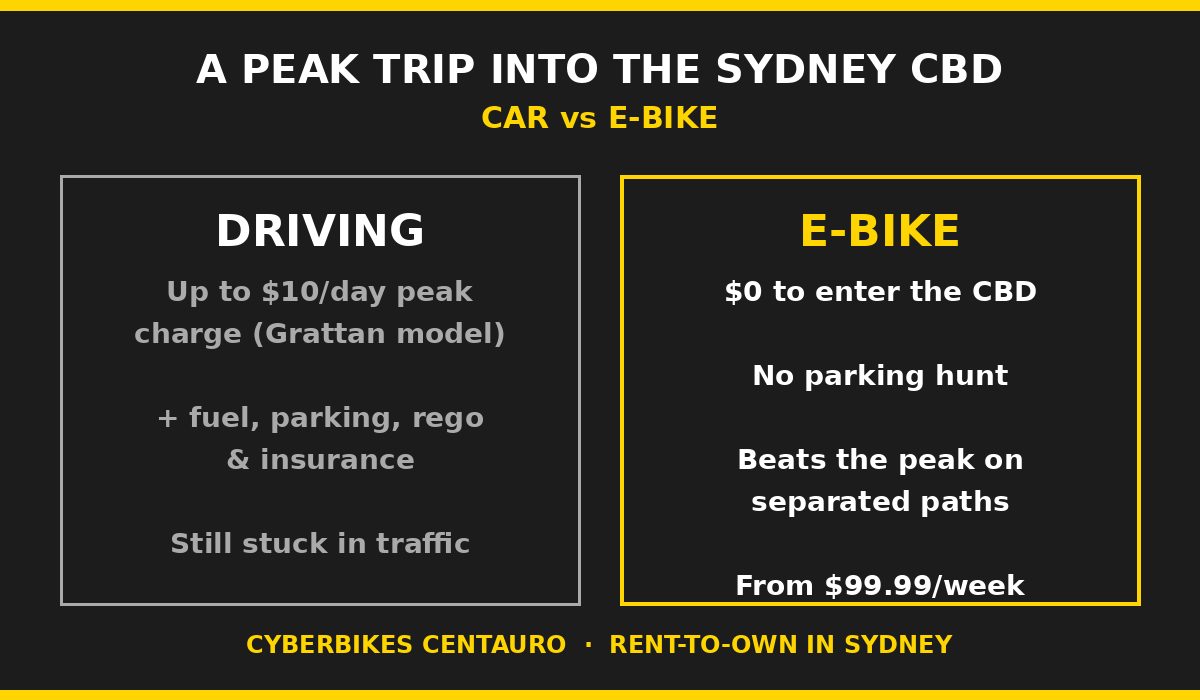
An e-bike glides past the peak on separated paths, costs nothing to park, and pays no charge to enter the city. Our Cyberbikes Centauro runs a 250W rear hub motor and a 48V 25Ah (1,200Wh) Samsung battery, and is built to UL 2849, UL 2271, ISO 4210 and EN 15194 (250W continuous, 25 km/h pedal assist). Its welded rear rack carries up to 50kg, so the weekly shop or a work run is no problem, and it’s $3,999 outright — or from $99.99/week rent-to-own here in Sydney. Better still, a compliant e-bike in NSW needs no licence, no registration and no insurance.
Want the full picture before you swap? Our car-free e-bike commuting and rent-to-own guide runs through how it works, and what owning a car in Sydney really costs shows exactly what you’d save.
Frequently asked questions
Does Sydney have a congestion charge?
No. Sydney has motorway tolls, but no charge for entering the CBD at peak times. A congestion charge has been proposed several times — most notably by the Grattan Institute’s 2019 plan for a roughly $5 peak charge to enter and exit the city centre — but none has been adopted.
How much would a Sydney congestion charge cost drivers?
Under the most detailed proposal, the Grattan Institute suggested about $5 to enter the CBD in the morning peak and about $5 to leave in the afternoon peak, with smaller amounts in the shoulder periods — roughly $10 on a full peak-in, peak-out day, and nothing off-peak.
Do you need a licence or registration to ride an e-bike in Sydney?
No. A compliant e-bike in NSW does not require a driver’s licence, registration or insurance, which is part of what makes it such a cheap, low-friction alternative to driving into the city.
You don’t have to wait for a congestion charge to beat the traffic. Swap one car trip a week for an e-bike ride and see what changes — or come talk it through with us at Cyberbikes, 281 Parramatta Road, Leichhardt.
#Cyberbikes #ebikeSydney #Leichhardt #congestioncharge #carfreeSydney #ebikecommute #Centauro #sustainabletransport