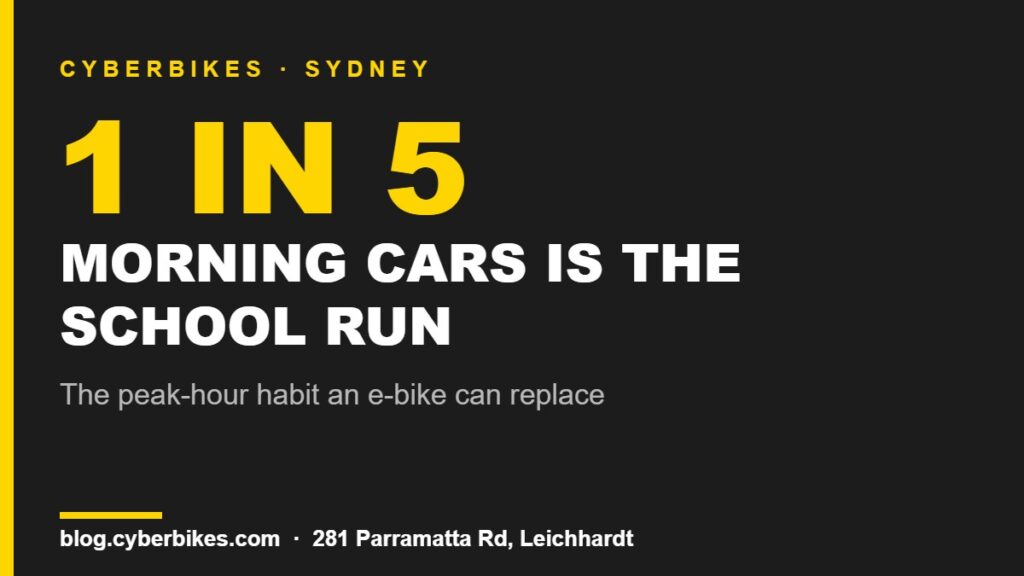
About one in five cars on the road during Sydney’s morning peak is doing the school run — roughly 20% of morning traffic is a parent driving a child to school, according to Transport for NSW. Nationally, cars now carry 61% of all school trips. That single daily habit is one of the most fixable causes of Sydney congestion — and for the huge share of trips that are genuinely short, an e-bike replaces the car completely.
The school run feels unavoidable when you’re stuck in it. But the data says most of it isn’t about distance at all — it’s about habit, road design and fear. Here’s what the morning rush is really made of, and why Sydney’s clogged school zones are an e-bike problem waiting for an e-bike answer.
How much of the morning rush is really the school run?
Transport for NSW puts it plainly: every morning, one in five cars on the road is driving a school student to school. Remove those trips and you don’t just ease the queue outside the gate — you cut a fifth of the vehicles from every arterial they pass through on the way. It’s why school holidays feel like someone drained the traffic: they did.
The pattern holds nationally. New research from the University of Sydney — the Australian School Travel Survey 2025, drawing on 4,968 families and travel data for 7,880 children — found that private cars now account for 61% of school trips. Walking and cycling make up just 21%, public transport 10%, and dedicated school buses 8%. In Perth, the WA Department of Transport estimates travel to school makes up 18.4% of morning peak trips — around 250,000 vehicle trips every weekday.
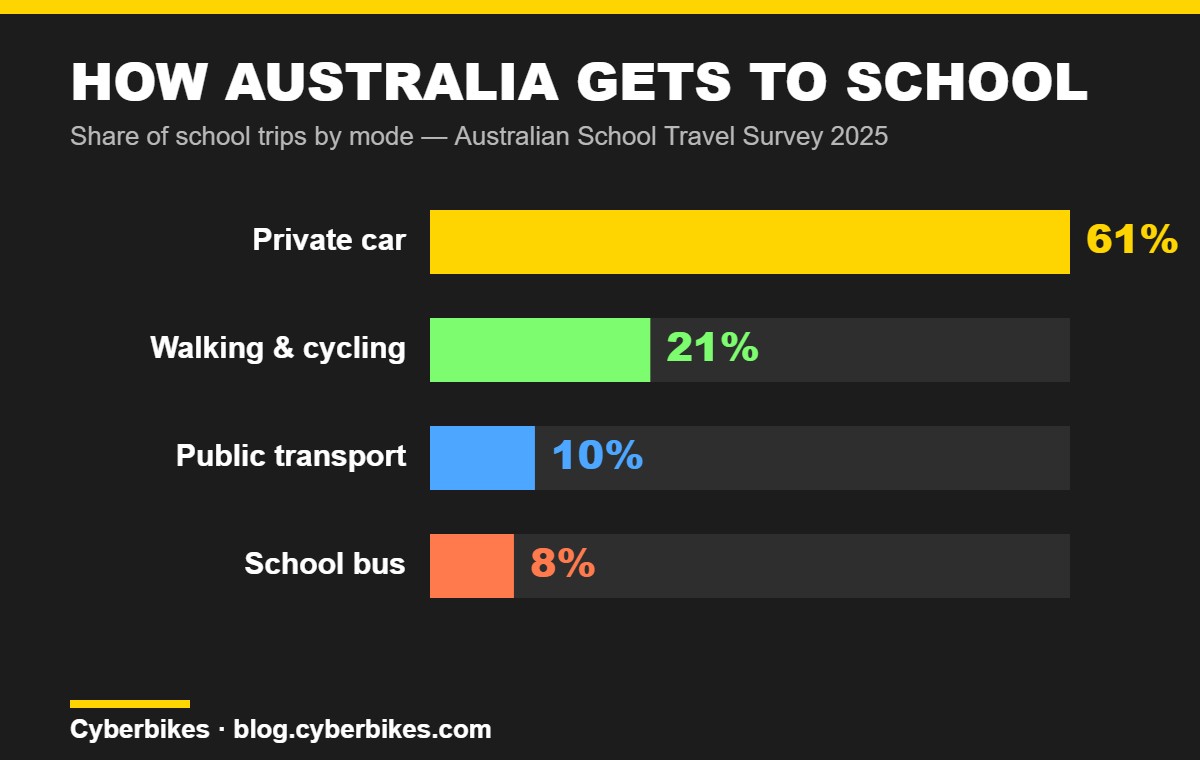
Put together, the school run isn’t a rounding error in the morning peak. It’s a fifth of it — concentrated into the same 30 minutes, on the same streets, at the same time.
Why do so many families drive — even short distances?
Because driving has quietly become the default, not the exception. The University of Sydney survey found that nearly four in ten children who live within one kilometre of school are still driven — a distance most kids could walk in fifteen minutes or ride in five. Distance matters, but it isn’t the whole story.
Three forces lock the habit in. First, fear of traffic: parents drive because the roads feel too dangerous to let kids walk or ride — which puts one more car on the road and makes the next parent feel the same way. It’s a feedback loop that manufactures its own congestion. Second, out-of-catchment enrolments: the survey found children who attend a school outside their local area travel much further and are the most car-dependent group of all. Third, time pressure: the school run rarely ends at 3pm, with more than 80% of after-school and extracurricular trips also made by car.
None of this is inevitable. Associate Professor Jennifer Kent, who led the survey, points to Germany, where slower street speeds and strong local school attendance see seven in ten children walk or cycle. In Australia, higher-speed streets and long commutes leave just two in ten doing the same. As she puts it, “This trajectory is not inevitable — it’s a policy choice.” Better street design and safer routes are exactly the fix Sydney keeps arguing about — the same logic behind why building more road lanes never actually clears Sydney’s traffic.
Could an e-bike actually replace the school run?
For most families, yes — because the trips are short and the loads are light. When four in ten sub-one-kilometre trips are still driven, the barrier isn’t range or fitness; it’s the feeling that a bike can’t carry a child, two schoolbags and a scooter. A modern cargo e-bike can, and it flattens the hills and the headwinds that make riding with kids feel like hard work.
That’s the case for a practical do-everything bike like the Cyberbikes Centauro. It’s a full-suspension, step-through frame (easy on, easy off, even loaded), with a welded rear rack for panniers or a child seat, hydraulic brakes for confident stopping in traffic, and a 48V 25Ah (1,200Wh) Samsung battery that runs for days of short school and shop trips between charges. In NSW, pedal-assist e-bikes are capped at 250W and cut assistance at 25 km/h — fast enough to keep pace on a shared path, gentle enough for the school zone.
Swap even one drive-to-school for a ride and the maths compounds: you skip the drop-off queue, you’re not hunting for a park, and your child arrives having actually moved their body before the first bell. For the deeper how-to on going car-lighter in the Inner West, our complete guide to car-free e-bike commuting and rent-to-own in Sydney walks through routes, costs and getting started.
What would a school-run-free morning look like for Sydney?
Shift even a third of those one-in-five school-run cars to bikes and you take a meaningful slice out of the entire morning peak — not just at the gate, but across every road those trips feed into. Fewer idling cars means cleaner air outside schools, safer crossings, and streets calm enough that the next family feels safe letting their kids ride too. That’s how the feedback loop reverses.
It doesn’t need a mega-project. It needs safe, connected routes to school and a critical mass of families willing to try. Inner West streets like ours around Leichhardt — flat, gridded and increasingly well-connected by shared paths — are some of the easiest places in Sydney to make the switch. Every child on a bike is one less car in the queue, and a quieter, more breathable street for everyone else.
Frequently Asked Questions
What percentage of Sydney’s morning traffic is the school run?
Transport for NSW estimates that one in five cars on the road during the morning peak — about 20% — is driving a school student to school. Nationally, cars carry 61% of all school trips, according to the University of Sydney’s Australian School Travel Survey 2025.
Why do parents drive kids to school even short distances?
Research shows nearly four in ten children living within one kilometre of school are still driven. The main drivers are fear of traffic, schools chosen outside the local catchment (longer trips), and time pressure — not distance. Safer streets and connected bike routes are the proven fix.
Can you do the school run on an e-bike in Sydney?
Yes. A cargo e-bike like the Cyberbikes Centauro carries a child, bags and gear, with a step-through frame and a big Samsung battery for days of short trips. NSW law allows pedal-assist e-bikes up to 250W with assistance to 25 km/h — ideal for school-zone speeds and shared paths. Helmets are mandatory in NSW.
Swap one drive-to-school a week for a ride and see what changes — for your morning, and for your street. If you’re curious what a car-lighter school run could look like, come and see us at Cyberbikes, 281 Parramatta Road, Leichhardt, or explore the Centauro on rent-to-own.
#Cyberbikes #eBikeSydney #SchoolRun #InnerWest #Leichhardt #CargoBike #CarFreeSydney #ActiveTravel