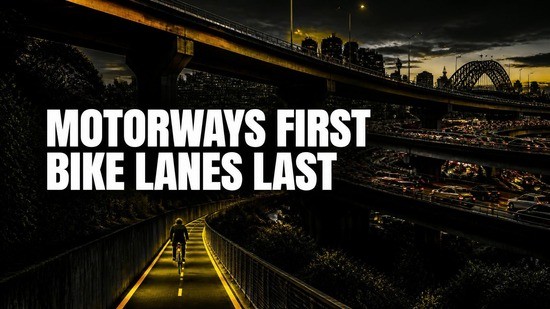
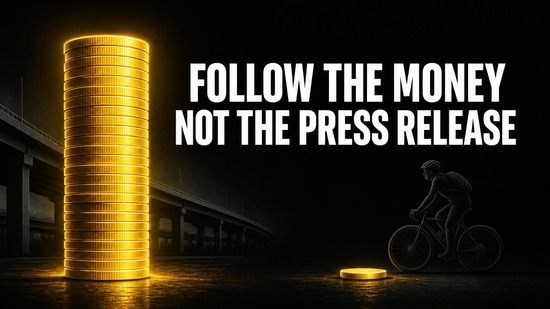
Sydney bike lane funding is a rounding error next to what we spend on motorways. One road project — WestConnex — was budgeted at $16.812 billion in its 2015 business case, and the Audit Office of NSW later found a further $4.26 billion of related work funded outside that budget. The entire national fund for walking and riding is $500 million spread over ten years. That is roughly forty dollars of motorway for every dollar of bike lane — and it is a choice, not a law of physics.
How big is the gap between motorway spending and Sydney bike lane funding?
Put the numbers next to each other and the argument stops being a vibe and starts being arithmetic. The Audit Office of NSW reported that WestConnex was costed at $14.881 billion in 2013, rose to $16.812 billion in the 2015 business case, and then had another $4.26 billion of connected projects delivered outside that budget altogether — $2.3 billion of network integration, $1.76 billion for the Sydney Gateway road component, and $198 million for the Parramatta Road Urban Amenity Program. The auditors’ conclusion was blunt: splitting those projects out “has understated the total cost”.
- One Sydney motorway, all in: about $21 billion
- National Active Transport Fund: $500 million over ten years, shared across every state and territory
- Ratio: roughly 42 to 1
That $198 million “urban amenity” line is the one we notice from the shop at 281 Parramatta Road, Leichhardt — a sweetener worth about one per cent of the motorway it came with, and still bigger than most cycling programs ever see.
Why does a $500 million fund sound big and spend small?
Because ten-year figures are a presentation trick, and because the queue is enormous. Bicycle NSW set out the profile: $90.2 million in 2026-27, $75.3 million in 2027-28, $68.8 million in 2028-29 — around $270 million actually spent by 2029, nationally. Its predecessor, a $100 million fund meant to last four years, was exhausted in year one because councils asked for far more than was on offer. And before any of it, there were fifteen consecutive years with zero dollars for active transport in federal budgets.
Unit costs make the scale obvious. The Wilson Street West Cycleway in Sydney drew $2.9 million from that first round. At roughly that price, $21 billion is on the order of seven thousand cycleways — the money that disappears into a single interchange would transform riding in every suburb of this city.
What does the funding gap actually cost Sydney?
It shows up as missing links. The NSW Government’s Active Transport to School program put $10 million toward wider footpaths, safer crossings and street trees, with individual grants between $50,000 and $800,000 delivered over two years. It also stated the problem it was built to solve: only 25 per cent of NSW school children currently walk or ride to and from school. Ten million dollars is less than 0.05 per cent of the WestConnex figure — against a behaviour change that would take cars out of every morning peak in the city.
It is worth being precise about blame here. Nobody drives their kid 800 metres because they are lazy. They drive because the route involves a road they would not walk down themselves, and the alternative was never built. The failure sits in road design, speed limits and appraisal method — not in people responding rationally to the city they were handed. Business cases are very good at counting the seconds a driver saves and very bad at counting the trips that never happen because the safe route is missing. Build the motorway and traffic arrives to fill it, which is exactly why adding lanes never fixes Sydney traffic. Build the cycleway and demand shows up too — it just isn’t counted the same way.
Can an e-bike close the gap before the budget does?
Partly, and sooner. An e-bike flattens Sydney’s hills and stretches the range at which riding beats driving, so it can use the patchy network we already have instead of waiting for the finished one. Before you buy, read the rules from Transport for NSW: in NSW a legal e-bike has a maximum continuous rated power of 500 W, motor assistance that stops at 25 km/h, and throttle-only power that cuts out at 6 km/h. A securely fitted helmet is mandatory. From 1 March 2029 only EN 15194 certified e-bikes will be allowed on NSW roads, at 250 W. And bikes that exceed those limits are illegal “even if the power or speed is restricted by software (app, switch or code)” — so a dealer offering to unlock one is offering you a problem.
For what that covers in practice, our Centauro runs a 250 W rear hub motor on a 48V 25Ah (1,200 Wh) Samsung battery, rated for up to 120 km at 25 km/h on a flat road with a 75 kg rider, charging in about five hours. It carries 150 kg of rider and cargo, with 50 kg on the rear rack, and is certified to UL 2849, UL 2271, ISO 4210 and EN 15194 — the standard that becomes compulsory in 2029. For the longer version of how this replaces car trips, there’s our car-free Sydney e-bike commuting guide.
What would actually change the maths?
Four things, none of them exotic. Fund active transport as transport, not as the amenity line attached to a road project. Make business cases count induced demand on both sides of the ledger, so a cycleway’s trips are valued the way a motorway’s are. Build complete routes, because a network with gaps is used like a network that doesn’t exist. And ring-fence a fixed share of every road budget for walking and riding. A city that can find $21 billion for one corridor can find a percentage of it for the cheapest mode it has — as our rent-to-own e-bike commuting guide for Sydney sets out.
Frequently Asked Questions
How much did WestConnex cost compared with national cycling funding?
The Audit Office of NSW reported WestConnex at $16.812 billion in its 2015 business case, plus $4.26 billion of related projects funded outside that budget — about $21 billion in total. The National Active Transport Fund is $500 million over ten years, shared nationally, which makes the motorway roughly 42 times larger.
What are the e-bike power and speed limits in NSW?
Transport for NSW allows a maximum continuous rated power of 500 W, with motor assistance cutting out at 25 km/h and throttle-only power cutting out at 6 km/h. An approved helmet is mandatory. From 1 March 2029 only EN 15194 certified e-bikes will be allowed on NSW roads, at 250 W. E-bikes exceeding these limits are illegal even if restricted by software.
How far can an e-bike realistically replace a car trip in Sydney?
Further than most people assume. The Centauro’s 48V 25Ah (1,200 Wh) battery is rated for up to 120 km at 25 km/h on a flat road with a 75 kg rider, and its rear rack carries 50 kg. That covers a typical Sydney commute, the school drop-off and a shopping run several times over on a single charge.
If you’re ready to be part of a car-lighter Sydney, come see us at Cyberbikes, 281 Parramatta Road, Leichhardt — the Centauro starts from $99.99/week on rent-to-own.
#eBikeSydney #CyberbikesLeichhardt #SydneyCycling #ActiveTransport #BikeLanes #CarFreeSydney #UrbanPlanning #RentToOwnEBike