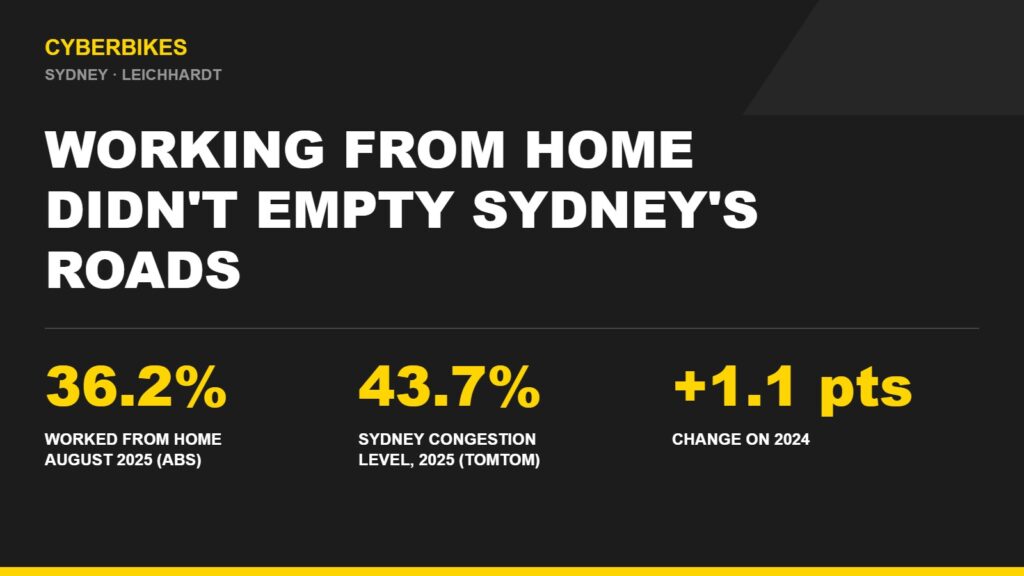
No. Working from home has flattened Sydney’s peak, but it has not cut Sydney’s traffic. In 2025, with 36.2% of employed Australians usually based at home, Sydney’s average congestion level still rose 1.1 percentage points to 43.7%, and a 10 km drive still took 24 minutes. Rush-hour traffic now moves at 20.8 km/h — slower than a legal e-bike. Hybrid work removed a share of long commutes and the road quietly refilled with other trips, most of them short and local.
Our position, with the working shown below: hybrid work handed Sydney a free congestion-reduction policy and the city spent it. Nothing was done with the road space that opened up, so induced demand swallowed it — exactly as it swallows every new lane. The trips that replaced the commute are shorter, more local and more car-based than ever, and they are precisely the trips a bike wins.
How many people in Sydney still work from home?
36.2% of employed Australians usually worked from home in August 2025, according to the Australian Bureau of Statistics. That is not a pandemic spike that is fading — it is a plateau. The same series recorded 36.3% in August 2024 and 37.3% in August 2023. Roughly one in three working Australians has been staying home on a given week for three years running.
But the share is wildly uneven. The ABS found 59% of managers and professionals usually worked from home, against 21% of all other occupations. The cleaner, the nurse, the chef and the childcare worker still travel every day — often from the outer suburbs, at the worst hours, with no alternative to a car. Hybrid work is a transport subsidy distributed by job title.
If a third of us stay home, why did Sydney congestion rise?
Because the road space freed up by absent commuters did not stay free. The TomTom Traffic Index for 2025 put Sydney’s average congestion level at 43.7%, up 1.1 percentage points on 2024. Average travel time for a 10 km drive was 24 minutes. A driver lost 93 hours — nearly four full days — sitting in rush hour across the year. Average rush-hour speed was 20.8 km/h.
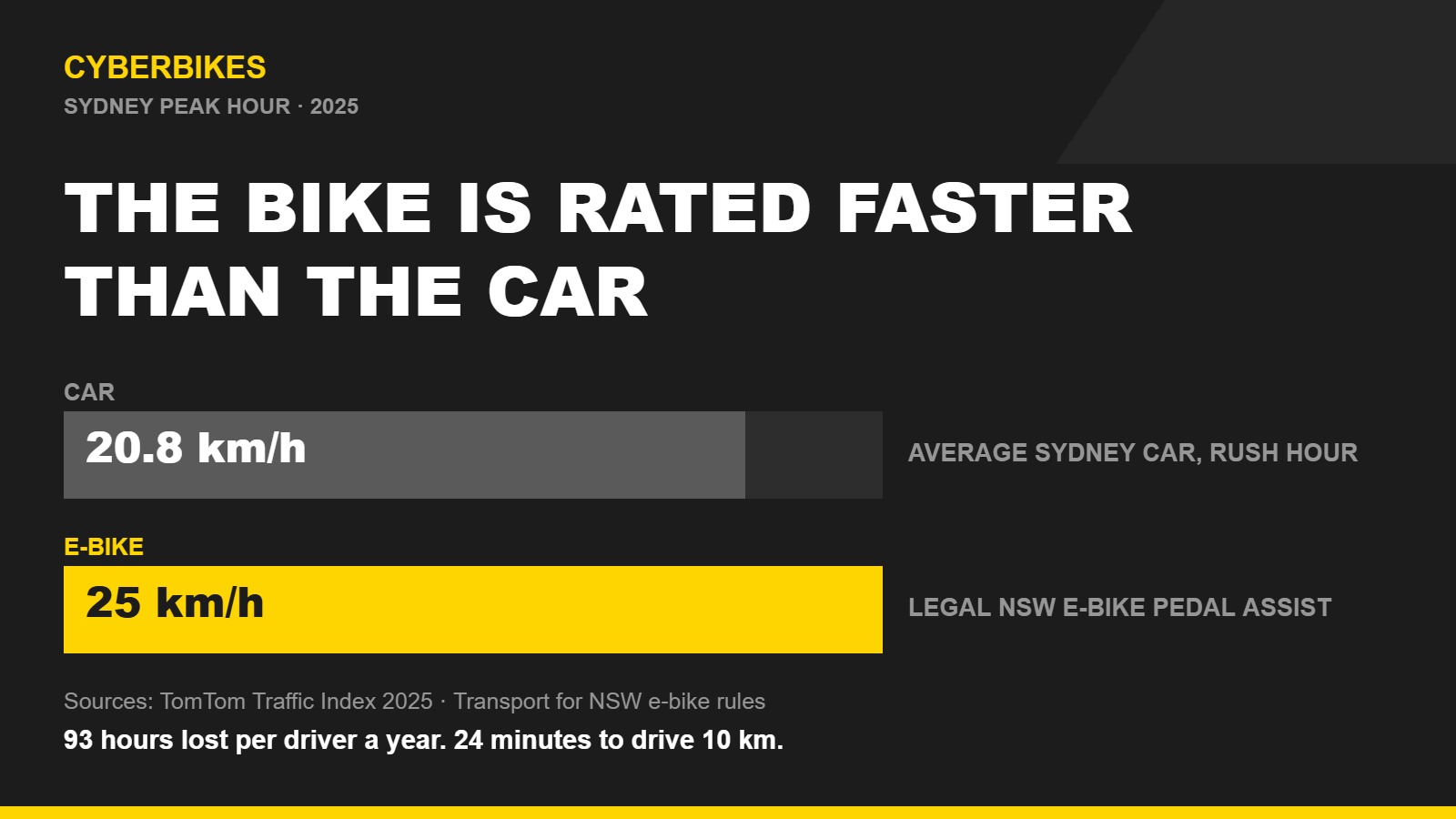
That 20.8 km/h figure is the one worth sitting with. In NSW a legal e-bike assists you up to 25 km/h, with a 500 W maximum continuous rated power limit, per Transport for NSW. The lightest vehicle on the road is rated to travel faster than the average car in Sydney’s peak. That is not a cycling statistic — it is an indictment of how road space is allocated.
The mechanism is induced demand, the most reliably ignored finding in transport economics. Space on a congested road is rationed by delay. Remove some drivers, the delay falls, trips that were not worth making become worth making, and the road refills until the delay is back where it started. Hybrid work created the same free capacity a new lane creates, and it was consumed the same way.
Where did the trips that left the commute actually go?
They became local trips. Transport for NSW research on working from home found that as the share of work-from-home days grows, non-commuting travel rises — time saved on the commute gets spent on shopping, personal business and social trips. Critically, these trips are likely to occur “in more local areas near the homes of those who WFH”, signalling long-term growth in local travel.
Read that again, because it is the whole story. The long radial commute — the trip our entire motorway and rail network was built to serve — partly evaporated. What replaced it is a scatter of two-, three- and five-kilometre trips to the shops, the school, the café. They are made overwhelmingly by car, because in most of Sydney the street outside your house offers no safe alternative for a 3 km journey. We already counted how many Sydney car trips are too short to justify a car, and hybrid work made that pile bigger.
Sydney got the worst available version of the deal: it lost the commute trips public transport was good at carrying, and gained local trips the road network is worst at absorbing.
What would actually take cars off Sydney’s roads?
Giving the local trip a safe alternative. Not a slogan or an app — a continuous, protected network of bike lanes that lets someone who is not brave ride 3 km to the shops without negotiating a 60 km/h arterial. Every city that has shifted mode share did exactly this, and none did it by asking people to be more virtuous.
The arithmetic on the vehicle side is already settled. Charging a 1,200 Wh e-bike battery — the pack on the Cyberbikes Centauro, a 48V 25Ah Samsung unit — draws about 1.2 kWh. At the Ausgrid residential flat rate of 33.1372 c/kWh in the Australian Energy Regulator’s 2026–27 Default Market Offer, that is roughly 40 cents a charge. The Centauro’s product page claims up to 120 km at 25 km/h for a 75 kg rider on flat ground with no headwind. Call it under half a cent per kilometre of energy. A car cannot reach that number in any configuration, electric or otherwise.
What is missing is not the vehicle and not the willingness. It is the road design, the speed limits and the budget priorities that still treat a 3 km trip to the supermarket as a driving problem. Hybrid work gave Sydney a rare chance to reallocate space while the peak was soft. The window is still open, but the traffic data says the clock is running.
Frequently Asked Questions
Has working from home reduced traffic anywhere?
Hybrid work flattens the morning and afternoon peaks by spreading departures across the day, which genuinely helps crowding. It does not reduce total travel. Transport for NSW research found non-commuting travel rises as work-from-home days grow, and TomTom measured Sydney’s 2025 congestion level at 43.7%, up 1.1 points on 2024.
How fast is Sydney traffic in peak hour?
20.8 km/h on average during rush hour in 2025, according to the TomTom Traffic Index, with a 10 km drive taking 24 minutes and 93 hours lost to congestion per driver over the year. A legal NSW e-bike provides pedal assistance up to 25 km/h, so on paper it is rated faster than the average peak-hour car.
Is an e-bike legal for commuting in NSW?
Yes. Transport for NSW allows e-bikes with a maximum continuous rated power of 500 W, with motor assistance cutting out at 25 km/h and any throttle-only function cutting out at 6 km/h. From 1 March 2029 the limit drops to 250 W and only EN 15194 certified e-bikes will be permitted. Helmets are mandatory. A bike exceeding those limits is illegal even if software restricts it, and can be seized.
If you want the full picture on swapping car trips for rides — costs, routes, law and rent-to-own — start with our complete guide to car-free e-bike commuting and rent-to-own in Sydney.
Swap one car trip a week for an e-bike ride and see what changes. We are at Cyberbikes, 281 Parramatta Road, Leichhardt, if you want to talk it through with someone who rides the same streets.
#eBikeSydney #CyberBikes #Leichhardt #WorkFromHome #SydneyTraffic #CarFreeSydney #ActiveTransport #InducedDemand #UrbanPlanning #CentauroEbike