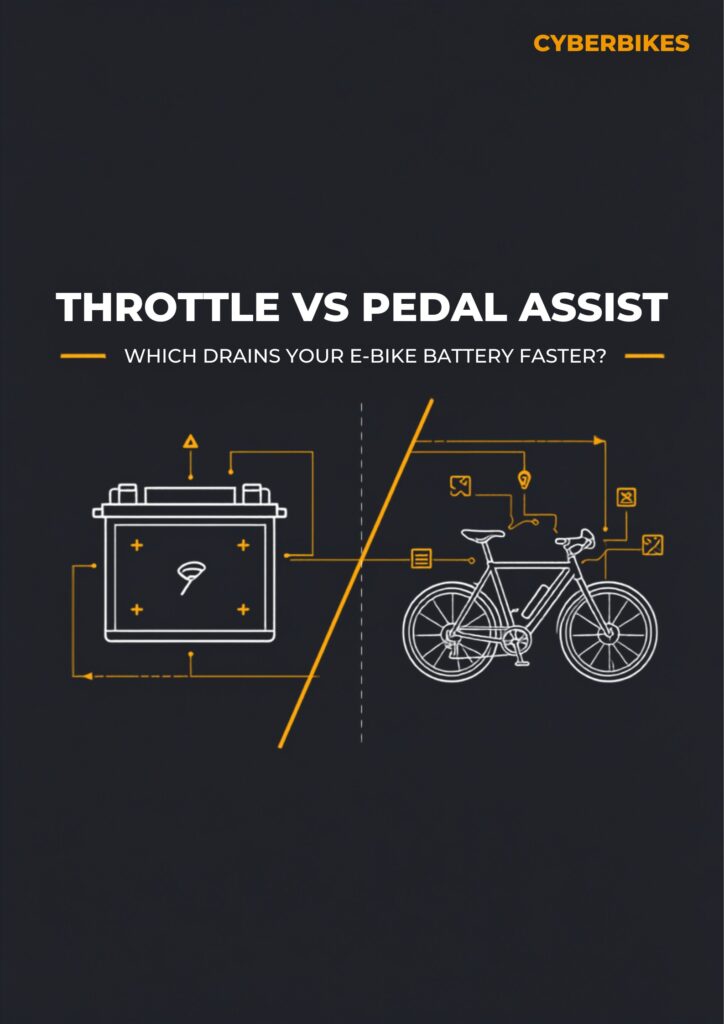
Throttle vs pedal assist: which drains your e-bike battery faster? Honestly, neither mode is inherently thirstier. Your range is set almost entirely by the average power your motor pulls from the battery and by how much of the work your own legs are doing — not by whether that power arrives via a throttle or a pedal-assist sensor. In the words of Grin Technologies (ebikes.ca), whose engineers have taught this stuff for two decades, “the range you get on an ebike fundamentally has nothing to do with what kind of control system you use, and everything to do with the average amount of power you draw.” The practical catch is that riders behave differently in each mode. Twist a throttle and it’s tempting to sit at full power while your legs freewheel; ride in a low pedal-assist level and your legs quietly cover part of the load. That behaviour — not the wiring — is what empties the battery. Below, the team at Cyberbikes in Leichhardt breaks down exactly where your watt-hours go, and how to stretch them further on a Sydney commute.
The short answer: what actually drains your e-bike battery
Every kilometre of riding demands a certain amount of energy to overcome air drag, rolling resistance and gravity. That energy comes from two places: your legs and the battery. Whatever your legs don’t supply, the motor has to — and the motor’s share is drawn from the pack as watt-hours (Wh).
Battery energy is simple to calculate: Wh = volts × amp-hours. A 48V, 25Ah pack (like the Samsung battery in the Cyberbikes Centauro) holds 48 × 25 = 1,200Wh. Your range is then just that number divided by your average consumption in Wh per kilometre. As a simple illustration, if your riding averaged 12 Wh/km you’d get roughly 100 km from a 1,200Wh pack; push it to 20 Wh/km and it falls to about 60 km. (Those figures are illustrative — real-world consumption depends on speed, wind, hills, tyre pressure, rider weight and load.) If you’d like the full picture on how battery capacity is measured, see our explainer on amp-hours versus watt-hours, and our definitive guide to e-bike batteries for everything about capacity, chemistry and care.
How the throttle uses battery power
A throttle gives you direct, instant control of motor power — twist for more, back off for less. On a throttle-only run with no pedalling, 100% of the propulsion comes from the battery. That’s the crucial detail: it isn’t that a throttle is electrically wasteful, it’s that riders using a throttle often add little or no leg power, so the pack carries the entire load.
There’s a second, more technical reason throttle-from-a-standstill can feel like it gulps energy. An electric motor is most efficient in a fairly narrow band of speed and load. Lug it hard at very low road speed — exactly what happens when you launch from a red light on throttle alone — and a larger share of the electrical energy turns into heat in the copper windings (the classic I²R heating loss) instead of forward motion. Pedalling through that low-speed launch takes the strain off the motor and keeps it in its efficient zone. It also explains why hammering the throttle up a steep Leichhardt back street costs far more Wh/km than a steady cruise on the flat.
Worth knowing for Sydney riders: under NSW rules a compliant e-bike may only use a throttle to move the bike without pedalling up to 6 km/h (a walk-assist function). Above that, the motor has to be driven by pedalling — which is why most legal riding here is pedal-assisted anyway.
How pedal assist uses battery power
Pedal assist (PAS) powers the motor automatically as you pedal, so you’re never holding a throttle. Because your legs are always contributing something, the motor typically needs to supply less for the same speed — and lower motor watts means lower Wh/km and more range. How much the motor chips in depends on the sensor behind the system.
Cadence sensors vs torque sensors
A basic cadence sensor only detects how fast you’re spinning the cranks (via a magnet ring — modern ones use 12 or even 24 poles for quick response, per ebikes.ca). It usually delivers a set amount of power for the assist level you’ve chosen, regardless of how hard you push. A torque sensor measures how hard you press the pedals and multiplies your effort, so power rises and falls with your legs. For battery life the key point is the same either way: the more of the work your legs do, the fewer watt-hours the motor pulls. Grin notes that if a torque-based setup encourages you to pedal harder, “that as well could help increase the share of propulsion power coming from your legs and result in better mileage from the battery.”

So which drains the battery faster?
Here’s the honest verdict: on identical power settings and the same speed, the throttle and pedal assist draw the same watts. What separates them in the real world is rider behaviour and how much leg power you add.
| Scenario | Who’s doing the work | Effect on range |
|---|---|---|
| Full throttle, legs resting | Battery does ~100% | Shortest range |
| High PAS level, light pedalling | Mostly battery | Short–moderate range |
| Low PAS level, steady pedalling | Legs share the load | Longest range |
| Throttle used only for hills/launches | Legs most of the time | Similar to low PAS |
So a throttle drains the battery faster only if it tempts you into riding at full power with your legs idle. Use it sparingly — for pull-aways and short climbs — and it can be just as frugal as pedal assist. Conversely, sitting in the highest PAS level and barely pedalling will flatten a pack about as quickly as a throttle would. The control type is a red herring; your average power draw is the whole story.
How to get more range from either mode
Whether you prefer a throttle or pedal assist, these habits stretch your watt-hours on a Sydney ride:
- Drop an assist level. Riding one PAS notch lower and letting your legs make up the difference is the single biggest range lever.
- Pedal through launches and hills. Helping the motor at low speed keeps it in its efficient band and cuts heat losses.
- Ease off the speed. Air drag climbs steeply with speed, so a slightly gentler cruise saves a surprising amount of energy.
- Keep tyres properly inflated. Under-inflated tyres add rolling resistance and Wh/km — a two-minute fix.
- Carry less, brake smoothly. Every kilo and every hard stop is energy you paid for.
Does pedalling recharge the battery? No — on a normal e-bike your pedalling drives the wheel directly; it doesn’t feed charge back into the pack. Only bikes with regenerative braking (usually direct-drive hub motors) recover a small amount of energy, and even then it’s modest. Which PAS level gives the best range? The lowest one you’re comfortable pedalling with. Is riding full throttle all the time bad? It won’t damage a quality e-bike, but it maximises battery use and motor heat, so it’s the least efficient way to ride.
What this means for the Cyberbikes Centauro
The Cyberbikes Centauro pairs a 250W rear hub motor with a 48V 25Ah (1,200Wh) Samsung battery, and gives pedal assist up to 25 km/h plus a 6 km/h throttle walk-assist — fully in line with NSW e-bike law and certified to UL 2849 and UL 2271, with an ISO 4210 frame. With that 1,200Wh on board, the range you actually see comes down to how you ride it: lean on low pedal assist for your Leichhardt-to-CBD commute and you’ll go a long way between charges; sit on the throttle and you’ll top up more often. Same battery, same bike — your riding style writes the range.
See it in action
Frequently Asked Questions
Does using the throttle drain the battery faster than pedal assist?
Not by itself. At the same power and speed, a throttle and pedal assist draw the same watts. A throttle tends to shorten range only because riders often sit at full power without pedalling, so the battery does all the work. Use the throttle sparingly and add leg power and it can be just as efficient as pedal assist.
Does pedalling an e-bike recharge the battery?
No. On a standard e-bike, pedalling drives the rear wheel directly and does not put charge back into the battery. Only e-bikes with regenerative braking recover a small amount of energy, and the effect is minor. Pedalling helps range because it reduces how many watts the motor needs to draw, not because it recharges the pack.
Which pedal-assist level gives the best e-bike range?
The lowest assist level you can comfortably pedal with. Lower levels mean your legs supply more of the propulsion, so the motor draws fewer watt-hours per kilometre and the battery lasts longer. Dropping one assist level is the easiest way to add range on any e-bike.
Want to feel the difference for yourself? Come in for a test ride at Cyberbikes, 281 Parramatta Road, Leichhardt, and try the Centauro on throttle and pedal assist back to back. Browse the range at cyberbikes.com or ask us about rent-to-own plans from $99/week.
#ebikeSydney #CyberBikes #electricbikeLeichhardt #CentauroEbike #pedalassist #ebikerange #ebikebattery