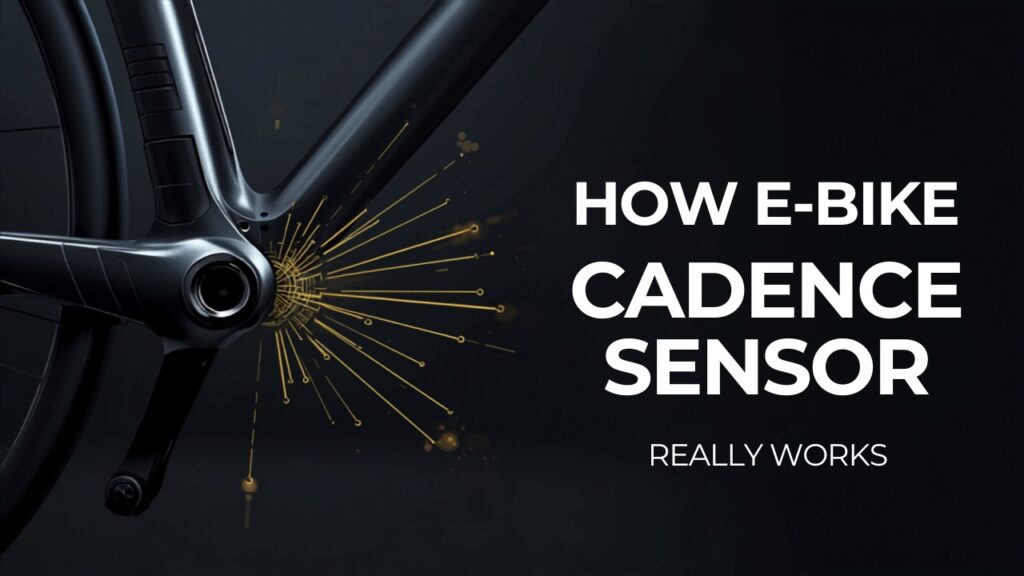
A cadence sensor tells your e-bike’s controller that you are pedalling and how fast the cranks are spinning, while a torque sensor measures how hard you are pushing on the pedals so the motor can amplify your actual effort. That single difference decides how an electric bike feels to ride: steady power on demand, or a bionic multiplication of your own legs.
It’s the question we hear most often on the shop floor at Cyberbikes in Leichhardt, and it’s worth answering properly. This guide unpacks the real engineering — drawing on the superb theory resources published by Grin Technologies at ebikes.ca — and ties every concept back to what it means on a Sydney commute.
What is a pedal assist system (PAS)?
A pedal assist system (PAS) is any device that powers an e-bike’s motor automatically when you pedal, without you pressing a throttle. Bikes that behave this way are called pedelecs. As Grin Technologies explains, a PAS can respond to the speed you spin the cranks, the force you apply to the pedals, or a combination of both — and that’s exactly the split between cadence and torque sensing.
In NSW this matters legally too: a road-legal pedal-assist e-bike can deliver up to 250W of continuous assistance (EN15194 pedelec standard), with the motor cutting out at 25 km/h, while throttle-operated bikes are limited to 200W. Either way, the sensor is the part that decides when and how much the motor helps.
How does a cadence sensor work?
The most common cadence sensor (Grin calls these “basic PAS sensors”) is a ring of magnets attached to the crank arm or spindle, with a small stationary sensor that counts the magnets sweeping past as you pedal. The controller then knows the cranks are turning and how fast — but it has no idea how much force you’re applying. Most systems simply deliver a set amount of motor power for your chosen assist level whenever the cranks are moving.
One spec genuinely worth knowing is the number of magnetic poles. Early sensors had only 5 or 6 magnets, so you’d turn the cranks about half a rotation before the power kicked in — and there was a matching lag when you stopped pedalling. Today 12 poles is the norm and 24-pole (and higher) sensors are increasingly common; more poles means the controller detects your pedalling sooner and responds faster. If you’ve ridden an older e-bike that felt “laggy” off the mark, low pole count was probably why.
The ride feel: consistent, predictable power that doesn’t depend on how hard your legs are working. Choose level 3, and level 3 is what you get — uphill, downhill, headwind or tailwind.
How does a torque sensor work?
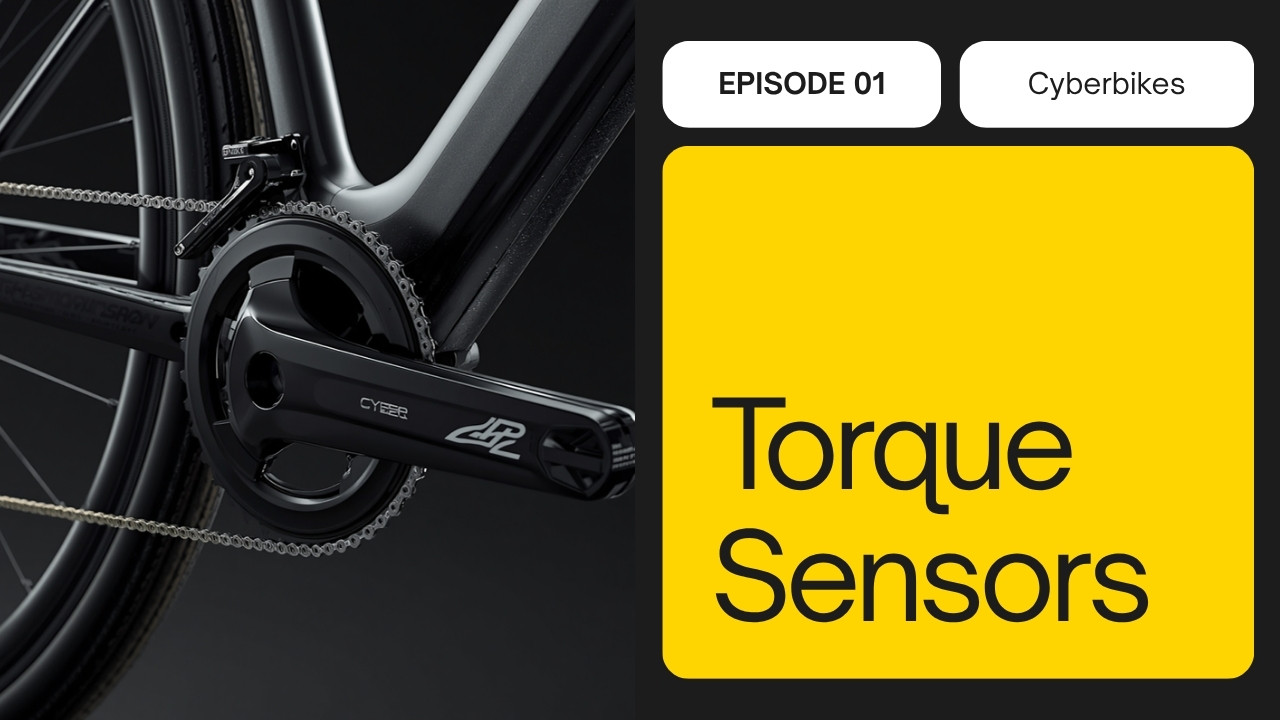
A torque sensor measures the force you put into the pedals. On aftermarket and many factory systems it’s built into a replacement bottom bracket that senses strain in the crank spindle, but engineers have measured rider effort almost everywhere: chain tension, the rear dropout, rear axle flex, the chainring spider, even inside the pedals. Whatever the method, the sensor outputs a voltage proportional to force, and the controller uses it to scale motor power.
Torque-based assist is usually configured as a multiplier of your own effort. At 1:1, every watt your legs produce is matched by a watt from the motor; at 2:1 the motor doubles you. Pedal harder, get more power; soft-pedal, get almost none. Physics ties it together neatly: your human power output equals torque multiplied by pedalling speed. Grin’s calibration example makes the scale tangible — a 60 kg rider standing with full weight on a horizontal 165 mm crank produces about 97 Nm of torque.
Two details most buyers never hear: torque sensors also include a cadence signal. It’s needed to compute your watts (torque × rpm), and it’s a safety requirement — if the bike could be driven by the force signal alone, a drifting sensor could power the motor with no pedalling at all. And because the sensor sits in the drivetrain, a good one must add virtually no flex; Grin notes a squishy, springy torque sensor ruins the direct pedal feel a cyclist expects.
Torque sensor vs cadence sensor: which is better?
Neither — they suit different riders, and the “torque is always better” assumption doesn’t survive contact with real riding. Here’s the honest comparison:
| Cadence sensor | Torque sensor | |
|---|---|---|
| What it measures | Crank rotation (that you’re pedalling, and how fast) | Pedal force, plus rotation |
| Ride feel | Consistent set power, independent of effort | Natural — like your legs got stronger |
| On hills | Same effort; bump the assist level and the motor does the work | You pedal harder to climb faster — you’ll sweat |
| Hardware | Simple magnet ring | Force-sensing bottom bracket, dropout or hub |
| Best for | Commuters who want to arrive fresh; riders decoupling effort from terrain | Fitness-focused riders who want to “earn” the power |
Grin Technologies puts it perfectly: torque control couples motor power to your effort, so the experience mirrors a normal bike — work hard uphill, relax downhill. But one of the great tricks of an e-bike is decoupling terrain from effort: with a cadence system and a handlebar level control, you keep a steady comfortable effort while the motor absorbs the hills and headwinds. If arriving at work in Sydney’s Inner West without needing a shower is the goal, that’s a feature, not a compromise.
More pedal assist questions Sydney riders ask
Will a torque sensor increase my range?
Not by itself. Range is determined by the average power you draw from the battery, not the type of control. A torque sensor can improve range indirectly — if it motivates you to pedal harder, more of the propulsion comes from your legs. Equally, a cadence system that powers the motor the whole time you pedal can use more energy than a throttle you only touch on hills. (This is straight from Grin’s FAQ, and it surprises almost everyone.)
Can I have both a throttle and pedal assist?
Electrically, yes — the two are not mutually exclusive, and Grin argues a throttle is a genuinely useful backup for bursts like accelerating out of an intersection. Just remember the NSW rules above: full 250W pedal-assist bikes are pedelecs, and throttle behaviour is more restricted, so ask us about a compliant setup before modifying anything.
Why doesn’t the motor kick in when I pedal backwards?
By design. Wheel a bike backwards out of a rack and the pedals spin in reverse — if that triggered the motor, you’d get a nasty surprise. Simple one-wire sensors only pulse when the cranks turn forwards, while better systems use a two-signal quadrature arrangement whose pulse order reveals direction. That’s also why some sensors only work on one side of the bike.
Can I change how my pedal assist feels?
Often, yes. Every e-bike lets you change assist levels, but programmable systems — including the Bafang mid-drives we work on every week at Cyberbikes — let you go deeper and reshape how much current each assist level delivers and how the motor responds to your pedalling. The result can transform a bike’s personality and its range. Here’s our walkthrough:
And if you want to nerd out properly, Grin’s free motor simulator lets you model motors, controllers and assist setups before you spend a dollar.
Frequently Asked Questions
Do all e-bikes have torque sensors?
No. Many excellent commuter e-bikes use cadence sensors, and torque sensing is more common on premium models. Neither is “the good one” — they feel different, so a back-to-back test ride tells you more than any spec sheet.
Which sensor type is better for hills?
Both climb well. A cadence system lets the motor do the climbing at whatever effort you choose, while a torque system asks your legs for more input to unlock more power. Motor torque and gearing matter more to climbing than the sensor type.
Is a torque sensor e-bike legal in NSW?
Yes. The sensor type doesn’t affect legality — what matters is that a pedal-assist e-bike is limited to 250W of continuous power (EN15194) with assistance cutting out at 25 km/h, or 200W for throttle-style power-assisted bikes.
The best way to choose? Ride both. Come in for a test ride at Cyberbikes, 281 Parramatta Road, Leichhardt and feel cadence and torque assist back to back on real Inner West streets — then pick the one that makes you grin. That’s how you buy an e-bike in Sydney with zero regrets.
#ebike #ebikeSydney #torquesensor #cadencesensor #pedalassist #Cyberbikes #Leichhardt #electricbike #ebikeSydneyGuide