Almost a third of Sydney’s population can’t legally get behind the wheel of a car — and it isn’t by choice. Add the 18.4% of Greater Sydney residents aged under 15 to the 15.2% aged 65 and over (ABS, 2021 Census) and you land close to one in three people who are either too young to hold a licence or in the age bracket where driving ability most often declines — before even counting the one in six people with disability who report real difficulty using transport at all. A city built entirely around the car doesn’t just inconvenience these people. It locks them out of school, work, and their own neighbourhood.
How Many Sydneysiders Actually Can’t Drive?
Run the numbers and the “non-driver” population in Sydney is bigger than most transport planning assumes. Greater Sydney’s 2021 Census shows 18.4% of residents are aged 0–15 (too young for a licence) and 15.2% are 65 or over, an age bracket where driving cessation becomes common due to vision, hearing and reaction-time decline. Layer on disability: the ABS Survey of Disability, Ageing and Carers found 16% of people with disability who leave home have difficulty using public transport, and a further 11% are unable to use it at all. Twenty-six per cent of people with disability report transport as a barrier to finding work, compared with 16% of jobseekers without disability. None of this shows up in a road-widening business case, but it shapes daily life for a huge share of the city.
Why Are Fewer Kids Getting to School Under Their Own Steam?
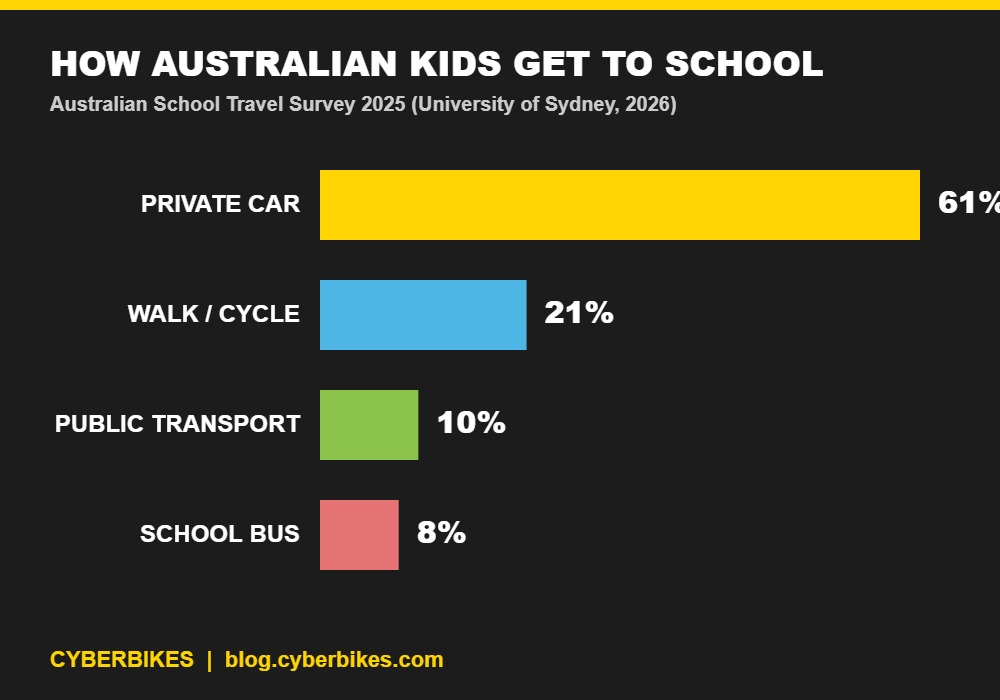
The Australian School Travel Survey 2025, led by Associate Professor Jennifer Kent at the University of Sydney and published in February 2026, surveyed 4,968 families and travel data for 7,880 children. It found private cars now account for 61% of school trips nationwide, with walking and cycling making up just 21%, public transport 10%, and dedicated school buses 8%. Distance isn’t the whole story: nearly four in ten children living within a kilometre of school are still driven, and car dependence climbs to two-thirds once the trip passes three kilometres. More than 80% of after-school activity trips are also made by car. As Kent put it, “for most Australian families, the school day now starts in the car — even when children live close to school, driving has become the default, not the exception.”
How Does Germany Get Three Times More Kids Walking or Cycling?
The same survey offers a direct comparison: in Germany, seven in ten children walk or cycle to school, against roughly two in ten in Australia. The gap isn’t genetics or weather — it’s street design and school policy. Germany combines slower local street speeds with high rates of children attending their nearest school, so trips are short and the roads along the way are built to be shared safely. Australia’s mix of higher-speed local roads and out-of-catchment enrolment pushes trip distances up and safety margins down, so families default to the car. It’s a policy choice, not an inevitability — and it’s one Sydney could make differently.
What Happens When Older Drivers Have to Give Up the Keys?
Driving cessation research consistently links giving up a licence to social isolation and worse mental health in older Australians — unsurprising in a city where almost every errand assumes a car. Studies of older drivers in north-west Sydney have documented how vision loss, arthritis and slower reaction times force people to stop driving long before they stop needing to get around, and how thin public transport coverage in car-oriented suburbs leaves few real alternatives once the keys are handed over. For a city with 15.2% of Greater Sydney aged 65 and over, that’s not a niche problem — it’s a growing one.
Do You Need a Licence to Ride an E-Bike in NSW?
No — and this is where e-bikes genuinely change the equation. Under current Transport for NSW rules, a road-legal e-bike is capped at 500W maximum continuous power, with pedal assistance cutting out at 25km/h and throttle-only riding capped at 6km/h; that cap tightens to 250W, with mandatory EN15194 certification, from 1 March 2029. Either way, a compliant e-bike is legally classed as a bicycle, not a motor vehicle — no driver’s licence, registration or insurance is required, and there’s no age-based licensing test to pass. That makes an e-bike one of the only forms of independent, self-powered transport open to a teenager who can’t drive yet, an older resident whose licence has lapsed, or anyone who simply can’t or doesn’t want to hold one.
Could E-Bikes Close the Gap for Sydney’s Non-Drivers?
E-bikes won’t replace every car trip, and they’re not a fit for everyone in the groups above — but for a huge slice of short, local trips, they lower the physical and financial bar to getting around independently. The Cyberbikes Centauro is built around exactly this brief: a 250W motor that comfortably sits under the current 500W NSW cap, a 48V 25Ah (1200Wh) Samsung battery for real-world range, a step-through frame that’s easy to mount for riders with limited mobility, and a rear rack rated to 50kg so a grandparent doing the school pick-up or a shopping run doesn’t need a second car. It’s certified to UL 2271 (battery), UL 2849 (e-bike systems) and ISO 4210 (frame), with a 150kg combined rider-and-cargo limit. If your household is weighing up whether everyone really needs to be a driver, our complete guide to going car-free in Sydney walks through what that actually looks like week to week.
Frequently Asked Questions
How many people in Sydney can’t legally drive?
Using 2021 Census figures, 18.4% of Greater Sydney’s population is aged under 15 and 15.2% is aged 65 or over — together close to a third of the region who are either too young to hold a licence or in the age bracket where driving ability most often declines. The ABS Survey of Disability, Ageing and Carers also found 16% of people with disability who leave home have difficulty using public transport, and 11% cannot use it at all.
Do you need a licence to ride an e-bike in NSW?
No. A road-legal e-bike in NSW is currently capped at 500W maximum continuous power, with pedal assistance cutting out at 25km/h and throttle-only riding capped at 6km/h (tightening to 250W with mandatory EN15194 certification from 1 March 2029). Either way, it’s legally treated as a bicycle, not a motor vehicle, so no driver’s licence, registration or insurance is required.
Why are fewer Australian children walking or riding to school?
The Australian School Travel Survey 2025 (University of Sydney) found 61% of school trips nationwide are now by private car, versus just 21% by walking or cycling. Nearly four in ten children living within a kilometre of school are still driven, rising to two-thirds once the trip passes three kilometres — a pattern researchers link to out-of-catchment enrolments and streets that don’t feel safe for children to move through independently.
If you’ve got a teenager who can’t drive yet, a parent who’s given up the keys, or you’re just tired of being the family’s only driver, come talk to us at Cyberbikes, 281 Parramatta Road, Leichhardt — or take a look at the Centauro with rent-to-own from $99/week. A car-dependent city doesn’t have to mean a car-dependent household.
#CyberbikesAU #ESydney #CarFreeSydney #EBikeSydney #Leichhardt #UrbanMobility