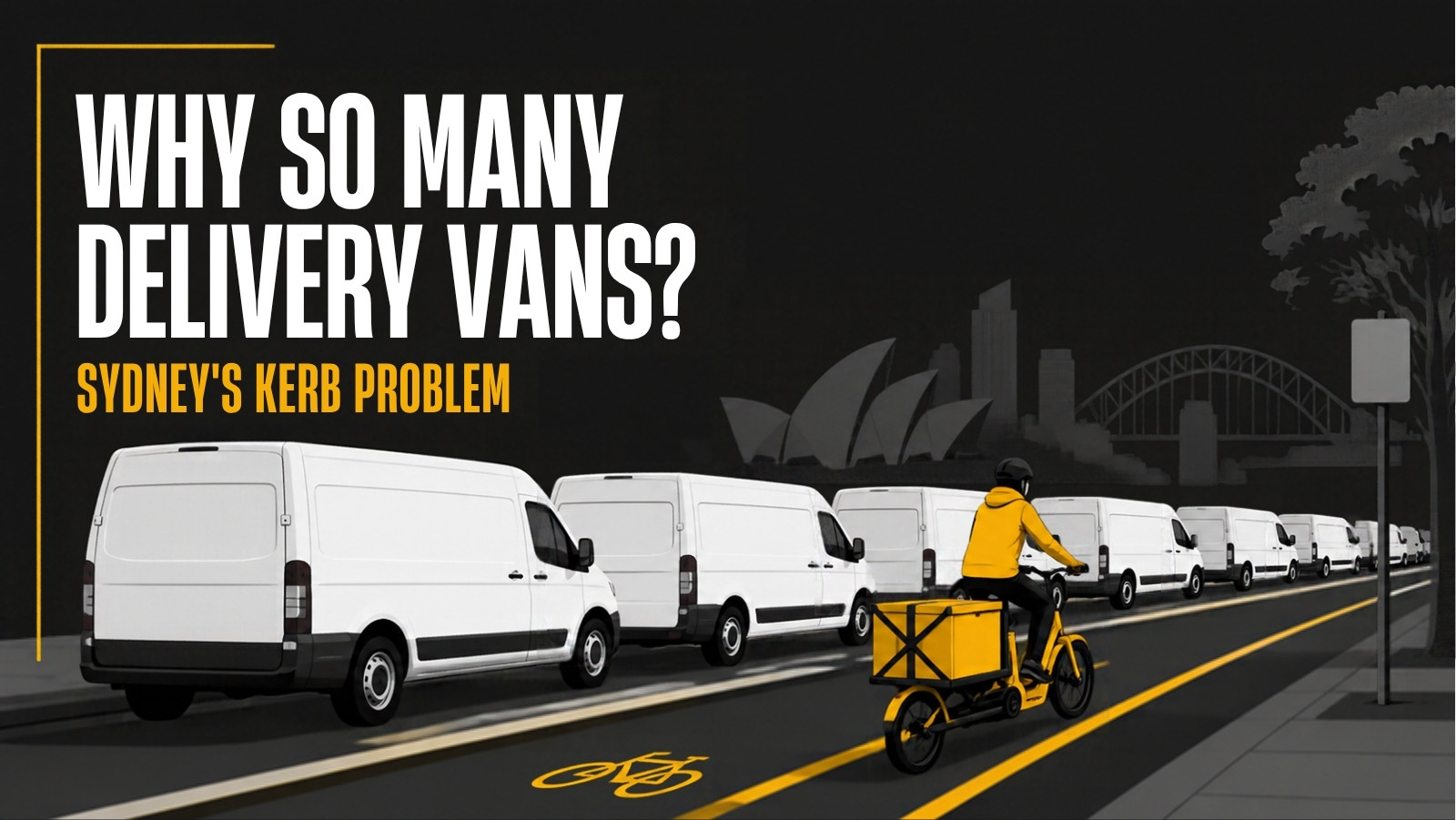

Australian cars have never been bigger — and it’s reshaping our streets for the worse. In 2025, SUVs made up 60.7% of new-car sales and utes and light commercials another 22.6%, so together the big stuff was around 83% of everything sold, while traditional passenger cars slid to just 13%, according to the NRMA. That shift towards taller, heavier vehicles has real consequences for a dense city like Sydney — more danger to people on foot, more road and parking space swallowed, and a stronger case than ever for swapping some trips to an e-bike.
Just how big have Australia’s cars got?
Very. The best-selling vehicles in the country are now utes — the Ford Ranger and Toyota HiLux — both well over two tonnes, sitting on top of a market where SUVs and utes crowd out almost everything else. As the RACV’s 2025 sales wrap shows, small cars and sedans are in steep decline. The average new vehicle in an Aussie driveway is taller, wider and heavier than the one it replaced a decade ago. On a wide highway that’s a personal choice. On the narrow terraced streets of Sydney’s Inner West, where cars share space with kids, pedestrians and cyclists, it’s everyone’s problem.

Why do bigger cars make Sydney’s streets more dangerous?
Because physics doesn’t care how safe the driver feels. Research from the Insurance Institute for Highway Safety found that every 10cm of extra front-end height raises a pedestrian’s risk of being killed by about 22%, and vehicles with bonnets over roughly a metre tall (40 inches) are around 45% more likely to kill someone they hit. Weight compounds it: a study reported in The Conversation found each extra 100kg of vehicle mass lifts the chance of death for the person or car it strikes by about 10%. Tall, blunt front ends are especially lethal for children, whose heads sit right at bonnet height, and they create bigger blind spots exactly where a small child might be standing. The tragedy is circular: parents buy big vehicles to feel safe, and those same vehicles make the street more dangerous for everyone outside them.
What does vehicle bloat cost our streets and hip pocket?
Space and money. A bigger vehicle needs a wider lane, a longer parking bay and more room to turn — and Sydney is already giving up an enormous share of its land to parked cars. Heavier vehicles also chew through roads faster and shed more tyre and brake particles into the air we breathe. Then there’s the cost: a two-tonne-plus ute is one of the most expensive ways imaginable to move one person a few kilometres to work or the shops. Compare that with a cargo e-bike that tips the scales around 30kg, parks in a fraction of the space, and does the daily two-to-five-kilometre trips that make up most urban journeys. If you want the full breakdown of ditching car trips for two wheels, our complete guide to car-free commuting and rent-to-own in Sydney walks through it.
Is there a way off the vehicle-size arms race?
Yes — and it doesn’t require everyone to give up their car overnight. The “arms race” is self-reinforcing: I buy big because you bought big. An e-bike quietly opts out of it. Our Cyberbikes Centauro carries a 150kg load on a frame-welded rear rack rated to 50kg, runs a 250W motor and a 48V 25Ah (1200Wh) Samsung battery, and costs $4,249 outright — or rent-to-own here in Sydney — against the tens of thousands a new ute demands. Swap even one car trip a week for a ride and you take one more heavy vehicle off a crowded street. Come and see what that looks like at Cyberbikes, 281 Parramatta Road, Leichhardt.
Frequently Asked Questions
What percentage of new cars sold in Australia are SUVs or utes?
In 2025, SUVs made up 60.7% of new-vehicle sales and utes and light commercials a further 22.6% — together about 83% of the market. Traditional passenger cars fell to roughly 13%.
Are bigger cars more dangerous to pedestrians?
Yes. Research shows each 10cm of extra front-end height raises pedestrian death risk by around 22%, and every extra 100kg of vehicle weight lifts the risk of death for those it strikes by about 10%. Tall bonnets and larger blind spots are especially dangerous for children.
Can an e-bike really replace a car for city trips?
For most short urban journeys, yes. A cargo e-bike like the Cyberbikes Centauro carries up to 150kg, handles the two-to-five-kilometre trips that make up most city travel, and takes a fraction of the road and parking space of an SUV or ute.
#CarFreeSydney #EbikeCommute #CargoBike #InnerWest #Leichhardt #Cyberbikes #SUV #RoadSafety #ActiveTravel #SydneyStreets