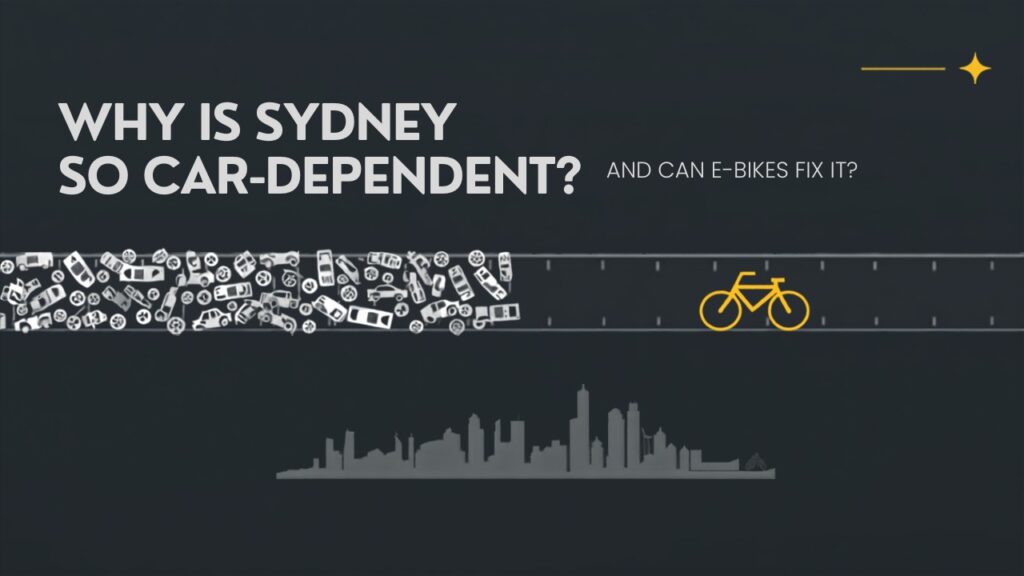
Sydney is car-dependent because it was physically built that way — decades of low-density sprawl, wide arterial “stroads” and mandated parking put most destinations too far apart to walk and too dangerous to cycle, so driving became the only rational choice for millions of people. E-bikes can’t undo that layout on their own, but they attack its weakest point: the distance problem. By turning an exhausting 12–15 km trip into an easy 30-minute ride, an e-bike puts roughly ten times more of Sydney within reach than a normal bike — and it does so using about 1% of the energy, a fraction of the road space, and a tiny slice of the cost of a car. This is the full breakdown: the geometry, the physics, the money, and the honest limits.
At Cyberbikes in Leichhardt we sell the solution, so treat us as biased — but every number below is sourced and checked. If you want the practical how-to version, our guide to going car-free in Sydney with an e-bike covers routes, costs and rent-to-own; this piece explains why the maths works. Much of the urban-design thinking here is inspired by the excellent Not Just Bikes channel, whose videos on stroads, induced demand and energy (like “When Oil Gets Expensive, Cities Get Better”) map almost perfectly onto Sydney.
What “car dependency” actually means
Car dependency isn’t about loving cars. It’s a design condition: a place is car-dependent when daily life is impossible without a car, regardless of what anyone would prefer. Not Just Bikes popularised the clearest test — can a 12-year-old or an 80-year-old get to school, shops and friends on their own? In most of Sydney beyond the inner ring, the answer is no.
Three design decisions, repeated for seventy years, created that condition. First, low-density zoning spread homes so thinly that destinations sit kilometres apart. Second, the “stroad” — a hybrid of a street (a place) and a road (a movement corridor) that does both badly — became the default: think Parramatta Road or Canterbury Road, fast enough to be hostile to people, slow and clogged enough to fail as a highway. Third, minimum parking requirements forced every shop, flat and office to bury itself behind a car park, pushing everything even further apart. The result is a landscape where the car isn’t a luxury; it’s the admission ticket.
Here is the trap in one sentence: the more a city optimises for cars, the further apart everything gets, which makes you even more dependent on the car. Breaking that loop is hard because you can’t rezone a suburb overnight — but you can change how far a person can comfortably travel under their own power. That is exactly what an e-bike does.
The geometry problem: cities are running out of room for cars
Start with space, because it’s the constraint you can see. A parked car needs a bay of about 2.5 m × 5.4 m — roughly 13.5 m², not counting the aisle to reach it. A bicycle needs about 1.2–1.5 m². So a single car parking space stores eight to ten bikes. Every kerbside bay in Leichhardt is a choice: park one car, or park a whole street’s worth of bikes.
Moving cars are worse, because speed demands empty space around each vehicle. At 50 km/h a safe following gap is around 25–30 m, so one moving car effectively “occupies” the better part of a bus-length of lane to carry, on average, about 1.1 people. This is why widening roads never creates enough capacity: the car is simply an inefficient way to pack humans onto finite tarmac. A protected bike lane the width of a single traffic lane can move several times more people per hour than that lane full of cars, precisely because bikes need so little space and so little separation.
The uncomfortable conclusion from geometry alone: a city can’t build its way out of congestion with more car lanes, because the car’s footprint per person is too large. It can only move more people by moving them in smaller, space-efficient vehicles — buses, trains, and bikes.
The energy problem: the physics of moving one person
This is where e-bikes stop looking like a lifestyle choice and start looking like an engineering answer. Moving a person takes energy, and the amount depends brutally on how much stuff you move along with them.
A typical petrol car weighs around 1,600 kg. If it’s carrying one 80 kg person, that person is about 5% of the moving mass — so roughly 95% of the fuel you burn is spent hauling the machine, not you. A pedal-assist e-bike weighs around 25–30 kg. Add the same 80 kg rider and the human is now about three-quarters of the mass. You are finally paying to move yourself, not a tonne and a half of steel.
Put it in the same units. One litre of petrol holds about 9.5 kWh of chemical energy. A car using 8 L/100 km therefore spends about 76 kWh to cover 100 km. An e-bike uses roughly 5–20 Wh per kilometre depending on terrain, assist level and how much you pedal — call it 10 Wh/km in flat urban riding, or about 1 kWh per 100 km. Even a battery-electric car, far cleaner than petrol, still draws around 15–20 kWh/100 km from the grid.
| Mode | Energy per 100 km | In plain terms |
|---|---|---|
| Petrol car (8 L/100 km) | ~76 kWh | A tank of fossil energy |
| Battery-electric car | ~15–20 kWh | A big grid draw |
| Pedal-assist e-bike | ~0.5–1 kWh | About a laptop-charger’s worth |
The e-bike uses on the order of 50–75 times less energy per kilometre than a petrol car, and still around 15–20 times less than an electric car. That isn’t marketing; it’s mass times distance. For the engineering behind those watt-hours — volts, amps, motor efficiency and range — our companion piece on how e-bikes work in the real world goes deeper, and Grin Technologies’ e-bike physics resources are the gold standard.
What it actually costs to charge an e-bike
The Centauro carries a 48V 25Ah (1,200 Wh) Samsung battery. A full charge is 1.2 kWh; at a typical NSW rate of around $0.33/kWh that’s about 40 cents, and on flat commuting that charge can carry you well over 60–100 km. A rider covering 7,500 km a year uses roughly 75 kWh — about $25 of electricity for the entire year. Compare that to fuel below and the gap stops being a rounding error and starts being a holiday.
The money problem: car vs e-bike over a year in Sydney
Here is where car dependency quietly drains a household. According to the Australian Automobile Association’s Transport Affordability Index (March 2025 quarter), the average Australian household spends about $23,389 a year — roughly $430 a week — to run its cars, around 15% of household income. The Sydney weekly breakdown looks like this:
| Weekly cost (Sydney) | Car | E-bike |
|---|---|---|
| Loan / purchase | $213.67 | Centauro $3,999.99 once (or rent-to-own) |
| Registration & CTP | $33.95 | $0 — no rego on a pedalec |
| Insurance | $51.61 | Optional, a few dollars |
| Fuel / energy | $99.66 | ~$0.50 of electricity |
| Servicing & tyres | $34.70 | Minimal |
| Tolls | $7.49 | $0 |
| Roadside assist | $2.50 | $0 |
| Rough weekly total | ~$443 | A few dollars |
Do the division. A Cyberbikes Centauro at $3,999.99 costs about the same as nine weeks of running a car in Sydney. Measured against fuel alone (about $5,200 a year), the bike pays for itself in well under a year and then keeps saving. This is the part of car dependency nobody advertises: it isn’t just a design problem, it’s a wealth transfer out of your household and into fuel, finance and insurance every single week.
The induced-demand trap: why more lanes never fix traffic
If congestion is bad, the intuitive fix is more lanes. The evidence says it doesn’t work, and the mechanism has a name: induced demand. When you add road capacity, you lower the “price” of driving (in time), so more people drive, trips get longer, and development spreads further out — until the new lanes clog to exactly the old level. Transport researchers call it the fundamental law of road congestion.
The textbook case is Houston’s Katy Freeway, widened at a cost of about $2.8 billion to 23 lanes — the widest motorway on Earth. Yet official traffic data showed that between 2011 and 2014 the morning commute got 30% longer and the afternoon commute 55% longer. Billions spent, and travel times went backwards.
The mirror image is just as real: give people a fast, safe alternative and some driving simply evaporates — “reduced demand.” Every trip that switches to an e-bike is a car removed from the exact roads everyone else is stuck on. You don’t need everyone to switch; you need enough marginal trips to switch to unclog the network. In dense inner-Sydney corridors, e-bikes are the cheapest congestion relief available, because they add capacity without adding a single lane.
The waste problem: steel, tyres and battery recycling
Car dependency has a materials footprint most people never count. Building and moving a ~1,600 kg car per person means manufacturing, maintaining and eventually scrapping roughly 55 times more vehicle mass than a ~28 kg e-bike does for the same job of moving one human.
Then there’s what wears off in use. As tailpipe emissions fall, researchers increasingly identify tyre and brake wear as a leading source of road-transport microplastics and fine particulate pollution — and a heavier vehicle sheds more of it. A car simply grinds far more material into Sydney’s air and stormwater than a bike ever will.
Batteries deserve an honest word, because it’s the obvious objection to anything electric. The Centauro’s pack is about 1.2 kWh. A typical electric car carries around 60 kWh — roughly 50 times the cells, and 50 times the lithium, nickel and cobalt, per vehicle. E-bike batteries are also recyclable and should never go in landfill or general waste; in Australia they can be dropped at battery-recycling points (schemes such as B-cycle) so the critical minerals re-enter the supply chain. The Centauro’s battery is UL 2271-certified, the recognised safety standard for e-mobility packs — which matters for fire safety as much as sustainability. Small battery, big leverage: it moves you for years on a tiny fraction of an EV’s mineral budget.
The safety problem: the physics of speed and mass
Sydney feels unsafe to cycle for a reason that is, at heart, physics. The danger a vehicle poses in a crash scales with its kinetic energy, and kinetic energy follows a simple law: KE = ½ m v². Both mass and the square of speed matter, which is why heavy fast vehicles are so lethal.
Run the numbers. A 1,600 kg car at 50 km/h (13.9 m/s) carries ½ × 1600 × 13.9² ≈ 154,000 joules of energy. An e-bike and rider totalling 110 kg at 25 km/h (6.9 m/s) carries ½ × 110 × 6.9² ≈ 2,600 joules. The car brings roughly 60 times more energy into a collision — energy that has to go somewhere, usually into whatever it hits.
Speed alone is decisive because of that v² term. A car at 50 km/h carries 2.8 times the kinetic energy it would at 30 km/h (50² ÷ 30²). That is the whole case for 30 km/h zones on people-heavy streets: a pedestrian struck at 30 km/h very often survives; struck at 50 km/h, very often does not. NSW pedalec e-bikes are capped at 25 km/h of assist precisely so they stay in the survivable band. The fix Not Just Bikes keeps pointing to — separate the fast heavy things from the slow light things, and slow the traffic where they must mix — is really just applied physics.
So can e-bikes actually fix Sydney’s car dependency?
Honest answer: not on their own, but they are the single fastest lever an individual can pull. Fixing the root cause needs zoning reform, protected bike lanes and better transit — slow, political work. An e-bike changes your personal maths today. It collapses distance (a 15 km commute becomes a comfortable ride), collapses cost (dollars a week, not hundreds), and sidesteps parking entirely. Enough people doing that is exactly how demand for better streets gets built.
What makes it legal and practical in NSW is the pedalec standard: a road-legal e-bike is capped at 250W of continuous motor power with assist cutting out at 25 km/h, and it needs no licence or registration. The Cyberbikes Centauro is built to exactly that spec — a 250W motor, a UL 2271-certified 48V 25Ah (1,200 Wh) Samsung battery, hydraulic disc brakes, an ISO 4210-rated frame, a 150 kg load rating and a welded rear rack that carries 50 kg of shopping or a kid. In other words, it replaces most of what a second car does in a Sydney household, for the price of nine weeks of running one.
To feel how much of Sydney an e-bike re-opens, watch our quick take from the Leichhardt workshop on choosing a bike that actually suits city riding (and why the flashiest option often isn’t the smartest):
The time problem: why an e-bike often wins door-to-door
Car dependency sells itself on speed, but the number that matters isn’t top speed — it’s door-to-door time, and in dense Sydney the car quietly loses a lot of it. A car’s trip includes walking to it, waiting in traffic, and — the hidden tax — hunting for a park. Studies of congested inner cities have repeatedly found that a substantial share of traffic at any moment is simply drivers circling for a space. That search time doesn’t show up on a map’s “drive: 14 minutes” estimate, but it’s real, and it lands at both ends of every trip.
An e-bike deletes most of that overhead. There is no parking search — you ride to the door and lock up. In stop-start traffic an e-bike holds a steady 20–25 km/h while cars accelerate and brake around it, so on trips under about 8 km through the Inner West the bike is frequently faster in practice, not just cheaper. The physics is unglamorous: average speed, not peak speed, decides arrival time, and a vehicle that never queues and never parks keeps its average high.
There’s a reliability bonus too. A car’s travel time is highly variable — a crash on Parramatta Road can double it without warning. A bike’s time is far more predictable, because it isn’t sharing a single clogged pipe with thousands of other vehicles. For getting to work on time, low variance often beats a slightly lower average.
The health dividend: assisted doesn’t mean effortless
One honest worry about e-bikes is that the motor does all the work, so you get none of the exercise. The research says otherwise, and so does the mechanics of pedal assist. A pedalec doesn’t replace your effort — it multiplies it. On a torque-sensing system the motor adds power in proportion to how hard you push, so you keep pedalling; you just do it against a friendlier hill and headwind. The result is sustained moderate-intensity activity, typically in the range that public-health guidelines count toward your weekly exercise, for far longer and more often than most people manage on a conventional bike they find too hard to ride uphill.
That “more often” is the key. The best exercise is the one you actually do — and because an e-bike removes the sweat-and-suffering barrier, riders tend to take more trips and longer ones, replacing sedentary car journeys with active ones. A gentle 30-minute assisted commute, done five days a week because it’s genuinely pleasant, beats an occasional exhausting ride you talk yourself out of. Car dependency doesn’t just cost money and space; it engineers physical activity out of daily life. An e-bike quietly engineers it back in.
What good streets look like — and where Sydney is already trying
None of this means everyone should sell the car tomorrow. The point Not Just Bikes makes so well is that behaviour follows design: give people safe, connected, separated infrastructure and they cycle in huge numbers; force them to mix with fast traffic and they stay home or drive. The ingredients of a good street are well understood — protected bike lanes physically separated from cars, connected networks rather than disconnected painted fragments, lower speed limits where people and traffic must share, and land use dense enough that destinations sit within an easy ride.
Sydney is, slowly, building pieces of this: separated cycleways through the inner city, shared paths along the harbour and canals, and 30 km/h trials in high-footfall precincts. The network still has dangerous gaps — and closing them is exactly the political work that individual choices can’t replace. But every rider on the road today strengthens the case for the next lane, and an e-bike makes it realistic to use the safe segments that already exist while route-planning around the gaps. Our car-free Sydney commuting guide maps the practical way through.
Frequently asked questions
Is Sydney really that car-dependent?
Outside the inner and middle rings, yes. Low-density zoning, wide arterial “stroads” and mandatory parking spread destinations far apart and make walking or cycling feel unsafe, so most households rely on a car for daily trips. E-bikes help by extending the comfortable self-powered range to about 10–15 km, which covers a large share of everyday journeys.
Do e-bikes really use less energy than cars?
Dramatically less. A pedal-assist e-bike uses roughly 0.5–1 kWh per 100 km, versus about 76 kWh for a petrol car and 15–20 kWh for an electric car. The reason is mass: a car spends about 95% of its energy moving the vehicle rather than you, while on an e-bike most of the moving mass is the rider.
Is an e-bike cheaper than a car in Sydney?
By a wide margin. Running a car in Sydney costs around $443 a week once loan, rego, insurance, fuel, servicing and tolls are counted. A Cyberbikes Centauro costs $3,999.99 once — about nine weeks of car costs — and then only a few dollars a week to run, mostly electricity.
Are e-bikes legal in NSW without a licence?
Yes. A pedal-assist e-bike (pedalec) limited to 250W of continuous power with assist cutting out at 25 km/h is legal to ride on NSW roads and paths with no licence or registration. The Centauro is built to that standard.
The maths is one-sided, but a spec sheet won’t convince your legs — a ride will. Come in for a test ride at Cyberbikes, 281 Parramatta Road, Leichhardt, and see how much of Sydney opens back up. Browse the Cyberbikes Centauro, ask about our rent-to-own plans from $99.99/week, or call us on 0491 794 668, Tuesday–Saturday.
#eBikeSydney #ElectricBikeLeichhardt #Cyberbikes #CentauroEbike #CarDependency #UrbanPlanning #NotJustBikes #CarFreeSydney