No. Adding lanes has never cured traffic in a growing city, and it won’t fix Sydney’s traffic either. The reason is a well-documented phenomenon called induced demand: when you make driving easier, more people drive, until the new road clogs up at the same speed as the old one. If we want to actually move Sydney, we have to move people more efficiently — and that’s exactly where the e-bike comes in.
What is induced demand, and why does it refill every new lane?
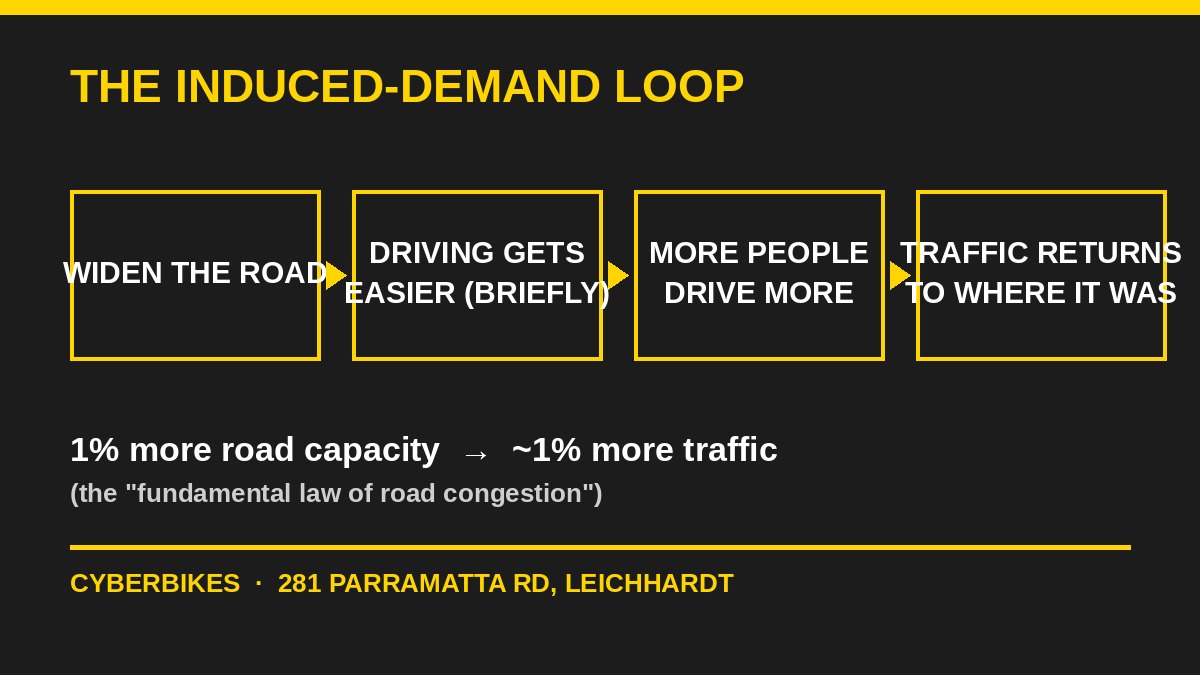
Induced demand is the idea that the supply of road space creates its own traffic. Build a wider motorway and, for a few glorious months, the commute is quicker. But that quicker trip tempts people who used to catch the train, travel off-peak, or skip the trip entirely to now drive at peak hour. Economists Gilles Duranton and Matthew Turner formalised this as the “fundamental law of road congestion”: across cities, a roughly 1% increase in road capacity generates about 1% more vehicle travel, so congestion returns to where it started (City Observatory; TomTom).
Has widening roads ever actually fixed traffic?
The global evidence says no. Houston’s Katy Freeway was widened to a monstrous 23 lanes — and within just three years, peak commute times were longer than before the expansion (City Observatory). Sydney has run the same experiment with WestConnex, a motorway network whose cost blew out to around A$16.8 billion. Its own 2015 business case estimated it would enable roughly 45,000 extra road trips every weekday by 2031 (WestConnex overview). After the Rozelle Interchange opened, congestion on Victoria Road, the Anzac Bridge and inner-west streets spiked badly enough to trigger a NSW parliamentary inquiry in 2024. A University of Sydney study that same year put it bluntly: the city “funnelled” and worsened congestion after spending tens of billions on new road infrastructure (University of Sydney).
What does Sydney traffic congestion actually cost us?
A fortune — in time, money and health. The Bureau of Infrastructure and Transport Research Economics (BITRE) estimated Sydney’s avoidable congestion cost at about A$6.1 billion in 2015, projected to rise to somewhere between A$9.5 billion and A$12.6 billion a year by 2030 (BITRE). “Avoidable cost” bundles lost productivity, extra fuel and vehicle wear, and additional pollution and crashes above free-flowing conditions. Every dollar of that is the price of a transport system that assumes the answer to too many cars is more room for cars. It’s the same logic behind the true cost of owning a car in Sydney — expensive by default, and getting worse.
Why is the e-bike the fix Sydney’s traffic actually needs?
Because the maths of road space favours bikes, not cars. A single car lane moves far more people per hour when it carries bikes instead of single-occupant vehicles, and a parked car swallows roughly the footprint of a small bedroom. Induced demand cuts both ways: just as new lanes induce more driving, safe, connected bike infrastructure induces more riding — which is precisely the shift Sydney’s bike lanes can learn from Paris. The e-bike is the piece that makes it realistic for ordinary Sydneysiders: it flattens the hills between Leichhardt and the CBD, shrinks a sweaty 12 km commute into an easy 30-minute glide, and keeps you moving past the queue rather than sitting in it. Under NSW rules, a road-legal pedal-assist e-bike simply gives you a boost that eases off at 25 km/h — no licence, no rego, no petrol.
You don’t need to wait for a new motorway that won’t help anyway. Something like the Cyberbikes Centauro can carry your gear, your groceries and the school run — replacing real car trips today.
Frequently Asked Questions
Does widening roads reduce traffic congestion?
Generally no. Because of induced demand, new road capacity is filled by additional car trips within a few years, and average speeds tend to revert to their pre-widening levels. Studies across many cities show roughly a 1% rise in traffic for every 1% of extra capacity.
What is induced demand in simple terms?
Induced demand means that increasing the supply of something cheap and useful — like road space — increases how much people use it. Make driving faster and easier, and more people choose to drive more often, which is why new lanes fill up.
Can e-bikes really reduce Sydney’s traffic?
Yes, at the margin that matters. A large share of Sydney car trips are short, and each one swapped for an e-bike frees road space, cuts emissions and reclaims parking. E-bikes make cycling viable for more people, over longer distances and hillier routes, than standard bikes.
The honest trade-off is that no single motorway or bike lane fixes a city overnight — but the direction is clear. Swap one car trip a week for an e-bike ride and see what changes. Curious what going car-lighter would look like for you? Come and talk to us at Cyberbikes, 281 Parramatta Road, Leichhardt.
#Cyberbikes #Sydney #eBike #InducedDemand #UrbanPlanning #CarFreeSydney #Leichhardt #Commuting