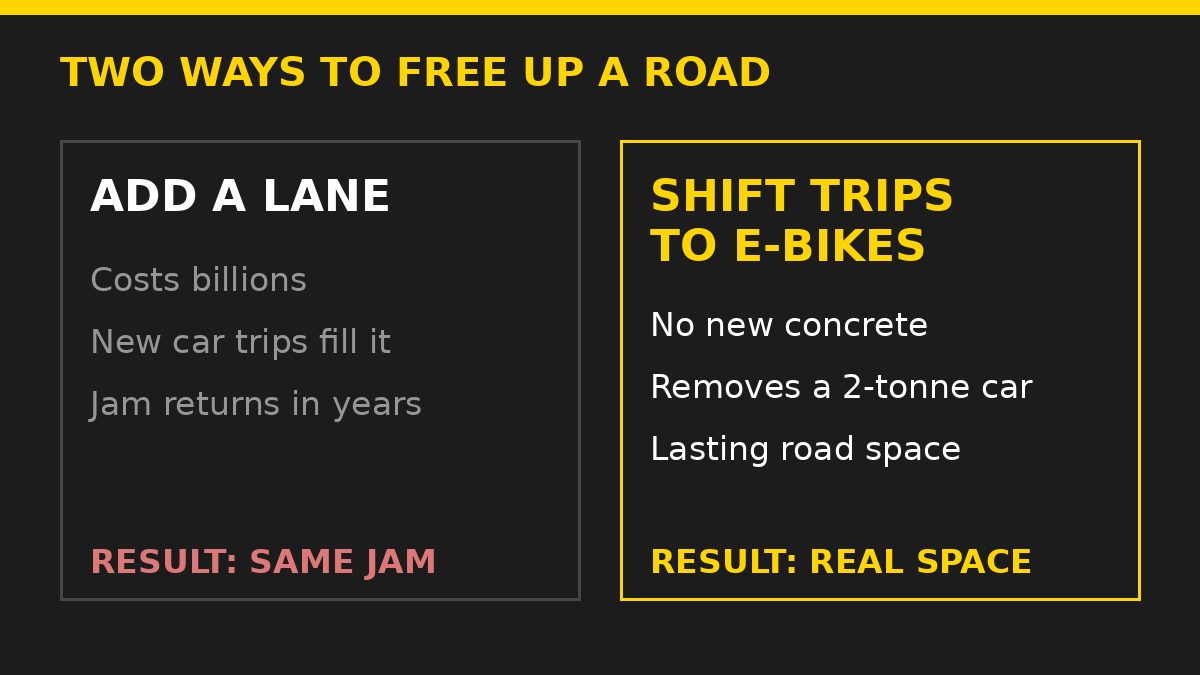
New motorways never fix Sydney’s traffic for one stubborn reason: induced demand. Add a lane and it fills with new car trips within a few years, congestion creeps back, and we are billions of dollars poorer for exactly the same jam. The only thing that reliably frees up road space is taking short trips out of cars — which is precisely what an e-bike does.
At Cyberbikes on Parramatta Road in Leichhardt, we watch this play out on our doorstep. So let’s unpack why concrete keeps losing the war on congestion, and what actually works instead.
What is induced demand, and why does it beat new lanes?
Induced demand is the tendency for new road capacity to generate its own extra traffic. In the landmark study The Fundamental Law of Road Congestion, economists Gilles Duranton and Matthew Turner found that vehicle-kilometres travelled rise almost exactly in proportion to the lane-kilometres of road built — roughly a 10% jump in capacity produces a 10% jump in driving. A University of Barcelona team later replicated the result across hundreds of European cities.
Translation: build more road, get more traffic. New lanes make driving briefly easier, which tempts people who used to travel off-peak, take another route, or catch the train back into their cars — until the road is just as clogged as before. You cannot pour your way out of congestion.
Did WestConnex actually fix the M4?
Sydney is the textbook case. WestConnex was sold as the cure for the M4 corridor, yet the same logic applies: new motorway capacity attracts new trips. And when tolls climbed, a well-documented side effect followed — drivers diverted onto surface streets like Parramatta Road to dodge the charge, pushing congestion straight back into the suburbs the motorway was meant to relieve.
It is a pattern every Sydney driver knows in their bones: a shiny new road, a few smooth months, then gridlock returns — and the streets around it wear the overflow.
What is Sydney’s traffic really costing us?
A fortune. The Bureau of Infrastructure and Transport Research Economics (BITRE) projects the avoidable cost of congestion across Australia’s capital cities could reach between $27.7 billion and $37.3 billion a year by 2030 — with Sydney carrying the single largest share of that bill. That is money burned on time stuck in traffic, wasted fuel and extra emissions, every single year.
To be fair, some road projects genuinely help freight, buses and outer-suburban trips with no realistic alternative. The trade-off is real. But for the millions of short, local car trips clogging inner Sydney, spending billions on lanes that simply refill is the most expensive way to stand still.
How do e-bikes free up road space better than concrete?
By removing cars from the queue instead of building more lanes for them. A large share of Sydney trips are short — the school run, the station, the shops, a mate’s place across the suburb — and these are exactly the trips an e-bike swallows effortlessly. Every short car trip you swap for an e-bike is one less two-tonne vehicle in the jam and one fewer parking space needed, with no new concrete required.
It is also legal and low-fuss: in NSW a pedal-assist e-bike is capped at 250W and cuts assistance at 25 km/h (200W for throttle models), so there’s no registration, licence or rego to think about. The electric motor flattens Sydney’s hills and headwinds — which is what turns “I could ride that” into “I actually will.”
If you’ve been wondering whether your household still needs a second car, or you’re weighing up swapping short car trips for an e-bike, the maths is on your side. Our Centauro commuter e-bike is built for exactly this kind of everyday Sydney riding, and rent-to-own starts from $99.99/week — a fraction of what running a second car costs.
Frequently asked questions
Does building more roads reduce traffic?
Usually not for long. Research on induced demand shows traffic rises roughly in step with new road capacity, so congestion tends to return within a few years. Shifting short trips to walking, cycling, e-bikes and public transport is a more durable way to cut congestion.
Are e-bikes legal to ride on Sydney roads and paths?
Yes. In NSW a compliant pedal-assist e-bike is limited to 250W with assistance cutting out at 25 km/h (200W for throttle-controlled models). These bikes need no registration, licence or insurance and can be ridden on roads and most shared paths.
Can an e-bike really replace car trips in Sydney?
For short, local trips, yes. Most everyday errands and commutes sit well within an e-bike’s comfortable range, and the electric assist handles the hills and distance that put people off an ordinary bike.
Sydney will not build its way out of traffic — but every one of us can opt out of it, one trip at a time. Swap a single car trip a week for an e-bike ride and see what changes. Curious what going car-lighter would look like for you? Come see us at Cyberbikes, 281 Parramatta Road, Leichhardt.
#Cyberbikes #Leichhardt #EbikeSydney #InducedDemand #CarFreeSydney #SydneyTraffic #SustainableTransport