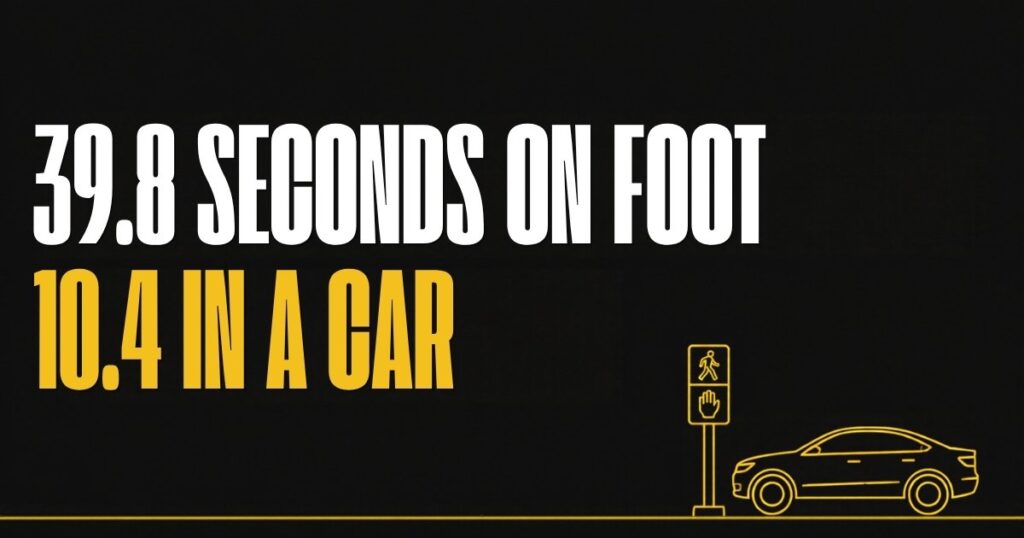
Sydney’s traffic lights make you wait because they are timed to clear cars, not people. Across 168 signalised Sydney intersections measured over 2,226 site-hours, the average person on foot waits 39.8 seconds for a Walk signal, while the average detected vehicle is delayed just 10.4 seconds — nearly four times the penalty for the mode that takes up the least road space (Levinson, Findings, 2026). That is not a bug in the hardware. It is a policy, written in seconds, at every intersection you cross.
We hear about it every week at Cyberbikes in Leichhardt: riders who gave up on a route not because of the hills, but because of eight sets of lights in four kilometres.
How long do Sydney’s traffic lights actually make you wait?
Longer than the research says anyone will tolerate. The City of Sydney’s own evidence paper, People won’t wait (June 2024), puts the globally accepted limit of patience at about 30 seconds, with annoyance setting in between 6 and 22 seconds. Measured reality in the city centre: a 2019 study of nine CBD intersections found an average 52-second wait, and 70 seconds at the worst one — roughly 70% longer than what people demonstrably accept.
Crowd-sourced timing is worse again. Volunteers measuring more than 148 intersections through the Better Intersections project have logged waits up to 180 seconds, including a reported 179 seconds at Elizabeth and Phillip Streets in Redfern, as ABC News reported in 2023. The same report noted that getting official signal timing for a single intersection costs at least $200 per request — while Victoria publishes the equivalent data openly.
Why does a car’s 10 seconds beat your 40 on foot?
Because the system counts vehicles, not people, and optimises what it counts. Sydney’s signals run on SCATS, the adaptive control system developed in New South Wales and now exported worldwide — and adaptive, in practice, means adaptive to traffic volume. Pile up enough cars on the approach and the green stretches to suit them. Nobody is standing on a loop detector.
The arithmetic that follows is the uncomfortable part. In the Findings study, people on foot account for just 5.6% of counted person-passages but absorb 18.6% of all person-delay. When the researchers modelled calling the Walk signal within 30 seconds across 95 sites, pedestrian delay fell from 38.05 to 26.46 seconds while vehicle delay rose from 9.55 to 11.01 seconds.
| Delay per passage | On foot | In a car |
|---|---|---|
| Sydney average now | 39.8 s | 10.4 s |
| Modelled 30-second Walk target | 26.46 s | 11.01 s |
| Share of person-passages | 5.6% | 94.4% |
| Share of person-delay | 18.6% | 81.4% |
Read that trade honestly: giving walkers 11.6 seconds back costs drivers 1.5. The current timing only looks rational if a minute of a driver’s life is worth more than a minute of a pedestrian’s — a value judgement dressed up as engineering.
Didn’t Sydney already test shorter signal cycles?
It did, and it worked. In January 2018 Transport for NSW reprogrammed the core of the Sydney CBD so a green appeared at least every 90 seconds, down from a 110-second maximum cycle. Over three months of monitoring, pedestrian waits fell by up to 40% on some streets and by at least 18% at every measured site, while bus performance was unchanged or faster — in one case buses arrived about 3.6 minutes earlier. The study stayed unpublished until Better Streets obtained it through a freedom-of-information request.
Eight years on, the 90-second cap still has not been extended past the CBD core. A measure that cost nothing but configuration, helped everyone including buses, and was proven on Sydney’s own streets is sitting in a drawer. Meanwhile the state finds billions for motorways — which is the same pattern we see in how Sydney sets its speed limits.

What do long waits do to walking, riding and the road rules?
They push people into cars and into risk. The City of Sydney paper is blunt: long waits and awkward intersections cut how far people are willing to walk by 10% to 20%, and the share of people crossing against the signal rises exponentially with the combined red and flashing-red time — a pattern drawn from 219,000 observed crossings at 20 locations. The intersections with the longest waits had the highest rate of people walking out on red, and people who cross against signals face a higher risk of being hit, seriously injured or killed.
So the signal meant to protect you manufactures the behaviour it punishes. The recommended fix is unglamorous: a maximum 45-second wait with a 30-second target, waiting kept to 15% or less of a walking trip, shorter cycles, and countdown timers instead of a flashing red that legally bars you from starting.
On an e-bike the same lights cost you differently: every stop dumps your momentum, and a long cycle on a 4 km commute can add more time than the hills ever will. Worth knowing where you legally stand while you wait — Transport for NSW’s e-bike rules currently allow a maximum continuous rated power of 500 W (dropping to 250 W from 1 March 2029, with EN 15194 certification required), assistance must stop above 25 km/h, throttle-only operation must cut out at 6 km/h, and an approved helmet is mandatory. Software-limiting an over-powered bike does not make it legal. We keep the detail current in our complete guide to e-bike laws in NSW.
What would fairer traffic lights look like in the Inner West?
Four changes, none of which require a tunnel. Extend the 90-second maximum cycle beyond the CBD to high streets like Parramatta Road, Norton Street and Marrickville Road. Adopt the 45-second maximum wait as a published standard. Switch the buttons to automatic recall wherever foot traffic is constant — you should not have to apply to cross. And publish the timing data free, the way Victoria does, so residents can audit their own corner instead of paying $200 for it.
None of this is anti-car. It is anti-waste, and it is one of the quiet reasons short trips in this city still default to driving. If you want the full case for ditching those trips, start with our car-free Sydney e-bike commuting guide.
Frequently Asked Questions
How long do pedestrians wait at Sydney traffic lights on average?
About 39.8 seconds per crossing if everyone waits for the Walk signal, measured across 168 Sydney intersections in a 2026 study published in Findings. The average detected vehicle is delayed 10.4 seconds. In the city centre, a 2019 study of nine CBD intersections found an average 52-second wait, with 70 seconds at the worst intersection.
What is the maximum pedestrian wait time recommended for Sydney intersections?
The City of Sydney’s 2024 evidence paper recommends a maximum wait of 45 seconds with a target of 30 seconds, counting both the red and flashing-red periods. It also recommends that time spent waiting at lights be 15% or less of a walking journey, because research shows tolerance runs out at roughly 30 seconds.
Do shorter traffic light cycles slow down buses and cars in Sydney?
The 2018 Transport for NSW trial in the Sydney CBD capped the signal cycle at 90 seconds instead of 110. Pedestrian waits fell by up to 40% on some streets and by at least 18% at every measured site, and bus performance was unchanged or faster, with buses arriving about 3.6 minutes earlier in one case.
Swap one car trip a week for an e-bike ride and see what changes — the lights will still be badly timed, but you will spend a lot less of your life paying for it. Our own Centauro e-bike runs a 250 W rear hub motor and a 48 V 25 Ah (1200 Wh) Samsung battery with UL 2271 certification, full suspension and hydraulic brakes. Come and ride one at Cyberbikes, 281 Parramatta Road, Leichhardt — rent-to-own plans are on cyberbikes.com.
#eBikeSydney #SydneyTraffic #TrafficLights #UrbanPlanning #CarFreeSydney #Leichhardt #ActiveTransport #Cyberbikes #Centauro #BetterStreets