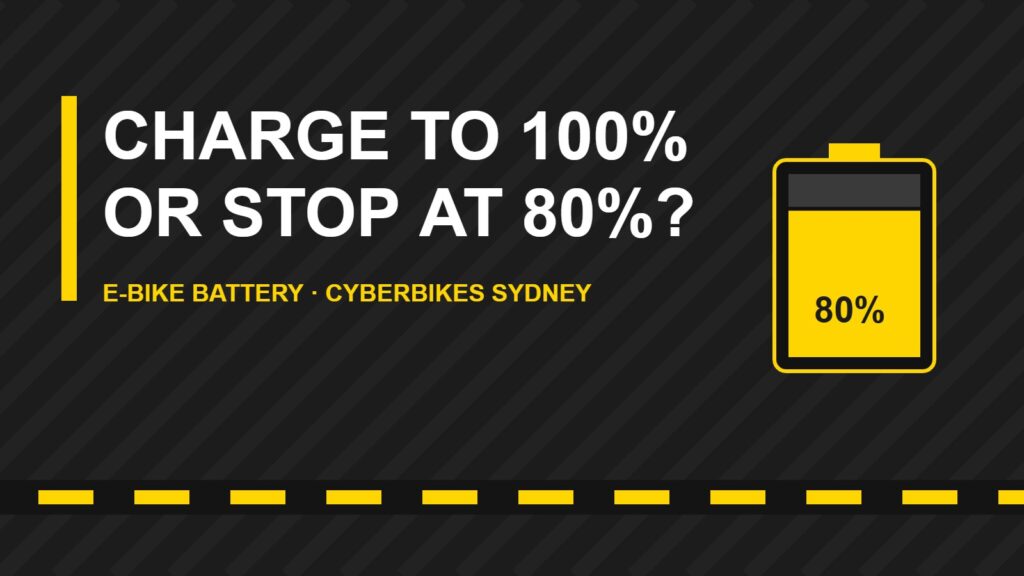
For daily riding, set your e-bike battery charge to stop at 80% and go to 100% only when you actually need the range. On most lithium cells a 100% charge means 4.2 volts per cell, and that last stretch of voltage is where cycle life gets spent fastest — Grin Technologies built the charge level into the Satiator Charge Simulator precisely so riders can “determine the charge voltage that will achieve a given % of full capacity in order to greatly improve cell cycle life while still having sufficient capacity for your range requirements”. On a 1,200 Wh Centauro, 80% still leaves about 960 Wh on board — roughly 96 km at the bike’s quoted test consumption. For a Leichhardt-to-CBD commute, that is not a compromise. It is just a smaller number on the display.
What does a 100% e-bike battery charge actually mean in volts?
It means a target voltage, not a fuel gauge. Your charger does not count energy going in; it pushes current until the pack reaches a set voltage, then holds that voltage while current tapers away. Grin describes the two stages plainly: a bulk charge at constant current, then a constant-voltage phase “as the current tapers down”.
The numbers that matter are per cell, not per pack. Grin’s simulator documentation states that “a 100% charge with most cells is 4.2V/cell, and at this voltage you should get the rated Amp-hours from the cell on discharge”. An 80% charge is not 80% of that voltage — it is “charging to whatever voltage produces 80% of the available capacity on discharge”. Their worked example: “a 10Ah pack with an 80% charge level should charge to exactly 8Ah instead of the full 10Ah”.
Crucially, there is no universal 80% voltage. Grin are explicit: “because every lithium chemistry is unique, the exact voltage per cell needed to achieve a certain charge level will vary from one cell type to the next”. That is why their simulator asks for your actual cell type, and why they tell riders to insist a vendor publishes it — the information lives in the pack’s UN38.3 test report or Safety Data Sheet. A seller who cannot name the cell in the pack is a seller you cannot model.
How much range do you really give up at 80%?
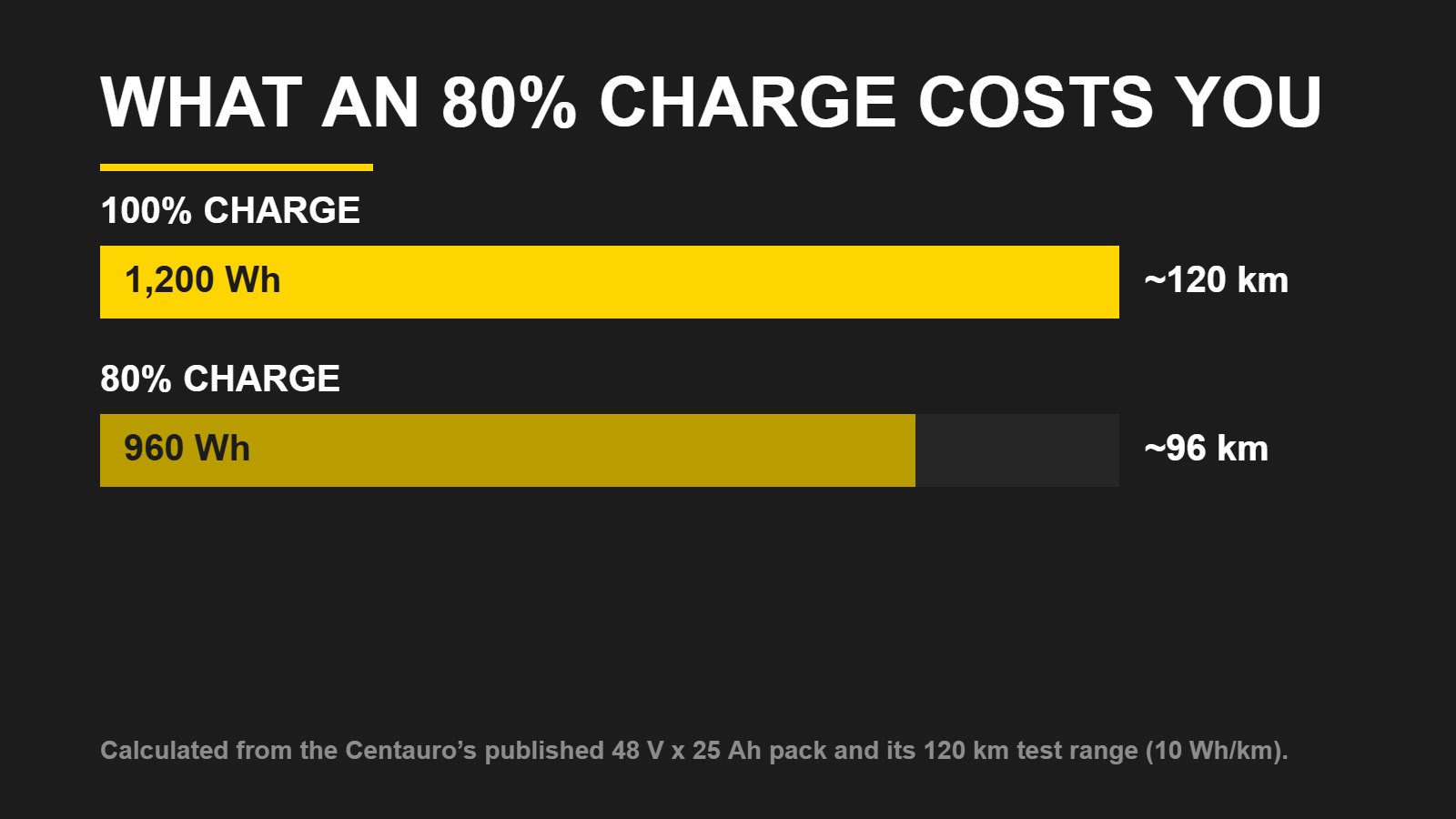
Less than most riders fear, and you can calculate it before you decide. Energy in a pack is simply Wh = V × Ah. The 2026 Cyberbikes Centauro ships a 48 V, 25 Ah Samsung pack, which the product page states as 1,200 Wh — and 48 × 25 is exactly 1,200, so the badge and the arithmetic agree.
Now turn that into distance. The same page quotes up to 120 km at 25 km/h, measured on flat road with a 75 kg rider and no headwind. Divide: 1,200 Wh ÷ 120 km = 10 Wh/km under those test conditions. Hold that figure and the 80% question answers itself:
- 100% charge: 1,200 Wh ÷ 10 Wh/km ≈ 120 km
- 80% charge: 960 Wh ÷ 10 Wh/km ≈ 96 km
- The difference: about 24 km — on a bike whose quoted range already assumes flat ground and no wind
Real Sydney riding will not hand you 10 Wh/km — hills, headwinds, cargo and higher assist levels all push consumption up, as the product page notes. But the ratio holds whatever your personal Wh/km turns out to be: 80% of the energy buys 80% of the distance. If your round trip is 20 or 30 km, which covers most inner-west commutes into the CBD, both numbers comfortably clear your actual need.
Does stopping at 80% actually make the pack last longer?
That is the trade the practice is built on, and the people who build chargers say so directly. Grin’s own product copy for the Satiator states you can “set it to stop at 80 or 90% for everyday charging and go to a full 100% only when you need maximum range, which could extend the life of your battery pack”. Their simulator page puts the same idea in engineering terms: choosing a charge voltage for a given capacity percentage “greatly improve[s] cell cycle life”.
Note the hedging in that quote — “could”. We will not put a cycle-count multiplier on it that nobody has published for your specific cells: the gain depends on your chemistry, how deeply you discharge, and how hot the pack gets. What is well established is the direction — the top of the voltage window is the stressful place for a lithium cell to sit, and a charger that stops short of it spends less time there.
The practical consequence for a Sydney commuter is a two-profile habit: 80% on weeknights, when your ride is a known 15 km each way, and 100% the night before a long weekend run. Our workshop at Leichhardt sees both kinds of pack — charged full and left full for months, or cycled gently — and the difference shows up as capacity, not as dramatic failure.
Will stopping early upset the battery’s cell balancing?
Not if you let the charger finish its job on the days you do charge full. This is the detail most “80% rule” advice skips, and Grin are blunt about it. On the Satiator, the “Charge Complete” message is set at “a somewhat arbitrary point, as the current approaches 0 amps” — and critically, “the Satiator continues to put out the full voltage and trickle current after this point”, because terminating charging there “would be a terrible idea for cell balancing”.
Why does that matter? A pack is many cells in series, and a BMS equalises them near the top of the charge, where the voltage curve is steep enough to tell cells apart. Charge only to 80% forever and you rarely give the BMS that window. The fix is not to abandon partial charging — it is to take the pack to a completed full charge periodically, leaving it connected until the current has genuinely tapered.
Can you charge faster and to 80% at the same time?
Yes — but the limit is the pack’s wiring and BMS, not the charger’s ambition. Charge power follows the same watts = volts × amps relationship as motor power: the Satiator is rated at 8 A maximum but, Grin note, “in practice may be limited even lower than this with 48V batteries to stay within the 360 watt Satiator power limit”.
Push more current than the pack’s charge path was designed for and you are heating it — resistive losses scale with the square of the current (I²R), so doubling charge current quadruples the heat in the connectors, the charge port and the BMS’s charging FETs. Grin’s warning is concrete: many ebike packs “are not designed to handle such a rapid charge current, and doing so may trip the BMS charge protection or blow the charging port fuse”. They give a safe rule of thumb instead — “even most low-current energy cells can safely be charged at a C/2 charging rate, so a 12Ah pack could be charged with a 6A charge current”.
For context, the Centauro’s published charge time is about five hours from empty to full. Its charger’s output rating is not stated on the product page, so we will not reverse-engineer an amp figure. Our breakdown of fast or slow e-bike charging covers the current side of the equation, while this post covers the voltage side — and the full picture sits in our definitive guide to e-bike batteries.
Watch: what e-bike power actually costs
Charging strategy is a battery-longevity decision, not a running-cost one: at roughly 1.2 kWh for a full Centauro charge, the electricity is a rounding error next to running a car — the point this clip makes.
Does NSW law care how you charge your e-bike?
Not directly — but it cares a great deal about what you are charging. Transport for NSW currently sets a maximum of 500 W continuous rated power, with motor assistance cutting out at 25 km/h and throttle-only power cutting out at 6 km/h. From 1 March 2029 the limit drops to 250 W and only EN 15194 certified e-bikes will be allowed on NSW roads.
Two things there bite. A bike over the limits is illegal “even if software, an app, or a switch restricts its power or speed” — a setting does not make a derestricted bike legal. And under seizure laws effective 21 August 2026, police and authorised officers can seize illegal e-bikes on NSW roads and road-related areas (Transport for NSW). The Centauro sits on the compliant side: 250 W rear hub motor, assist cutting at 25 km/h, throttle limited to 6 km/h, and certification to UL 2849, UL 2271, ISO 4210 and EN 15194 — already the standard 2029 will require.
Frequently Asked Questions
What voltage is 80% on an e-bike battery?
There is no single figure. Grin Technologies state that 100% is 4.2 V per cell on most lithium cells, while 80% means whatever voltage yields 80% of the pack’s capacity on discharge — and that this voltage “will vary from one cell type to the next” because every lithium chemistry is unique. You need your pack’s actual cell type to model it, which is why Grin’s Charge Simulator asks for it.
How much range does an 80% charge give on a 1,200 Wh e-bike?
About 80% of the full-charge range. The Cyberbikes Centauro’s published 1,200 Wh pack and up to 120 km test range work out to 10 Wh/km, so an 80% charge of 960 Wh gives roughly 96 km under the same flat-road, 75 kg rider, no-headwind conditions. Hills, headwinds and cargo reduce that figure for both charge levels equally.
Should I ever charge my e-bike battery to 100%?
Yes — when you need the range, and periodically for cell balancing. Grin note that a charger holding full voltage and trickle current after the “charge complete” point is what lets a BMS equalise cells, and that terminating charge at that point “would be a terrible idea for cell balancing”. Charge to 80–90% for daily riding and go to a full, completed charge before long rides.
Try it before you theorise about it
The fastest way to find your real Wh/km is to ride your own route on a bike that reports it. Book a test ride at Cyberbikes Leichhardt, 281 Parramatta Road and take a Centauro up Parramatta Road and back — hills, lights and traffic included. We are open Tuesday to Saturday on 0491 794 668, or browse the range at cyberbikes.com. Rent-to-own starts from $99.99 per week.
#Cyberbikes #EBikeSydney #EBikeBattery #ElectricBikeLeichhardt #CentauroEBike #EBikeCharging #BatteryHealth #SydneyCommute #RentToOwnEBike #EBikeRange