Yes — regenerative braking on an e-bike really works, but with a big asterisk. It only functions on bikes with a direct-drive hub motor (or a special non-freewheeling geared hub) running a controller that supports it, and in the real world it usually claws back only a few per cent of your range — most of that on hilly, stop-start routes and almost none on flat cruising. Its bigger everyday payoff isn’t free charging at all: it’s smooth, weatherproof braking that barely wears your pads. Here’s exactly how regenerative braking works, which e-bikes can actually do it, and whether it matters for a Sydney commute.
What is regenerative braking on an e-bike?
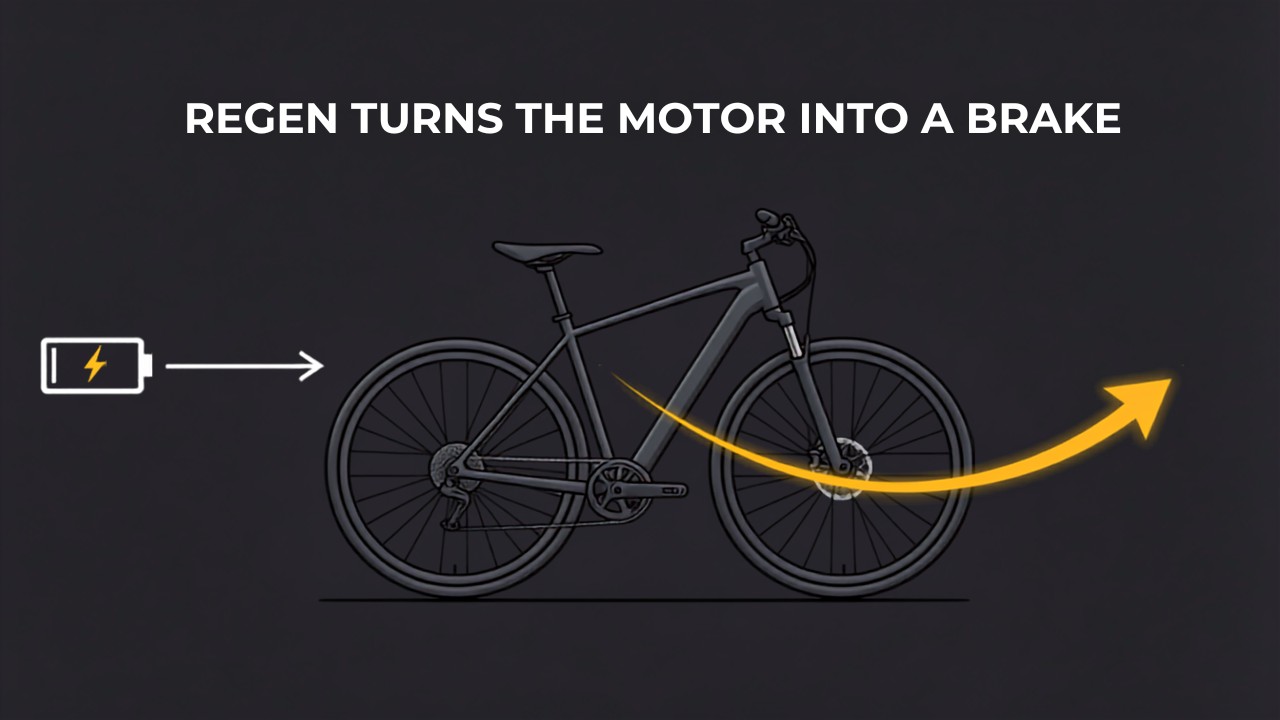
Regenerative braking — “regen” for short — means using the electric motor itself as a brake. A motor and a generator are the same machine run in opposite directions: push current in and it spins the wheel; spin the wheel and it pushes current back out. When you trigger regen, the controller flips the motor into generator mode, so the bike’s forward motion is turned into electricity that flows back into the battery instead of being burned off as heat in your brake pads. The engineers at Grin Technologies (ebikes.ca) — who built the Cycle Analyst partly to study this — describe regen as capturing braking energy and putting it “back into the battery pack, rather than burning it all off as heat.”
The physics is the same relationship that governs the whole drivetrain: power (watts) = voltage × current. Under power, the battery feeds volts and amps into the motor. Under regen, the spinning motor generates its own voltage (called back-EMF) and pushes amps the other way, into the pack. The faster you’re travelling, the more braking force it produces and the more energy it recovers — which is exactly why regen earns its keep on long descents rather than gentle flat riding.
Does regenerative braking actually recharge your battery — and how much?
A little, not a lot. On flat roads you’ll recover almost nothing; on a hilly, stop-start loop with plenty of braking, most measurements put the gain in the single digits to low teens as a share of range. The reason is simple energy accounting: you can only ever recover a fraction of the energy you already spent getting up to speed, and some of that fraction is lost as heat in the motor and controller on the way back. So think of regen as a modest range top-up and a serious brake-saver — not a way to “charge as you ride” forever. If you want the full picture of where your e-bike’s energy really goes, efficiency losses are the other half of this story.
Which e-bikes can do regen? Direct-drive vs geared hub motors
Here’s the part most buyers get wrong: the large majority of e-bikes physically cannot do regen, whatever the marketing says. Regen needs the wheel to stay mechanically connected to the motor when you slow down. A direct-drive hub motor is permanently coupled to the wheel, so it can act as a generator. A normal geared hub motor contains a freewheel (a one-way clutch) that lets it coast with zero drag — great for efficiency, but it also means the wheel can’t drive the motor backwards to make electricity. The one exception is a purpose-built geared hub with a locked clutch, like Grin’s GMAC, which keeps the connection and can regen. Mid-drive motors, which send power through your chain and gears, also freewheel and can’t recover energy.
| Motor type | Coasts freely? | Can do regen? | Best for |
|---|---|---|---|
| Direct-drive hub | No (slight drag) | Yes | Regen, high speed, durability |
| Geared hub (freewheeling) | Yes (no drag) | No | Light, discreet commuters |
| Non-freewheeling geared (e.g. GMAC) | No (locked clutch) | Yes | Strong torque plus regen |
| Mid-drive | Yes (freewheels) | No | Steep hills, cargo via gears |
This trade-off sits right at the heart of the mid-drive vs hub motor decision. Direct-drive hubs are heavier and have a touch of cogging drag, but they’re near-silent, almost maintenance-free, and they’re the only common motor that can hand energy back to the battery.
How do you switch regenerative braking on?
Regen doesn’t just happen — the controller needs a signal telling it you want to brake, and how that signal is delivered decides how much control you get:
- E-brake lever: most regen-capable controllers have a brake-cutoff input, so squeezing the lever triggers a fixed regen force. Simple, but you can’t dial the strength up or down.
- Brake lever + throttle: using a throttle (or a bidirectional throttle) to modulate the force lets you feather regen like a proper brake, which is where the biggest gains come from.
- Advanced controllers: Grin’s Phaserunner and Baserunner controllers offer variable regen you can trigger proportionally — even by back-pedalling — for smooth, controllable engine-braking down a hill.
One catch worth knowing: many budget controllers either don’t support regen or do it poorly, which is a big reason regen is so often dismissed in the e-bike world. Good hardware makes all the difference.
Is regen worth it for a Sydney commuter — and is it legal in NSW?
It’s completely legal, and for the right rider it’s genuinely useful. Regen doesn’t change your motor’s rated power, so it has no effect on your legal status: in NSW a pedal-assist e-bike is capped at 250W continuous output with assistance cutting off at 25 km/h, and using the motor as a brake sits well within those rules. If you ride a hilly route — think the drop down toward the harbour, or repeated stops through inner-west traffic — regen buys you a little extra range and, more importantly, saves your brake pads and gives consistent stopping power in the rain.
That said, most everyday commuters don’t need regen at all. Our own Cyberbikes Centauro runs a 250W rear hub motor and leans on its big 48V 25Ah (1200Wh) Samsung battery for range, plus 4-piston hydraulic disc brakes with 180mm rotors for stopping — a setup that’s simpler, lighter and cheaper than a regen system, and more than enough for city and cargo duty. Regen is a brilliant feature if your riding is hilly and stop-start; for flat commuting, a big battery and good discs win.
Not sure which motor and braking setup suits your ride? Come in for a test ride at Cyberbikes, 281 Parramatta Road, Leichhardt, and we’ll match you to the right e-bike — ask about our rent-to-own plans from $99.99/week.
Frequently asked questions
Does regenerative braking charge an e-bike battery while you ride?
It puts some energy back into the battery during braking and descents, but only a small amount — typically a few per cent of your range, most of it on hilly, stop-start routes. Regen tops the battery up; it cannot fully charge a bike on the move, because a bike can’t power itself.
Can any e-bike do regenerative braking?
No. Regen only works on a direct-drive hub motor, or a non-freewheeling geared hub like the Grin GMAC, paired with a controller that supports it. Standard freewheeling geared hub motors and mid-drive motors coast freely and cannot recover energy.
Is regenerative braking legal on a 250W e-bike in NSW?
Yes. Regen does not change your motor’s rated power. In NSW a pedal-assist e-bike is limited to 250W continuous output with assistance cutting out at 25 km/h, and using the motor as a brake is unaffected by those rules.
#Cyberbikes #eBikeSydney #ElectricBikeLeichhardt #RegenerativeBraking #eBikeTech #RideElectric