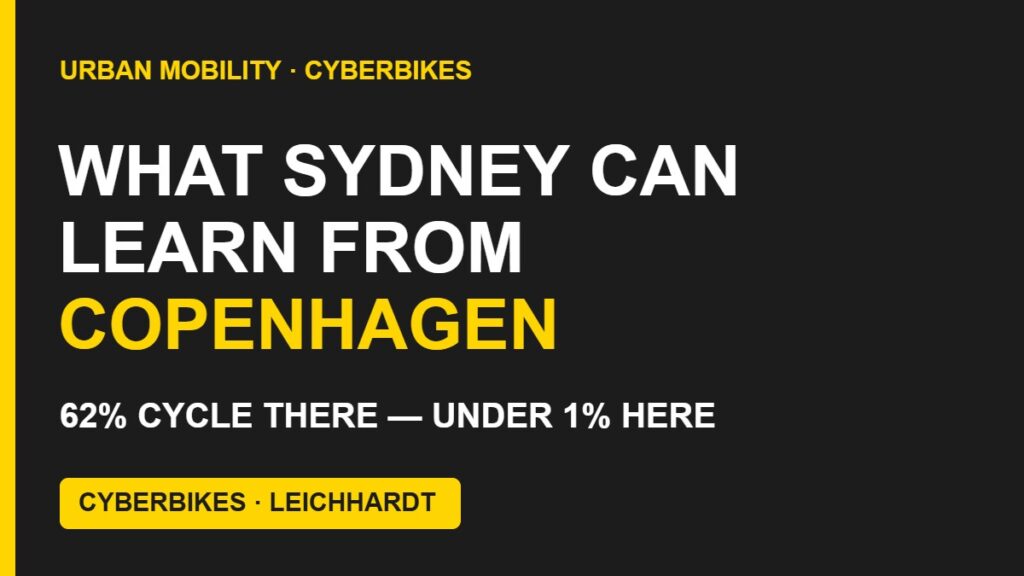
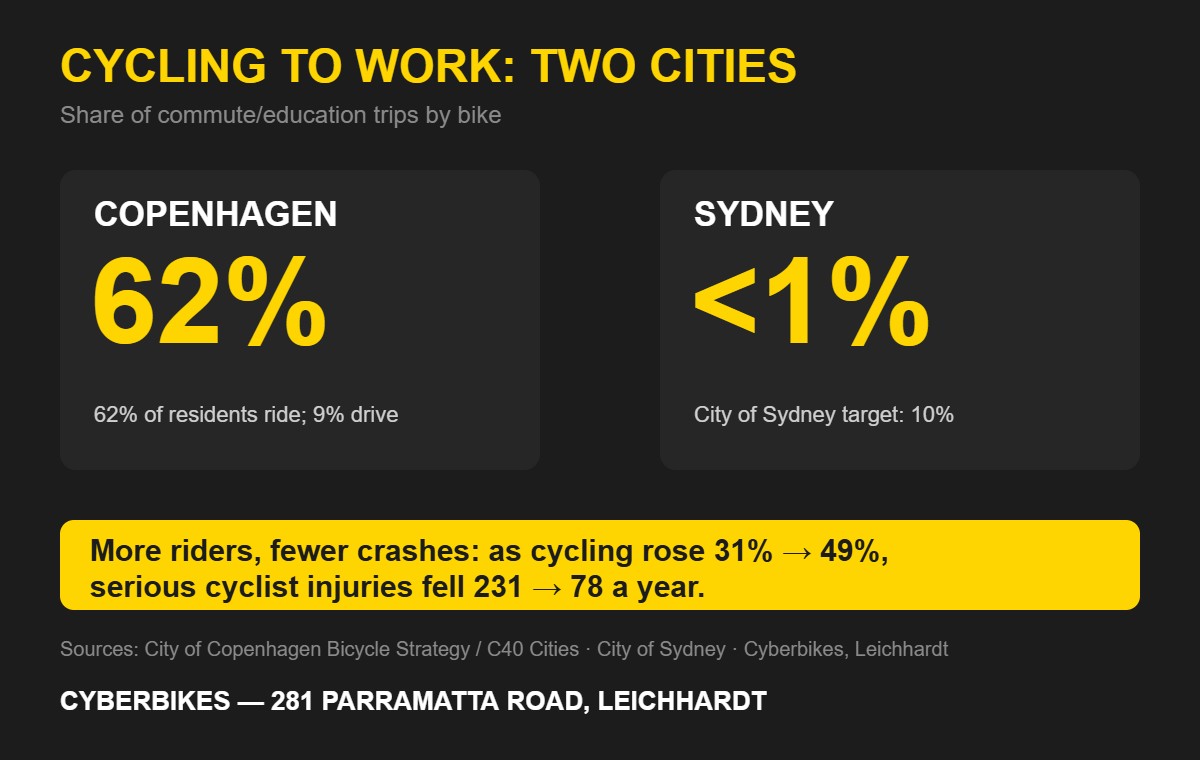
Copenhagen didn’t out-pedal Sydney on willpower — it built protected bike lanes and made riding feel safe for ordinary people. Today around 62% of Copenhagen residents cycle to work or study and just 9% drive, while fewer than 1% of Sydney commuters ride a bike. The lesson isn’t “try harder.” It’s “build better” — and let the e-bike do the heavy lifting.
At Cyberbikes in Leichhardt we hear the same doubts every week: Sydney is too hilly, too hot, too spread out to ever be a cycling city. Copenhagen’s story — and modern e-bikes — quietly dismantle every one of those excuses.
How did Copenhagen become a city of cyclists?
Not by accident, and not overnight. Over decades Copenhagen converted road space and parking into a connected network of physically separated cycle tracks — kerb-protected lanes that keep bikes away from moving traffic. The city now has roughly 385 km of segregated cycle tracks plus a growing web of Cycle Superhighways linking the suburbs to the centre. The payoff: bicycles now outnumber cars in the city centre, and cycling’s share of trips to work and education has climbed to around half.
The crucial detail is what they built. Paint on a busy road doesn’t move the needle; protection does. When people — kids, parents and older riders included — feel safe, they ride. That is the whole game.
Why does protected infrastructure beat willpower?
Because safety is the number-one thing that stops people cycling, and separated lanes deliver it. Between 1995 and 2018 Copenhagen’s cycling mode share rose from 31% to 49% — and over the same period the number of cyclists seriously injured each year fell from 231 to 78. More riders, fewer crashes. It is the “safety in numbers” effect: protected lanes bring people out, and a street full of bikes is a street where drivers expect and see them.
Sydney has proven the same principle on a smaller scale: separated routes such as the College Street and Kent Street cycleways carry far more riders than the painted lanes around them. The barrier isn’t Sydneysiders’ appetite to ride — it’s a network still full of gaps and “paint-only” lanes that dump you back into traffic.
“But Sydney is too hilly and hot” — is that still true?
It was a fair objection twenty years ago. It isn’t anymore, because the electric motor flattens the hill and takes the sweat out of the trip. A pedal-assist e-bike that’s road-legal in NSW is capped at a 250W motor with assistance to 25 km/h — enough to make a Leichhardt-to-CBD run or the school run feel effortless, with no licence or registration required.
Our Cyberbikes Centauro is built for exactly that job: a 250W NSW-legal motor, a Samsung 48V 25Ah (1,200Wh) battery for genuine all-week range, a UL 2271-certified battery for peace of mind, and a rear rack rated to 50 kg so it can swallow the groceries or a kid. It turns Copenhagen’s “anyone can ride” promise into something that works across Sydney’s hills and heat.
What does it cost Sydney to keep waiting?
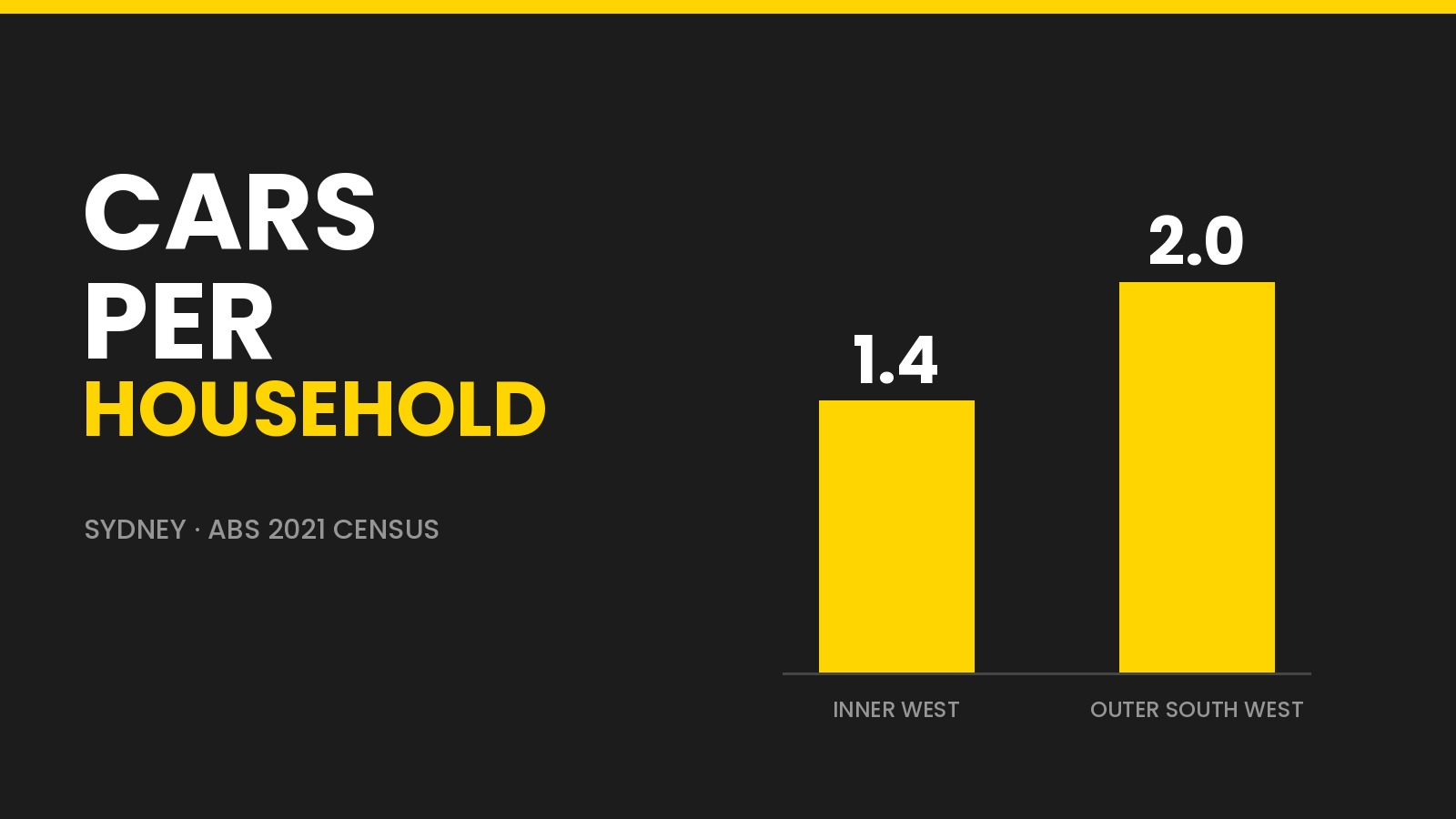
A lot. The avoidable cost of congestion in Sydney — lost time, wasted fuel, extra crashes and pollution — is already estimated at around $8 billion a year and is projected to climb toward $15 billion by 2030. Every trip we shift from a car seat to a bike saddle hands time, road space and clean air back to the city. It’s cheaper for households, too — it’s worth seeing what owning a car in Sydney really costs before you write off going car-lighter.
Copenhagen isn’t a fantasy; it’s a to-do list. Sydney already knows the moves — Paris ran the same playbook in just a few years, as we covered in what Sydney can learn from Paris’s bike boom. Protected lanes plus e-bikes is the fastest, cheapest congestion fix we have.
Frequently Asked Questions
What percentage of Copenhagen commutes by bike?
Around 62% of Copenhagen residents cycle to work or education, compared with just 9% who drive. City-wide, cycling makes up close to half of all trips to work and study.
Why do so few people cycle in Sydney?
Fewer than 1% of Sydney commuters ride, mainly because the bike network is fragmented and many lanes are unprotected. Where Sydney has built separated cycleways, ridership is much higher — evidence that infrastructure, not attitude, is the barrier.
Can an e-bike handle Sydney’s hills and distances?
Yes. A NSW-legal pedal-assist e-bike (250W motor, assist to 25 km/h) flattens hills and extends comfortable range well beyond a regular bike, making commutes like Leichhardt to the CBD easy without a licence or registration.
If you’re ready to be part of a car-lighter Sydney, come and try one at Cyberbikes, 281 Parramatta Road, Leichhardt — or ask us about rent-to-own and ride the change before you buy.
#Cyberbikes #EbikeSydney #Leichhardt #CopenhagenCycling #BikeLanes #CarFreeSydney #UrbanMobility