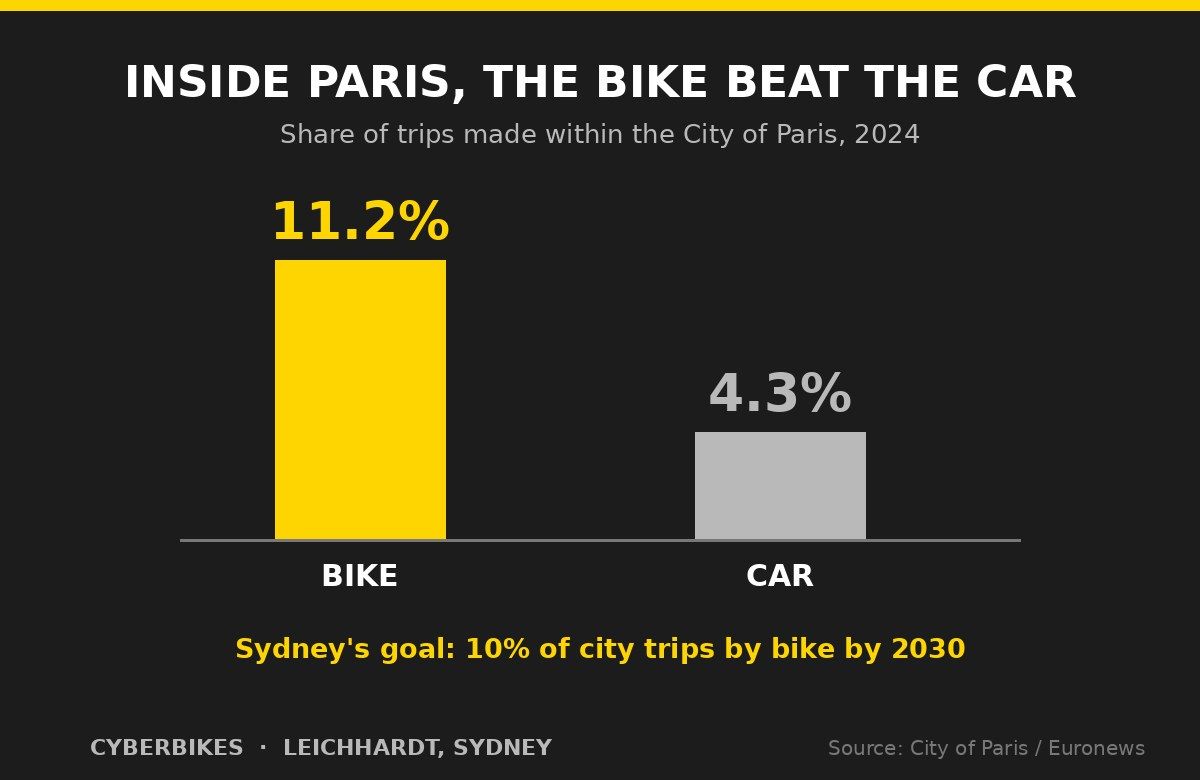
What can Sydney learn from Paris’s bike boom? The biggest lesson is blunt: car traffic is a choice, not a law of nature. In 2024, for the first time, more trips inside the City of Paris were made by bike (11.2%) than by car (4.3%) — the payoff from a decade of deliberately redesigning streets around people instead of parking. Sydney, still aiming for just 10% of city trips by bike by 2030, can follow the same playbook.
At Cyberbikes in Leichhardt we watch this shift every day: give people a safe, direct route and an e-bike that flattens the hills, and they leave the car at home. Here’s what Paris got right — and how Sydney can copy it.
How did Paris get more cyclists than drivers?
Paris didn’t wait for attitudes to change; it changed the streets first. Since 2020 the city has built more than 1,000 km of cycleways under its “Plan Vélo,” and cycling traffic jumped 240% between 2018 and 2023, according to the mobility study reported by Euronews. During the morning peak (8–9am) the gap is even starker: bikes carry 18.9% of trips inside Paris, cars just 6.6%.
Just as important, Paris took space back from cars. Around 10,000 on-street parking spaces were removed in five years, and in March 2025 Parisians voted to scrap another 10,000. Fewer car lanes and car parks, more protected bike lanes — and the ridership followed.
Where does Sydney sit right now?
Sydney is climbing, but from a low base. The City of Sydney counted a record 55,030 bike trips in a single March 2025 count — up 7% year-on-year — and has set a target of at least 10% of city trips by bike by 2030, per the City of Sydney. New links like the Oxford Street cycleway are exactly the kind of protected infrastructure that moved the needle in Paris.
The gap is instructive. Paris already sits above 11% inside the city; Sydney is still working toward 10%. The difference isn’t weather, hills or “culture” — it’s a connected network. Painted lines on a busy road don’t convince a nervous rider; a protected lane that goes where they actually need to go does.
What can Sydney learn from the Paris playbook?
Three moves did most of the work in Paris, and each one translates directly to Sydney:
- Build a connected, protected network — not disconnected fragments that dump you back into traffic. Riders need routes that join up, from the Inner West to the CBD.
- Reallocate road space and parking — every protected lane and bike hangar is space reclaimed from storing or speeding cars.
- Prioritise short trips — most city journeys are only a few kilometres, precisely the distance where a bike beats a car on time, cost and parking.
The trade-off is real: reallocating road space and removing parking is politically hard, and some businesses fear losing customers. But Paris is the counter-evidence — foot traffic and street life rose as driving fell, and the city became more pleasant, not less. For the full picture of going car-light here, read our complete guide to car-free e-bike commuting in Sydney, and our case for why Australia must take electric bicycles seriously.
Where do e-bikes fit into Sydney’s shift?
E-bikes are the accelerant. They erase Sydney’s hills and headwinds, so a 5–10 km commute stops being a sweaty ordeal and becomes the fastest door-to-door option — often quicker than crawling through traffic and hunting for a park. That’s how Paris pulled in riders who would never have swung a leg over a regular bike, and it’s why e-bike demand is rising here too.
Our Centauro commuter e-bike is built for exactly this kind of ride: a 48V 25Ah (1,200Wh) Samsung battery, a UL 2271-certified battery pack, and a 250W rear-hub motor that stays within NSW’s 25 km/h pedal-assist limit — legal, and ready for a real Sydney commute. Rent-to-own starts from $99.99/week, so you can swap a car trip for a ride without buying anything outright.
Frequently asked questions
Does Paris really have more cyclists than drivers?
Inside the City of Paris, yes. A 2024 mobility study found 11.2% of trips within Paris were made by bike versus 4.3% by car — the first time cycling overtook driving. Across the wider Paris region, the car still dominates.
Is cycling actually growing in Sydney?
Yes. The City of Sydney recorded a record 55,030 bike trips in its March 2025 count, up 7% on the year before, and is targeting at least 10% of city trips by bike by 2030.
Are e-bikes legal to commute on in Sydney?
Yes. In NSW, pedal-assist e-bikes that cut power at 25 km/h and are limited to 250W are legal on roads and cycleways, with no licence or registration required. Cyberbikes in Leichhardt can set you up with a compliant bike.
Paris proves the car-dominated city isn’t permanent — it’s just a set of choices, and we can make them differently. Swap one car trip a week for an e-bike ride and see what changes. When you’re ready to go a little more car-light, the team at Cyberbikes, 281 Parramatta Road, Leichhardt is here to help.
#Cyberbikes #eBikeSydney #Leichhardt #CarFreeSydney #UrbanMobility #BikeLanes #ParisCycling #Centauro