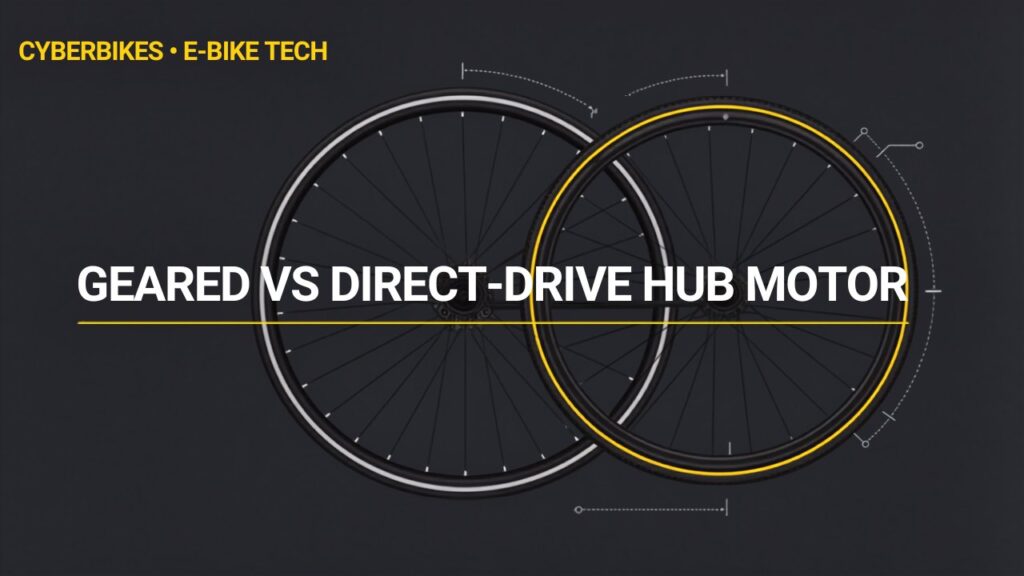
The difference comes down to gearing. A direct-drive hub motor is a single large motor whose body spins with the wheel, while a geared hub motor hides a small, fast-spinning motor and a planetary gearbox inside a lighter, more compact shell. In short: geared hubs are lighter, freewheel when you coast and make more low-speed torque; direct-drive hubs are simpler, near-silent, longer-lasting and are the only type that can do regenerative braking.
At Cyberbikes in Leichhardt we get asked this constantly, because it changes how an e-bike feels on Sydney’s hills and stop-start streets. Here is the engineering, drawn from the hub-motor resources published by Grin Technologies (ebikes.ca), translated into what it means for your ride.
Geared vs direct-drive hub motor at a glance
| Feature | Direct-drive hub | Geared hub |
|---|---|---|
| Internal gearing | None — motor body is the wheel hub | Planetary gears + freewheel |
| Weight (same power) | Heavier | ~50% lighter |
| Typical peak torque | ~35 Nm | Up to ~80 Nm |
| Coasting drag | Always engaged (0.3–1 Nm cogging) | Freewheels — almost none |
| Regenerative braking | Yes | No (freewheel blocks it) |
| Noise | Near silent | Audible gear whine |
| Moving parts / wear | Very few | More parts to wear |
How a direct-drive hub motor works
A direct-drive hub motor is about as simple as an electric drive gets. Imagine holding the axle of an electric motor still and letting the outer body spin instead — then lace a bicycle rim straight onto that spinning body. There are no moving parts other than the wheel itself. Inside sits a ring of permanent magnets and a set of stator windings on the axle; alternating current through the windings drags the magnets (and the wheel) around.
The catch is physics. A direct-drive wheel only turns at roughly 200 rpm, and an electric machine’s power density is proportional to the relative speed between its magnets and windings. Spin slowly and you must build the motor big and heavy to make useful power and torque. That is why direct-drive hubs are the chunky, heavy wheels you see on some cargo and speed bikes.
Because the magnets are permanently, mechanically coupled to the wheel, a direct-drive hub is always engaged. That is a double-edged sword. On the plus side, it makes regenerative braking on an e-bike possible, because the spinning wheel can push current back into the battery. On the minus side, you are always dragging the motor along, even unpowered. That resting “cogging” drag is around 0.3 to 1 Nm and, in a rough motor, can feel like riding with a slightly flat tyre.
How a geared hub motor works
A geared hub motor solves the slow-wheel problem with a gearbox. Inside the shell, a small motor spins fast — often well over 3,000 rpm — and a planetary gear set steps that speed down to wheel speed. Because the motor itself runs fast, it can be small and still make good power, so the whole unit is typically around 50% lighter than an equivalent direct-drive hub, and it usually makes more torque. Grin cites geared units producing up to about 80 Nm, versus roughly 35 Nm for typical direct-drive machines — a big deal on a loaded bike heading up a Leichhardt back street.
Almost every geared hub also has an internal freewheel (a one-way clutch). When you stop feeding it power, the wheel decouples from the gears and spins freely, so there is barely any drag when you coast or pedal a dead battery home. The trade-off is that the same freewheel makes regenerative braking impossible, and the extra gears add moving parts, cost and a faint audible whine.
The real trade-offs: weight, drag, regen and noise
Both types are permanent-magnet motors, so head-to-head the decision is about how you ride, not raw quality. Here are the questions Sydney riders actually ask.
Which hub motor is lighter — and does it matter?
Geared wins on weight, usually by around half for the same power. Lighter unsprung weight at the wheel makes a bike easier to lift onto a rack, carry up stairs to an apartment, and manoeuvre in traffic. If you ever store your e-bike indoors or up a flight of steps, weight matters more than the spec sheet suggests.
Does a hub motor slow you down when it’s off?
Only direct-drive does, meaningfully. Its always-engaged magnets create that 0.3–1 Nm of cogging drag whenever the wheel turns. Geared hubs freewheel, so above the 25 km/h assist limit — or any time you are coasting downhill — a geared bike rolls almost like a normal bicycle. For riders who like to spin past the assist cut-off, that free-rolling feel is noticeable.
Can a hub motor recover energy with regen braking?
Direct-drive can; geared cannot. Only a permanently-engaged direct-drive hub can turn the wheel’s momentum back into battery charge. In real-world Sydney riding the range gain from regen is modest, but it does add braking control on long descents and reduces brake-pad wear. If you never see big hills, it is rarely a deciding factor.
Why do some hub motors whine — and which lasts longer?
The whine comes from the geared hub’s internal planetary gears meshing at speed; direct-drive hubs have no gears, so they run close to silent. Fewer moving parts also means a direct-drive motor has less to wear out over years of commuting, which is part of why they are favoured on high-mileage and cargo builds. Geared hubs are reliable too, but the gears and clutch are consumable parts over a long enough life.
Which hub motor is right for Sydney riding?
For everyday commuting, shopping runs and the odd hill, a geared hub is the sweet spot: light, torquey at low speed and free-rolling when you coast. That is exactly why most lightweight 250W city e-bikes lean geared. The Cyberbikes Centauro runs a 250W rear hub motor paired with a 48V 25Ah (1,200Wh) UL 2271-certified Samsung battery, tuned for smooth pedal assist up to the legal limit — enough torque to carry up to 150kg of rider and cargo without feeling heavy underfoot.
If your riding is mostly flat and high-mileage, and you value silence, durability and regen on descents, a direct-drive hub is worth the extra weight. Not sure which suits you? It helps to also understand how hub motors compare with mid-drive systems before you choose.
What the 25 km/h assist limit means for both motor types
Whichever hub you pick, the law is the same. In NSW a pedal-assist (pedelec) e-bike is limited to 250W continuous rated power with motor assistance cutting out at 25 km/h, and any throttle limited to 6 km/h. The Centauro is built to the EN 15194 standard for exactly this. This video explains why that 25 km/h cap shapes how every Australian e-bike — geared or direct-drive — is set up:
Frequently asked questions
Is a geared or direct-drive hub motor better for commuting?
For most Sydney commuting a geared hub motor is the easier pick: it is roughly 50% lighter than an equivalent direct-drive motor, freewheels so there is almost no drag when you coast or ride unpowered, and delivers strong low-speed torque for hills and traffic starts. Direct-drive suits riders who want near-silent running, maximum durability and regenerative braking.
Can a hub motor slow you down when you pedal without power?
Only a direct-drive hub motor adds noticeable drag, because its magnets are always mechanically engaged and produce a cogging torque of about 0.3 to 1 Nm. In a poor-quality motor this can feel like riding with a slightly flat tyre. Geared hub motors have an internal freewheel, so once you stop pedalling under power the wheel spins almost freely.
Do both hub motor types obey NSW e-bike law?
Yes. Whether a bike uses a geared or direct-drive hub motor, NSW law caps a pedal-assist (pedelec) e-bike at 250W continuous rated power and cuts motor assistance at 25 km/h, with throttle assistance limited to 6 km/h. The Cyberbikes Centauro is built to the EN 15194 standard to meet exactly those limits.
Come and feel the difference
The best way to understand geared versus direct-drive is to ride both. Come in for a test ride at Cyberbikes, 281 Parramatta Road, Leichhardt, call us on 0491 794 668, or ask about our rent-to-own plans from $99.99/week. We will match the right hub motor to how you actually ride Sydney.
#Cyberbikes #eBikeSydney #electricbikeLeichhardt #hubmotor #CentauroEbike #ebiketech #rideelectric