
Regenerative braking on an e-bike uses the electric motor itself as a brake: instead of throwing away your momentum as heat in the brake pads, the motor spins backwards as a generator, turns that motion into electricity, and feeds it back into the battery. It only works on the right kind of motor — a direct-drive hub or a special non-freewheeling geared hub — paired with a controller that supports it. Here at Cyberbikes in Leichhardt we get asked about it constantly, so here is exactly how e-bike regenerative braking works, which bikes can do it, and whether it is worth chasing.
What is regenerative braking on an e-bike?
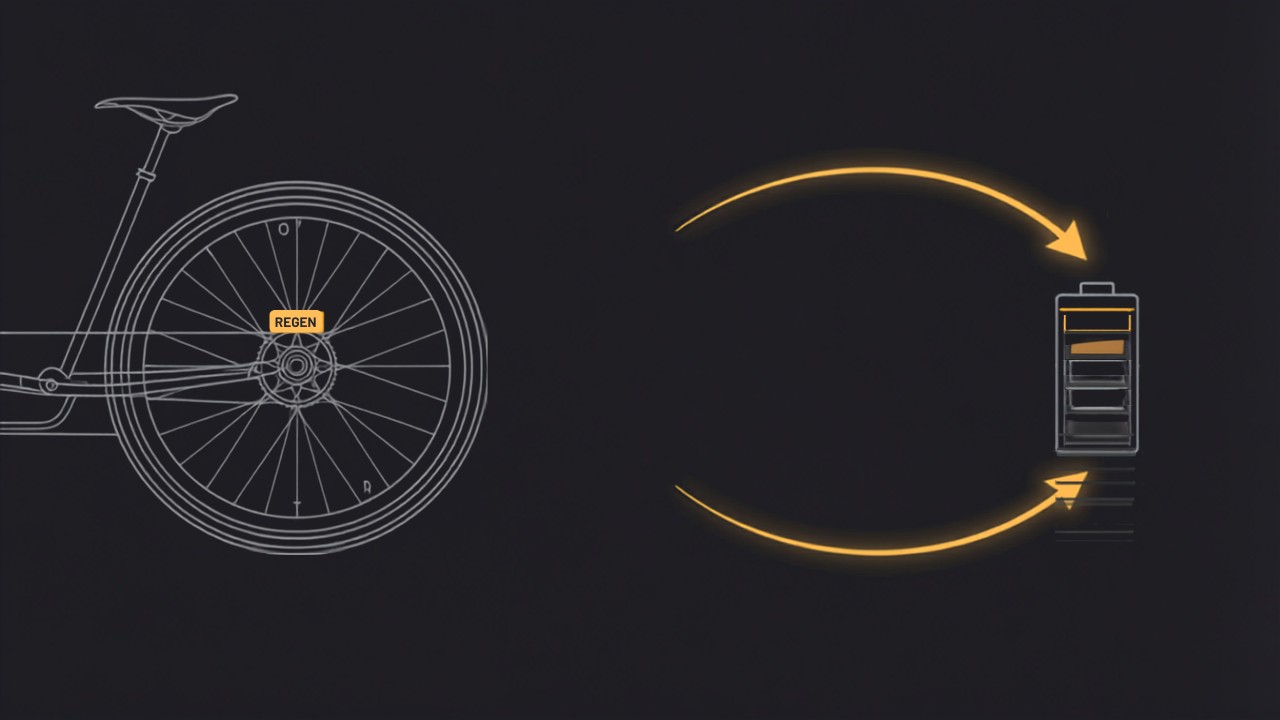
An electric motor and a generator are the same machine running in opposite directions. When you twist the throttle, electricity flows from the battery into the motor and the motor pushes the wheel. Lift off and start braking with a regen-capable system, and the wheel now drives the motor: the spinning magnets induce a voltage (electrical engineers call it back-EMF), the controller steers that current back into the battery, and the effort of generating that electricity is what slows you down.
As Grin Technologies — the Vancouver engineers behind the ebikes.ca learning resources and the Cycle Analyst — put it, regen “not only provides a zero maintenance and perfectly consistent braking force in all weather conditions, it also captures this braking energy and puts it back into the battery pack, rather than burning it all off as heat.” That is the headline benefit: a bit of range back, brake pads that last longer, and consistent stopping power whether it is a dry Sydney summer or a wet winter morning on Parramatta Road.
The physics also explains a quirk you will feel: kinetic energy rises with the square of speed (½ × mass × velocity²), so regen braking is strongest when you are moving quickly and fades to almost nothing as you approach walking pace. That is why regen can never fully replace friction brakes — more on that below.
Which e-bikes can actually do regen?
This is where most of the confusion lives. Regen is only possible on a motor that the wheel can “back-drive.” In practice that means a direct-drive hub motor (no internal gears, the axle is bolted straight to the magnets) or an unusual geared hub built without a freewheel, like Grin’s GMAC. On any of these, spinning the wheel spins the motor, so generation is on the table.
The vast majority of e-bikes cannot do it. Standard geared hub motors and almost all mid-drive motors use an internal clutch — a freewheel — so the motor disengages when you stop powering it. That clutch is great for low weight and efficient pedalling, but it means the wheel cannot turn the motor, and no back-driving means no regeneration. If you want the full picture on those two families, our guide to the difference between geared and direct-drive hub motors breaks down the trade-offs.
Even with the right motor, you still need a controller that supports regen. Grin note that “many budget controllers either don’t or don’t support it very well,” which is a big reason regen is under-appreciated and sometimes dismissed outright in the e-bike scene. Grin’s own Grinfineon, Phaserunner and Baserunner controllers all support it.
Motor types and regen at a glance
| Motor type | Can it do regen? | Why |
|---|---|---|
| Direct-drive hub | Yes | No internal gears — the wheel back-drives the motor directly |
| Non-freewheeling geared hub (e.g. GMAC) | Yes | Purpose-built without a freewheel clutch |
| Standard geared hub | No | Internal freewheel disengages the motor from the wheel |
| Mid-drive | No (almost always) | Freewheel/clutch in the drivetrain blocks back-driving |
How is regen switched on?
For the controller to brake, it needs a signal that you want to slow down. Grin’s regen resource lists several ways riders trigger it, from simplest to most refined:
- E-brake lever: a digital input that applies one fixed level of regen the moment you squeeze the lever. Simple, but you can’t dial the strength up or down.
- Throttle-as-brake: an idea Grin trialled back in 2007 — while the brake lever is held, the throttle switches from controlling power to controlling braking force, giving you variable regen from existing hardware.
- Bidirectional throttle: on Grin’s controllers the unused part of the throttle signal does the work. Roughly 1.2–3.6 V gives proportionally more power, while dropping the signal below about 0.8 V down to 0 V ramps regen from gentle to maximum — all on one wire.
- Speed-limit regen: the controller automatically feeds in regen to hold a set speed. This is the one Sydney’s hills love — proportional braking kicks in on descents with no input from you.
- Back-pedalling on a quadrature PAS sensor, or the display’s up/down assist buttons, can also engage a steady dose of regen on long downhills.
Does regen add real range — and can it replace your brakes?
Set expectations honestly. On flat, stop-and-go inner-west riding, the energy you recover is modest — you are only ever getting back a fraction of what it took to get up to speed, minus losses in the motor, controller and battery. Where regen genuinely shines is long descents: coasting down a big hill, the motor can pour a steady trickle back into the pack while holding your speed in check, which is exactly why speed-limit regen is such a nice feature on hilly terrain.
What regen will not do is replace your mechanical brakes. Because braking force fades at low speed, and because you always need a reliable, powerful stop for traffic and emergencies, friction brakes stay essential — Grin are clear that “the mechanical brakes still come into play.” It is also a legal point: your e-bike still needs brakes that work to be road-legal in NSW. Treat regen as a bonus that saves your pads and claws back a little charge, not as your primary stopping system.
Regen, hills and real riding in Sydney
Sydney is exactly the kind of place where regen’s strengths matter: undulating inner-west streets, the run down toward the harbour, and plenty of wet-weather days where consistent, fade-free braking is genuinely reassuring. If you are building or converting a bike specifically to squeeze back range on long descents, a direct-drive hub plus a regen-capable controller is the combination to look for.
For most everyday commuters, though, a well-braked, lighter geared-hub build is the more practical pick — which is what most compact commuter e-bikes, including many step-through builds, are designed around. Our own Cyberbikes Centauro ($4,249) runs a 250W rear hub motor with a 48V 25Ah (1200Wh) UL 2271-certified Samsung battery, and — crucially for the braking conversation above — 4-piston hydraulic disc brakes on 180mm rotors, which is where your real stopping power should always come from. Whether a specific build supports regen comes down to its exact motor and controller, so it is worth asking us in-store rather than assuming.
Want the bigger picture on the electronics behind all of this? Our deep dive on how e-bikes actually work: motors, sensors and controllers ties the motor, sensor and controller together.
See it in action
Here is the Cyberbikes Centauro, the full-suspension step-through we build for exactly this kind of mixed Sydney riding:
Frequently Asked Questions
Does regenerative braking charge my e-bike battery much?
A little. On flat, stop-and-go riding the recovered energy is modest because you only reclaim a fraction of your kinetic energy after motor, controller and battery losses. The real gains come on long descents, where a regen-capable system can trickle charge back while holding your speed.
Why doesn’t my e-bike have regenerative braking?
Most likely because it uses a geared hub or mid-drive motor. Both rely on an internal freewheel clutch that disengages the motor from the wheel, so the wheel can’t back-drive the motor to generate electricity. Regen needs a direct-drive hub (or a non-freewheeling design like Grin’s GMAC) plus a controller that supports it.
Can regenerative braking replace the brakes on my e-bike?
No. Regen braking weakens as you slow down and can’t deliver a hard, reliable emergency stop, so mechanical brakes remain essential — and are required for your e-bike to be road-legal in NSW. Think of regen as a pad-saving bonus, not your main stopping system.
Want to feel the difference in person?
The best way to understand how a motor, controller and brakes work together is to ride a few and compare. Come in for a test ride at Cyberbikes, 281 Parramatta Road, Leichhardt, browse the Cyberbikes Centauro and our full range, or ask about our rent-to-own plans from $99/week.
#Cyberbikes #ebikeSydney #electricbikeLeichhardt #regenerativebraking #ebiketech #CentauroEbike #Sydneycycling