No — and the data is remarkably one-sided. Study after study, in Australia, Europe and North America, finds that swapping a strip of kerbside parking for a bike lane leaves local retail sales flat or higher, not lower. The reason is simple: shopkeepers dramatically overestimate how many customers arrive by car, and underestimate how much people who walk, ride and catch transit actually spend. For a shopping strip like Parramatta Road in Leichhardt — where Cyberbikes sits at number 281 — that gap between belief and reality matters.
Why do traders fear losing car customers?
The fear is intuitive: take away a few car spaces and you take away paying customers. It is also why traders across Australia have often been the loudest voices against protected bike lanes. But the intuition is wrong, and we can measure how wrong.
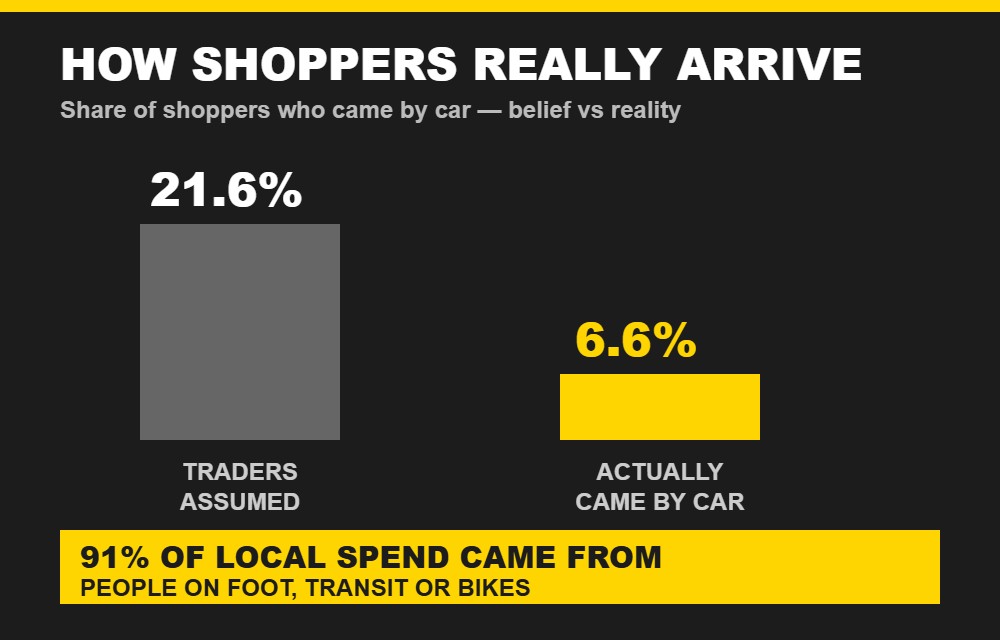
A study of two busy Berlin shopping streets — 145 traders and 2,000 shoppers surveyed, reported by Bicycle Network Australia — found that only 6.6% of shoppers arrived by car, even though traders estimated 21.6% (and car-commuting traders guessed closer to 29%). People who walked, rode or caught public transport made up 91% of all spending in the study zones. Traders also thought just 13% of their customers lived within a kilometre; the real figure was 51%. The pattern is consistent: traders who drive assume everyone else does too.
What does the Australian and global evidence say?
Local numbers tell the same story. A City of Melbourne analysis of Carlton (Lee & March) found that a square metre given to bike parking returned roughly five times the retail spend of the same space used for car parking — about $31 per hour per square metre versus $6. On that measure, one car space generating around $27 an hour was outperformed by six bike spaces worth about $97.
Zoom out and the direction is unchanged. A systematic review in the journal Transport Reviews (2021) concluded that active-travel infrastructure has positive or non-significant effects on nearby retail and food businesses — in other words, better at worst neutral. A Portland State University study of 14 street corridors across six US cities found sales and employment held steady or grew after upgrades, with one Minneapolis corridor recording a 52% jump in food sales. Toronto’s Bloor Street kept its retail indicators stable or improved after a bike lane went in. The takeaway from eight spending studies: people on bikes and on foot spend as much or more per month, because they come back more often.
Why do e-bikes make the case even stronger in Sydney?
Two objections usually follow: “cyclists can’t carry anything” and “the shops are too far to ride to.” E-bikes dismantle both. Pedal assist turns a sweaty 6–8 km trip into an easy one, widening the catchment of every local strip so more people can reach it without hunting for a park. And a cargo-ready e-bike carries a real shop. The Cyberbikes Centauro has a welded rear rack rated to 50kg plus an optional 15kg front basket, a 150kg total load rating, and a 48V 25Ah (1,200Wh) Samsung battery driving a 250W motor — legal in NSW at 25 km/h pedal-assist. That is a boot’s worth of groceries, minus the boot.
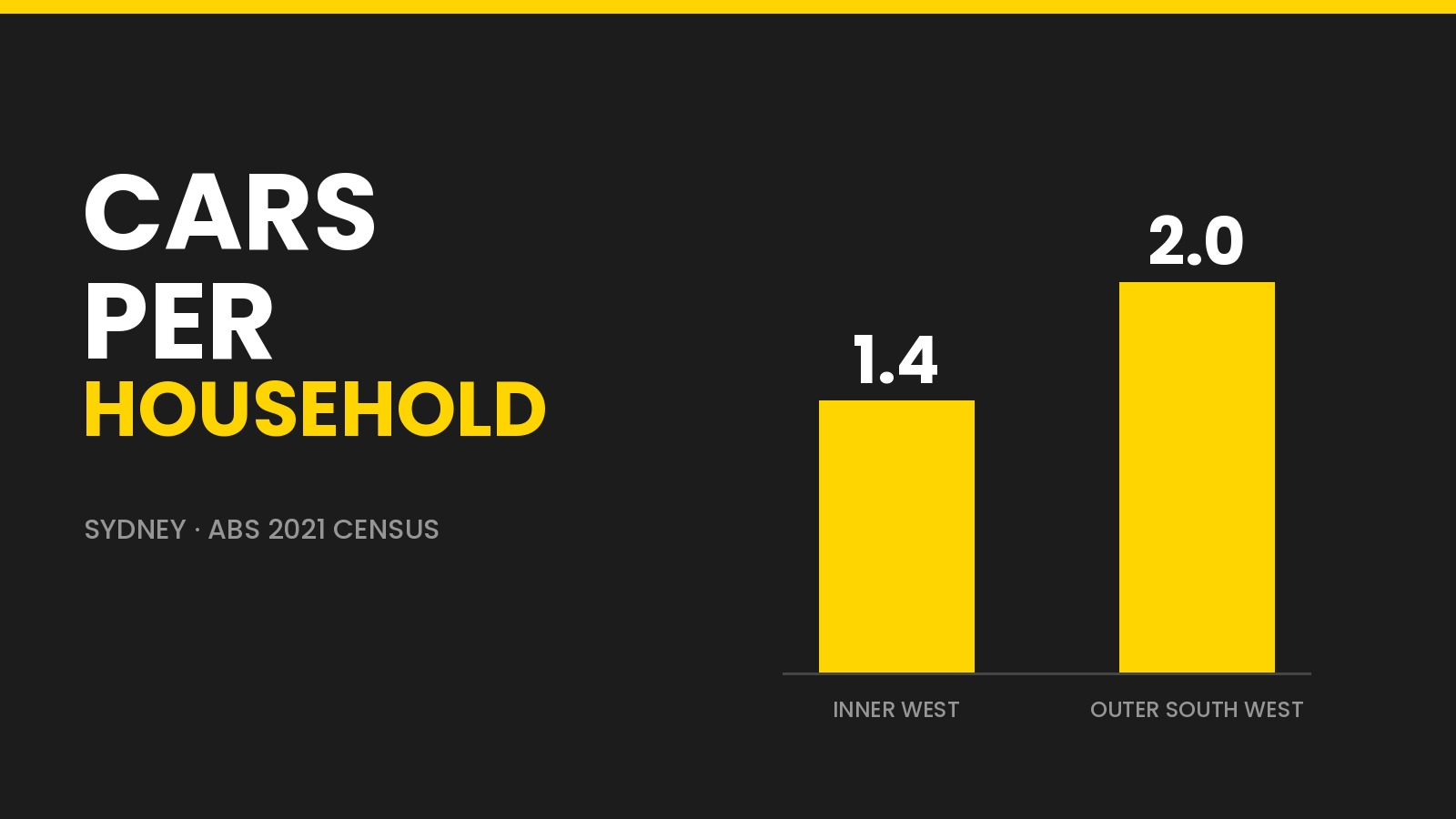
More riders making more frequent, smaller trips is exactly the shopping pattern the research says local retailers benefit from. It also explains why Sydney leans so heavily on cars in the first place — our streets were built to move and store vehicles, not people.
What could this mean for a street like Parramatta Road?
Parramatta Road is the textbook example of a car-dominated stroad: fast, wide and hostile to anyone not in a car, with shopfronts that traffic blows straight past. Reallocating even a slice of that road space to a protected lane would not empty the shops — the evidence says it would bring more people close enough, and slow enough, to actually stop and spend. That is good for Leichhardt traders, and good for the Inner West.
The car park was never the customer. Swap one car trip a week for an e-bike ride and you will feel how much of local Sydney is genuinely within reach. Curious what that looks like for you? Come and see us at Cyberbikes, 281 Parramatta Road, Leichhardt — we have been selling, renting and repairing e-bikes here for over a decade.
Frequently Asked Questions
Do bike lanes reduce local business revenue?
No. Reviews of studies across Australia, Europe and North America find that replacing kerbside parking with cycling infrastructure has a positive or neutral effect on local retail and food sales. At worst the impact is negligible, and in many corridors sales and employment rose after bike lanes went in.
How many shoppers actually arrive by car?
Far fewer than shopkeepers think. A study of two Berlin shopping streets found only 6.6% of shoppers drove, though traders estimated 21.6%. People arriving on foot, by public transport or by bike accounted for 91% of all spending, and 51% of customers lived within one kilometre.
Can you really do the shopping by e-bike?
Yes. A cargo-capable e-bike like the Cyberbikes Centauro has a welded rear rack rated to 50kg plus an optional 15kg front basket, so groceries, work gear and school bags are easy to carry without a car park.
#Cyberbikes #ebikeSydney #Leichhardt #InnerWest #BikeLanes #CarFreeSydney #Centauro #ParramattaRoad