A “250W” e-bike motor rating is a continuous power figure — the power the motor can keep producing indefinitely without cooking itself — not a cap on how much power it can ever make. The very same motor might briefly peak at 600, 800 or even 1,000 watts up a hill, then settle back to a level it can sustain. That’s why, as Grin Technologies (ebikes.ca) puts it plainly, “there is NO SUCH THING as a rated watt” in any standardised sense. Here’s what the number on your motor actually tells you — and what it doesn’t.
The short answer: 250W is a ceiling on heat, not on power
An electric motor doesn’t behave like a 60-watt lightbulb that always draws 60 watts. Spin a motor with the wheel off the ground and it makes almost zero power. Load it up a hill and it produces torque, drawing more current and making more power — until it either hits the controller’s current limit or starts to overheat. A wattage “rating” is really an attempt to describe the level a motor can hold continuously without the windings getting hot enough to fail. On a legal NSW pedal-assist e-bike like the ones we sell and service at Cyberbikes in Leichhardt, that continuous figure is 250W — but the motor can safely deliver much more for the few minutes it takes to crest a bridge.
Why the exact same motor is sold as 250W, 500W and 1,000W
This is the part that confuses everyone. According to ebikes.ca, “you can see the exact same motor listed as 250 watts, 500 watts, and 1000 watts by different vendors, and there is a valid justification for all those numbers.” There’s no legal or engineering standard forcing a single method, so vendors pick whichever number suits them. Three completely different things all get called “watts”:
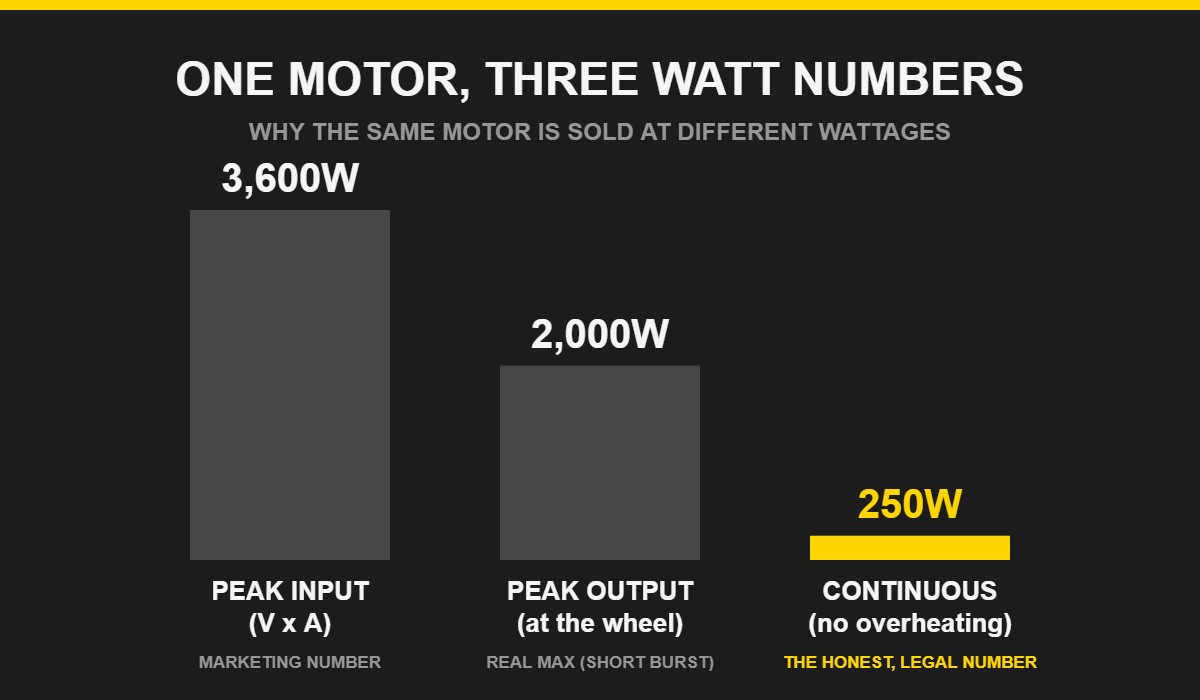
Peak input power (the marketing number)
Multiply battery volts by controller amps and you get the peak input power shown on a display like a Cycle Analyst. A 72V pack with a 50A controller reads “3,600W” — so that’s what gets printed on the box, even if the motor only turns maybe 2,000W of that into actual mechanical output, and could only sustain half of that again without overheating. ebikes.ca notes the advertised watts often exceed real peak output “by a factor of 2 or 3.” It’s the biggest, least honest number.
Peak output power (the real maximum)
This is the actual mechanical power at the wheel, and it’s well defined — but it’s mostly a property of your controller and battery, not the motor. Swap a 20A controller for a 40A one on the identical motor and peak output can jump ~80%. Raise the battery from 36V to 52V and the bike feels stronger still. So “peak output” tells you more about the electronics than the motor itself.
Continuous power (the honest number)
This is what the motor can put out forever without overheating — and it’s the fairest basis for a rating. It’s also the number NSW law cares about. The catch: it depends on wheel RPM, the temperature you’re willing to let the core reach, the ambient air temperature, and any cooling mods. That’s why a genuine continuous rating is always lower than the flashy peak figures.
Watts, torque and the I²R rule: what actually heats a motor
Here’s the engineering that makes “watts” so slippery. Power is simple: watts = volts × amps, and mechanically, power = torque × rotational speed. A motor making 20 Nm of torque at 100 rpm produces about 209W; the same 20 Nm at 300 rpm produces 628W. Identical torque, triple the power — just because it’s spinning faster. So do you call that a 200W motor or a 600W motor? Both are “correct,” which is exactly the problem.
Crucially, ebikes.ca stresses that it’s torque, not power, that overheats a motor. Torque comes from current flowing through the copper windings, and that current generates heat by the I²R relationship: double the current for double the torque, and you get four times the heat. That heat is what eventually burns the enamel off the windings, softens nylon planetary gears, or demagnetises the magnets — the failure riders call a “cooked” motor. A 250W continuous rating is really the manufacturer saying “at this load, the heat going in equals the heat we can shed, so the motor stays alive.” For a deeper look at that failure mode, see our guide on why e-bike motors overheat and how to prevent it.
Peak vs continuous: the number that matters on a Leichhardt hill
Why does this matter for your actual ride? Because a hub motor takes a long time to heat up. ebikes.ca’s testing shows a hub motor can need one to two hours to reach a steady-state temperature — but the longest steep climbs you meet on a real commute are over in five to ten minutes. So your motor happily uses its big peak numbers to haul you over the Anzac Bridge, then cools right back down on the flat. You rarely spend long enough at full load to reach the temperature the continuous rating protects against.
| Rating type | What it measures | Typical honesty |
|---|---|---|
| Peak input (V×A) | Electrical power into the controller | Inflated — often 2–3× real output |
| Peak output | Max mechanical power at the wheel | Real, but set by battery + controller |
| Continuous | Power sustainable without overheating | The honest, law-relevant number |
Ambient heat matters too. You can push a motor harder on a freezing morning than in 40°C summer heat, because the core starts closer to its limit when the air is hot. That 40°C swing between a Sydney winter dawn and a February heatwave genuinely changes how much continuous power your motor can safely hold — one reason cooling mods like Statorade can lift a motor’s continuous output by around 40% without changing its peak power at all.
What “250W” means under NSW e-bike law
In NSW, a legal power-assisted pedal cycle is capped at 250W of continuous rated power with assistance cutting off at 25 km/h (throttle-only power is limited to 200W). The law deliberately measures continuous, not peak — which is exactly why your compliant e-bike can still surge past 250W of instantaneous output to climb a hill and remain perfectly legal. As the Cyberbikes video below argues, watts alone are a poor proxy for danger; the legal number is a thermal rating, not a speed limit.
How the Centauro’s 250W hub motor handles real Sydney loads
Our Cyberbikes Centauro is rated to EN 15194 for exactly this: 250W continuous power and a 25 km/h pedal-assist cut-off. But look at what it’s asked to carry — a 150 kg maximum rider-plus-cargo load, fed by a 48V 25Ah (1,200Wh) UL 2271-certified Samsung battery. A fully loaded cargo run up a hill briefly demands far more than 250W, and the rear hub motor delivers it, then returns to its sustainable level once you’re rolling again. That gap between the honest 250W continuous number and the short-burst peak is precisely why the bike feels far stronger than “250 watts” sounds. If you’re comparing drive types for hilly, loaded riding, our explainer on what your e-bike controller actually does shows how the electronics set those peak numbers.
Frequently Asked Questions
Is a 250W e-bike motor powerful enough for Sydney hills?
Yes. A 250W continuous rating is a heat limit, not a power cap — the motor can briefly output 600W or more to climb, because short hills are over long before it overheats. The rider’s weight, gearing and battery voltage matter more than the headline wattage.
Why is my e-bike sold as 250W when it feels stronger than that?
Because 250W is the continuous (sustainable) rating, while the motor’s peak output — set mostly by the battery and controller — is much higher for short bursts. NSW law rates the continuous figure, so a compliant bike can still surge well past 250W momentarily.
Does a higher watt number mean a better e-bike motor?
Not reliably. There’s no standard for “rated watts,” so vendors quote peak input power (V×A), peak output, or continuous power interchangeably. Peak input figures are often inflated 2–3× over real sustainable output. Compare torque and continuous ratings, not marketing watts.
Want to feel the difference between a headline wattage and how a bike actually rides? Come in for a test ride at Cyberbikes, 281 Parramatta Road, Leichhardt, browse the Centauro e-bike at cyberbikes.com, or ask about our rent-to-own plans from $99.99/week. Call us on 0491 794 668 or visit Tuesday–Saturday.
#CyberbikesLeichhardt #ebikeSydney #electricbikeLeichhardt #CentauroEbike #ebikeMotor #250W #ebikeTech #Sydney