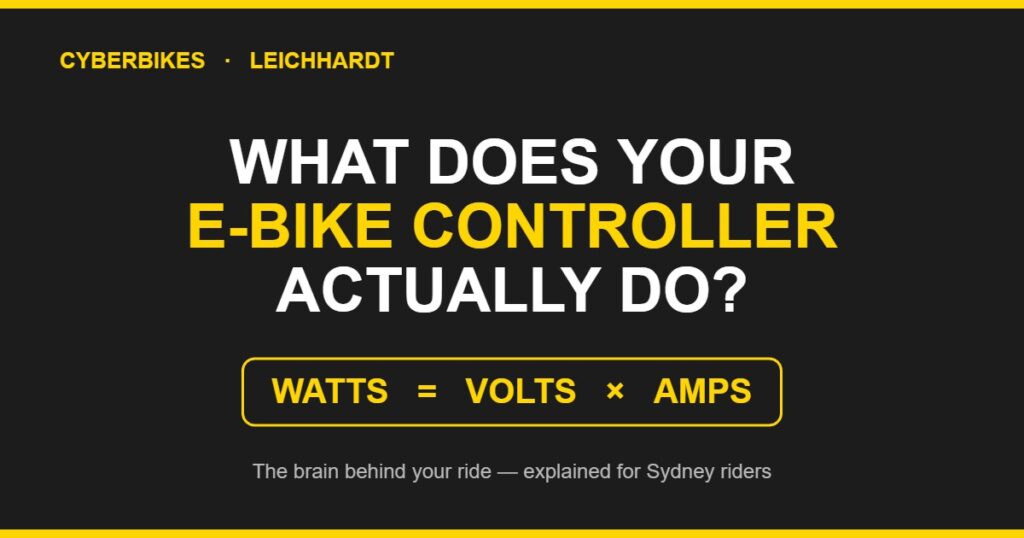
Your e-bike controller is the small electronic box that acts as the bike’s brain: it takes DC power from the battery and rapidly switches it into the precise pulses the motor needs, deciding exactly how many amps to send every millisecond based on your throttle or pedal input. In short, the battery is the fuel and the motor is the muscle, but the controller decides how hard, how smoothly and how legally that muscle pulls.
Most riders never see it — it is usually tucked inside the frame or bolted under the rack — yet it shapes almost everything about how your e-bike feels. Here is what it actually does, explained for everyday Sydney riders.
What is an e-bike controller, in plain English?
A battery stores energy as steady direct current (DC). A brushless e-bike motor, however, needs that current delivered as three carefully timed alternating pulses to spin. The controller is the translator in the middle. Thousands of times a second it switches the battery current on and off across the motor’s three phases, using tiny electronic switches (MOSFETs) to meter exactly how much current reaches the windings.
It also reads your inputs — throttle position or the pedal-assist sensor — and the motor’s own position sensors, then decides how much power to release. Push harder or select a higher assist level, and the controller simply lets more amps through.
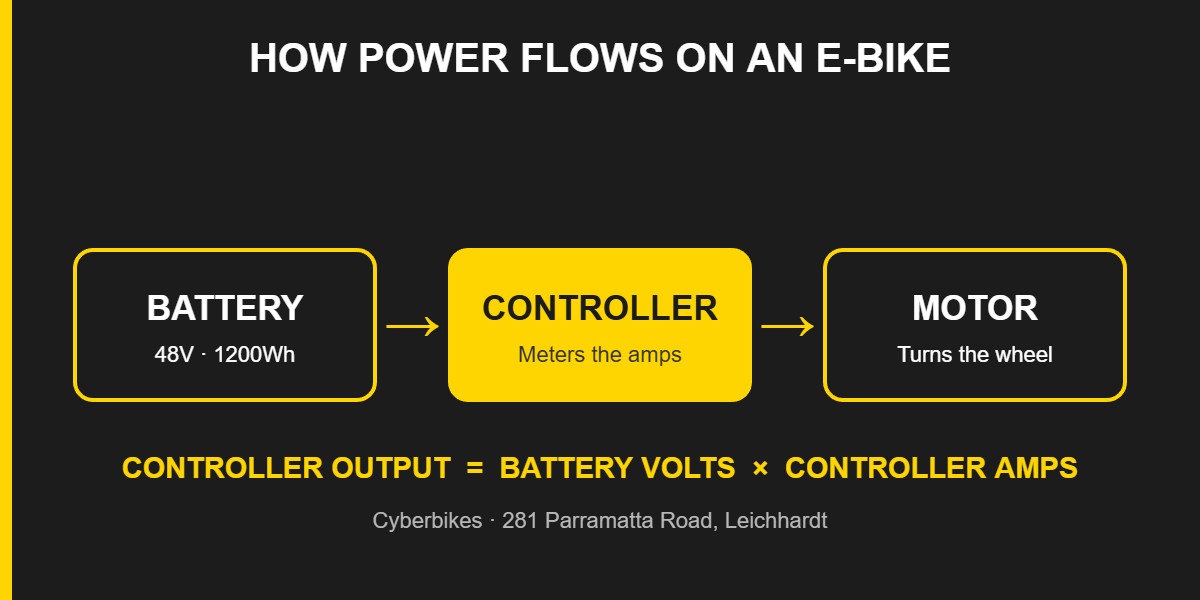
Watts, volts and amps: what the numbers actually mean
Here is the one equation worth remembering: watts = volts × amps. Power (watts) is simply the battery voltage multiplied by the current the controller allows through. So a 48V battery with a 20-amp controller can push a peak input power of about 48 × 20 = 960 watts.
This is why a motor’s advertised wattage on its own tells you very little. As Grin Technologies’ e-bike engineers explain on their motor power ratings page, the exact same motor gets sold as 250W, 500W or 1000W by different sellers, because the real output depends on the motor, the controller’s amp limit and the battery voltage working together. The controller’s current limit is the number that actually sets how much power you can draw. Their free motor simulator lets you model any motor, controller and battery combination across the whole speed range.
Battery amps vs phase amps
Many controllers quote two current figures. Battery amps is the current drawn from the battery and, multiplied by voltage, gives your power draw and range impact. Phase amps is the current sent to the motor windings, which can be higher than battery amps at low speed — this is what gives a strong e-bike its punchy standing-start torque. A well-tuned controller manages both so you get grunt off the line without cooking the battery.
Continuous vs peak: why “500W” tells you almost nothing
A controller can deliver a big burst of power for a few seconds — its peak — but only a lower figure indefinitely without overheating, its continuous rating. A cheap controller quoting a huge peak number may quietly throttle itself back on a long Sydney hill once it warms up. Our deeper explainer on continuous versus peak power and what e-bike watts really mean breaks this down, and if you are weighing up voltage, see whether a higher-voltage e-bike actually goes faster.
So what changes when you fit a bigger or smarter controller? Here is the honest version:
| Change | What the rider feels | The trade-off |
|---|---|---|
| More controller amps | Stronger acceleration and hill climbing | More heat and faster battery drain; can exceed legal limits |
| Higher battery voltage | Higher top speed and better efficiency at cruise | Needs a matched battery and controller |
| Smarter firmware and sensor tuning | Smoother, more natural, more predictable assist | No extra raw power — but usually the best real-world upgrade |
How your controller keeps you legal in NSW
In New South Wales two kinds of e-bike are road-legal. A pedelec must comply with the EN 15194 standard: up to 250 watts continuous rated power, with motor assistance cutting off once you reach 25 km/h. The older throttle-style category is limited to a 200-watt motor. In both cases it is the e-bike controller that enforces the rules — its firmware caps the current and switches the assistance off at the legal speed. That is exactly why unlocking or over-amping a controller can quietly make an otherwise legal bike non-compliant. Every e-bike Sydney riders buy from Cyberbikes ships tuned to these limits out of the box.
What the controller listens to
Good assist feel comes from the signals the controller reads. A torque sensor measures how hard you press the pedals and scales power to match, giving that natural “strong legs” feeling. A simpler cadence sensor just detects that the pedals are turning and applies a set level. The controller also reads the motor’s hall sensors to know rotor position, plus throttle and brake inputs — pull the brakes and it instantly cuts power. The smarter the controller’s handling of these inputs, the more your e-bike feels like an extension of your own legs.
How Cyberbikes tunes the Centauro
On our Centauro e-bike, the controller is matched to a 48V 25Ah (1200Wh) Samsung lithium-ion battery with UL 2271 certification, on an ISO 4210-compliant alloy frame, and tuned to the NSW 250W and 25 km/h rules. That pairing is why the Centauro feels punchy on Parramatta Road hills yet stays comfortably within the law — the big 1200Wh pack supplies the energy, and the controller meters it out smoothly. Priced at $3,999, it is built to replace car trips, not just add a bit of a push.
Frequently Asked Questions
What does an e-bike controller do?
The controller is the electronic brain of an e-bike. It converts DC power from the battery into precisely timed pulses that drive the motor, meters how many amps flow based on your throttle or pedal-assist input, and enforces the legal speed and power limits. Without it, the battery and motor could not talk to each other safely.
What do the amps on an e-bike controller mean?
Amps measure electrical current. Power in watts equals volts multiplied by amps, so you multiply the controller’s battery-amp rating by the battery voltage to estimate power. A 48V battery paired with a 20A controller peaks at roughly 960 watts of input power. More amps mostly help acceleration and hill climbing, not flat cruising speed.
Can upgrading the controller make my e-bike faster?
A higher-amp controller mainly improves hill-climbing and acceleration rather than top speed, while a higher battery voltage raises cruising speed. Both increase heat and battery drain and can push the bike outside the NSW limits of 250W continuous and 25 km/h assistance, so any tuning should be done by a professional like Cyberbikes in Leichhardt.
Come and feel the difference
The best way to understand what a well-tuned controller feels like is to ride one. Come in for a test ride at Cyberbikes, 281 Parramatta Road, Leichhardt, browse the range at cyberbikes.com, or ask about our rent-to-own plans from $99.99/week.
#Cyberbikes #eBikeSydney #electricbikeLeichhardt #CentauroEbike #eBikeTech #eBikeController