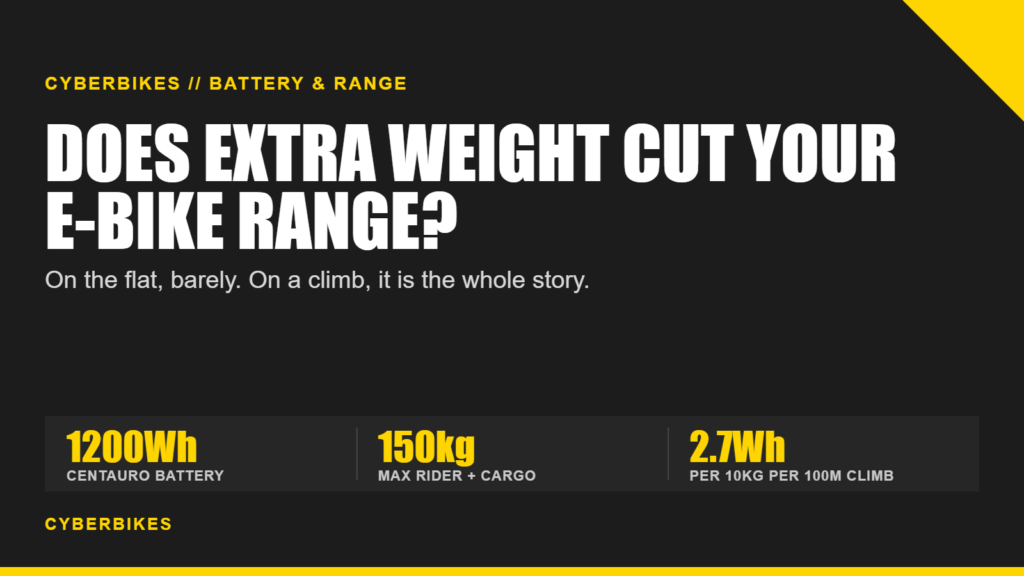
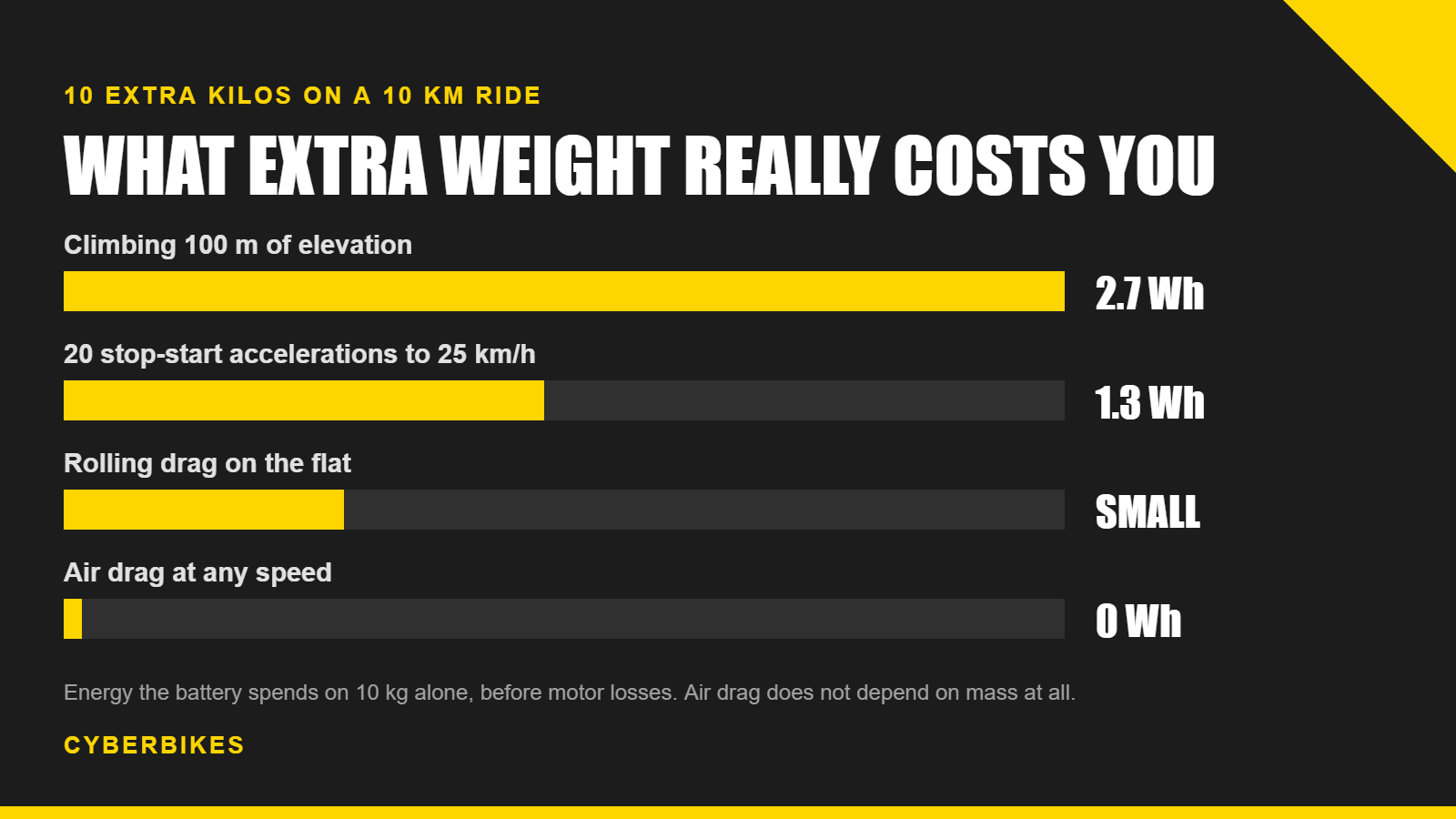
Extra weight cuts your e-bike range, but far less than most riders expect — and almost all of the cost lands in one place: climbing. Every extra 10 kg you carry costs roughly 2.7 watt-hours for every 100 metres of elevation you gain (that is straight physics: mass × gravity × height). On flat ground at a steady speed, the same 10 kg is close to invisible, because the dominant force at 25 km/h is air drag — and air drag does not care what you weigh.
That single fact explains why a loaded cargo run across flat Leichhardt barely dents the battery, while the same load up a Sydney ridge line will have you watching the bars drop. Here is where the energy actually goes, what it means for a real commute, and why heat — not watt-hours — is the thing that bites first.
How much e-bike range does extra weight actually cost?
Weight enters the energy budget in exactly three places, and it is worth separating them because they are wildly different in size.
Climbing: this is where weight really costs you
Lifting mass against gravity is unavoidable and exact. Ten kilograms raised 100 metres takes 9,810 joules, which is 2.7 Wh at the wheel. Add motor and drivetrain losses and you are paying somewhere near 3.4 Wh from the battery for that same 10 kg and that same 100 metres.
Put it another way: on a 5% grade at 20 km/h, each extra 10 kg demands about 27 watts of continuous extra power, purely to fight gravity. Load 30 kg of shopping and a child seat onto the bike and that becomes roughly 82 watts — a third of a 250 W motor’s nameplate, spent on lifting cargo alone.
Stop-start riding: smaller than it feels
Every time you accelerate mass up to speed you buy kinetic energy, and every time you brake without regeneration you throw it away as heat in the pads. Accelerating an extra 10 kg from a standstill to 25 km/h costs 241 joules — about 0.07 Wh. Twenty sets of lights between Leichhardt and the CBD and you have spent roughly 1.3 Wh on that extra 10 kg. Real, but small next to a decent climb.
Flat, steady riding: almost nothing
On the flat at constant speed you are fighting two things: rolling resistance and air. Rolling resistance rises in direct proportion to weight, but it is a modest force to begin with on properly inflated tyres. Aerodynamic drag — which becomes the dominant cost as speed climbs, and is why faster e-bikes drain the battery so much harder — depends on frontal area and the cube of speed, and not at all on mass. A 60 kg rider and a 100 kg rider punch a very similar hole in the air.
Why does a loaded e-bike feel slower than the numbers say?
Because the limit you hit first is usually thermal, not electrical. Motor torque is produced by current, and heat in the copper windings goes up with the square of that current. As Grin Technologies puts it on the ebikes.ca motor power ratings page, doubling the current doubles the torque but increases the copper heating “by a factor of FOUR” — the classic I²R relationship. A heavier bike on a hill asks for more torque, more torque means more amps, and more amps means disproportionately more heat.
The saving grace is time. ebikes.ca notes that a hub motor “takes a LOT longer than most people would realize” to reach a steady-state temperature — “upwards of 1-2 hours” — while a genuinely steep climb is usually over “in less than 5-10 minutes”. That thermal inertia is why a well-built hub motor can pull far above its continuous rating on a short Sydney pinch without ever getting near the roughly 100 °C core temperature ebikes.ca flags as the danger zone for sustained loads.
It also explains why motor wattage labels tell you so little. ebikes.ca points out that “you can see the exact same motor listed as 250 watts, 500 watts, and 1000 watts by different vendors” — the number is a marketing and regulatory choice, not a measurement of what the motor can do. The honest relationship is Power (W) = Torque (Nm) × RPM × 0.104, which is why a motor spinning slowly up a hill produces far less power than the same motor at speed, even while it is working its hardest.
Weight, speed or hills: which one costs the most range?
If you want to protect your range, it helps to know which lever is worth pulling. Ranked by how much energy each one moves on a typical urban ride:
| What changes | How the energy cost scales | Effect on range |
|---|---|---|
| Riding faster | Air drag rises with the cube of speed | Largest lever on flat ground |
| Climbing more | Directly proportional to mass and height gained | Largest lever on hilly routes |
| Carrying more weight | Proportional to mass, but only on climbs, acceleration and rolling drag | Modest on the flat, significant on hills |
| Under-inflated tyres | Raises rolling resistance at every speed | Small but constant, and free to fix |
The practical takeaway from the shop floor in Leichhardt: riders who complain about range almost never have a weight problem. They have a speed problem, a tyre-pressure problem, or a hills-they-forgot-about problem. If you want the full picture of what sets the ceiling in the first place, our definitive guide to e-bike batteries covers capacity, chemistry and degradation in depth.
How much can you load onto a Cyberbikes Centauro?
Numbers read live from the product page as we write this. The 2026 Cyberbikes Centauro is rated to a 150 kg maximum rider and cargo load, with a rear rack welded to the frame rated to 50 kg and an optional front basket rated to 15 kg. The frame is ISO 4210 MTB-compliant 6061 aluminium, and stopping the loaded bike is handled by 4-piston hydraulic brakes on 180 mm × 2.3 mm rotors.
The battery is a 48V 25Ah Samsung lithium-ion pack. Multiply volts by amp-hours and you get the number that actually matters for range: 48 × 25 = 1,200 Wh. Against that budget, the 2.7 Wh per 10 kg per 100 m climbing figure stops looking frightening — you could haul a 50 kg rack load up 100 metres of Sydney hill roughly ninety times over before a full pack ran dry on that task alone. Weight is not what ends your ride. Speed, wind and a cold pack are.
The Centauro pairs that pack with a Super 250W rear hub motor, 100 mm of front and 120 mm of rear suspension travel and 26 × 2.4 e-bike-rated tyres — the suspension and the tyre casing matter more than people think once you are running near the load limit, because an overloaded, under-sprung wheel is what turns a pothole into a broken spoke. It carries UL 2849, UL 2271, ISO 4210 and EN 15194 certifications, and sells for $3,999.
Does carrying more weight affect NSW e-bike law?
No. NSW regulates the motor, not the load. As Transport for NSW sets out on its e-bikes page, a legal electrically power-assisted cycle has a maximum continuous rated power of 500 watts, assistance while pedalling that cuts out at 25 km/h, and any throttle-only function that cuts out at 6 km/h. Nothing in that changes when you strap on a crate of groceries.
What is changing is the standard. Transport for NSW has confirmed that from 1 March 2029 the limit drops to 250 W maximum continuous power and only EN 15194 certified e-bikes will be allowed on NSW roads. Its own advice is blunt: choose a bike that complies with EN 15194, because it is “legal now and in the future”. That is worth weighing if you are buying a bike you intend to load up and keep for a decade.
Two safety points that are load-dependent, and that we check on every service at Cyberbikes Leichhardt: tyre pressure rises in importance with weight, and so does brake condition. A bike at 150 kg all-up carries far more kinetic energy into a stop than the same bike at 90 kg — that is the ½mv² term again, and it lands entirely on your pads.
Frequently Asked Questions
How much e-bike range do you lose per 10 kg?
On flat ground at a steady speed, very little — often a couple of percent, because air drag dominates and does not depend on mass. On hills the cost is exact and unavoidable: about 2.7 watt-hours at the wheel for every 10 kg you carry per 100 metres of elevation gained, or roughly 3.4 watt-hours drawn from the battery once motor losses are counted.
Does a heavier rider need a bigger e-bike battery?
Usually not for range alone. A heavier rider on a flat commute uses only slightly more energy per kilometre than a lighter one. A bigger battery is worth it if your route is hilly, if you carry cargo regularly, or if you want a margin against cold weather — a 48V 25Ah pack holds 1,200 Wh, which is a large buffer for any of those.
Can extra weight damage an e-bike motor?
Weight itself does not damage a motor, but the sustained high current it demands on a long climb produces heat, and heat is what kills windings. ebikes.ca notes copper heating rises with the square of current, and that a hub motor needs one to two hours to reach steady-state temperature — far longer than most climbs last. Riding within the bike’s rated load, keeping a gear that lets the motor spin rather than lug, and staying under the rated maximum rider and cargo load are the practical protections.
Load it up and see for yourself
The fastest way to settle a range question is to ride the bike with your actual load on it. Come and test ride a Centauro at Cyberbikes Leichhardt, 281 Parramatta Road — bring the panniers, the child seat, the crate of whatever you actually carry, and we will point you at a hill. Call 0491 794 668, Tuesday to Saturday, or browse the range at cyberbikes.com. If you would rather not pay for it all at once, our rent-to-own plan starts from $99.99 per week.
#Cyberbikes #EbikeSydney #EbikeRange #CargoEbike #Leichhardt #EbikeBattery #SydneyCommute #ElectricBike #Centauro #RentToOwn